

On this page
Determiners are short words, but they turn up in almost every grammar line you will edit. In CBSE's English Language and Literature curriculum for Class 10 (2026-27), the grammar section carries 10 marks and determiners are the first of five listed grammar areas. The same document says grammar is tested through gap filling, editing and transformation exercises, with ten out of 12 questions to be attempted. If you are in Class 9, settle these rules now so that Class 10 is revision, not first contact.
What is a determiner?
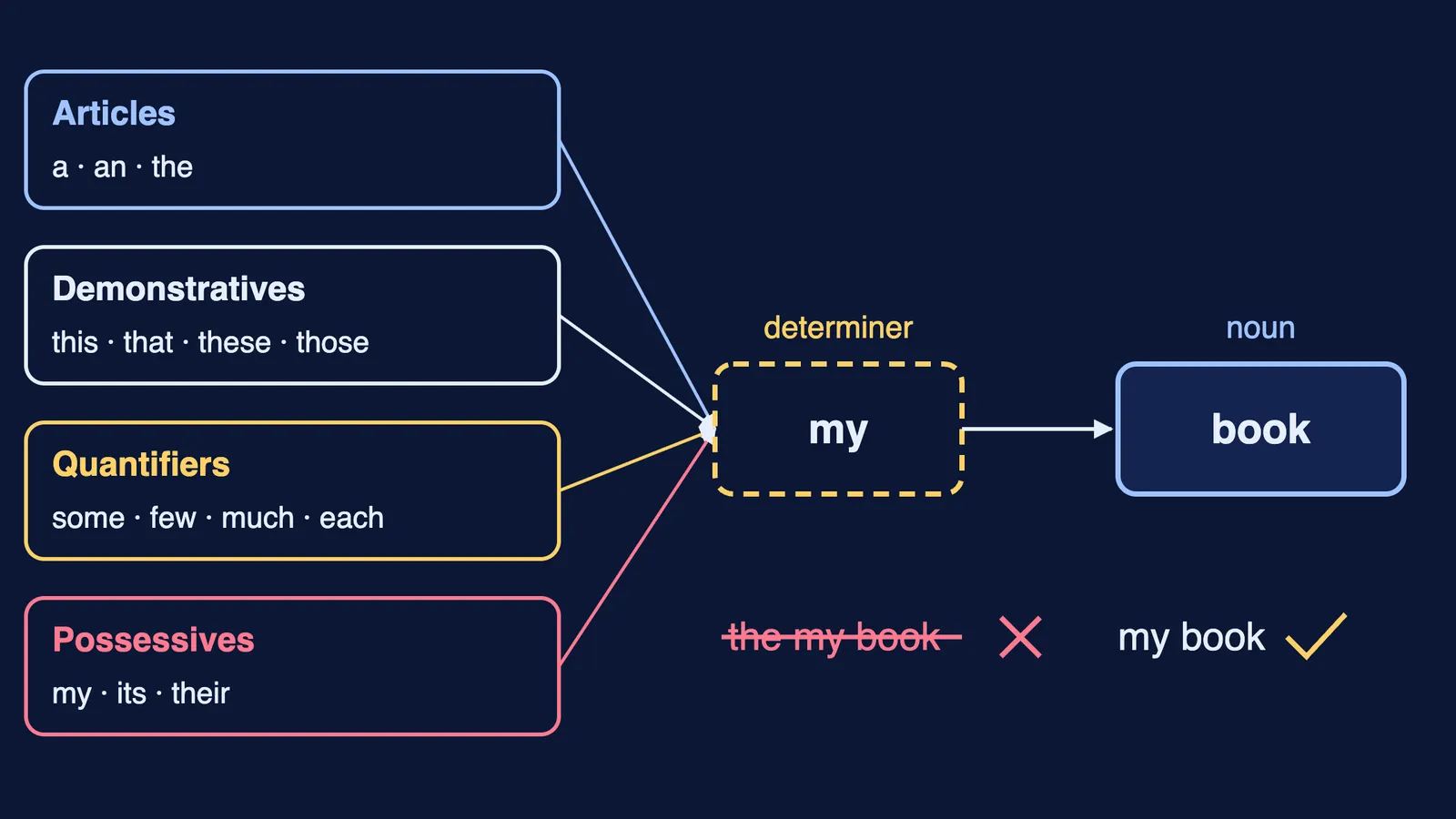
A determiner is a word that comes before a noun and tells you which one or how much. The British Council's LearnEnglish grammar reference puts it this way: determiners identify things (this book, my sister), and quantifiers say how much or how many. In “my book”, “this book” and “some books”, the words my, this and some all sit in that position before the noun.
The rule that catches most students: a noun takes only one of the main determiners (an article, a demonstrative or a possessive). You can write “my book” or “the book”, never “the my book”. A few words, such as all and both, can sit in front of them: “all the books”.
What are the main types of determiners?
Articles (a, an, the). Use a or an when the reader does not know which one you mean, and only with singular countable nouns. The choice depends on sound, not spelling: “a university” and “an hour”, as the British Council's page on a and an explains. A plural or uncountable noun never takes a or an.
Use the when the reader knows which one: there is only one (the moon), you have already mentioned it, or there is only one in that context, as set out on the definite article page.
Demonstratives (this, that, these, those). This and these point to things near you; that and those point to things farther away. This and that go with singular or uncountable nouns; these and those go with plurals. “These book” is always wrong.
Quantifiers (some, any, much, many, few, little, each, every). First ask whether the noun is countable. The British Council's quantifiers page groups them like this:
Countable only: many, few, a few, several, each, either, neither, both
Uncountable only: much, a little, a bit of
Both: some, any, a lot of, enough, more, most, all, no
The same page says each and every go with singular nouns and take no other determiner: “Each child was given a prize”, not “The each child”. One more pair to know: few and little are negative (almost none), while a few and a little are positive (some, enough).
Possessives (my, your, his, her, its, our, their). Its, the possessive, has no apostrophe; it's always means “it is” or “it has”, according to the British Council's possessives page.
How do you find the right determiner in an editing question?
Run this four-step check on every blank or line:
Find the noun the gap belongs to.
Decide: countable or uncountable, singular or plural.
Ask whether the reader already knows which one (the) or not (a, an, some).
Check the one-slot rule and the sound of the next word.
Determiners and subject-verb agreement often meet in one line (“each student was”, not “each students were”), so a quick refresher of subject-verb agreement rules with examples pays off even in Class 10.
Can you spot the determiner errors?
Find the error in each sentence, or write “correct”. Answers follow.
She waited for an hour at a university gate.
Each students were given a form.
There is not many milk left.
The dog wagged it's tail.
These book belongs to my sister.
He is an European writer.
Sun rises in the east.
I have few money for the trip.
Can you lend me the your pen?
We have a little time, so let us revise one more chapter.
Answers:
Correct: an before the vowel sound of hour, a before the “yoo” sound of university.
Each student was given a form.
There is not much milk left (milk is uncountable).
The dog wagged its tail.
This book belongs to my sister.
He is a European writer (a “yoo” sound again).
The sun rises in the east (there is only one).
I have little money for the trip.
Can you lend me your pen?
Correct: a little means some, which fits “so let us revise”.
Got two or more wrong? Redo the four-step check on those lines tomorrow before moving to timed papers. To fit grammar into the final weeks, see our week-by-week plan for Class 10 boards, and use the minute-per-mark plan so grammar does not eat into your writing time.
When your board plan turns to science and maths, Fermi's AI tutor can work out what you already know and build a plan for the session, so you sit down to a clear next step.


