On this page
What happens in Deep Water?
NCERT's Flamingo chapter presents Deep Water as an excerpt from Of Men and Mountains by William O. Douglas (1898-1980). The textbook notes that he retired in 1975 after a term of thirty-six years and remains the longest-serving Justice in the court's history.
At ten or eleven, Douglas decides to learn to swim at the Y.M.C.A. pool in Yakima. The Yakima River is treacherous and his mother keeps warning him about it, but the pool is safe. He already dislikes being in water: at three or four, waves on a California beach knocked him down.
One day, as he sits alone at the pool's edge, a big boy of about eighteen shouts, asking how he would like to be ducked, and throws him into the deep end, which is nine feet deep. Douglas plans to spring off the bottom, but he rises too slowly and goes down a third time before he blacks out. He wakes beside the pool, vomiting.
For years the fear spoils his fishing and canoeing trips. One October he hires an instructor, and slowly wins. He has conquered his fear of water.
What are the main themes of Deep Water?
NCERT's own note on the unit names the theme as a real personal story of fear and of how it was overcome, with a sub-theme of "psychological analysis of fear" (NCERT). Every quotation below is from that chapter.
Fear grows when you avoid it. He never returned to the pool and stayed afraid of water.
Will and patience beat fear. "Piece by piece", the instructor "built a swimmer".
Facing fear directly. In mid-lake Douglas laughs, and dares his terror to do its worst.
Fear of death is worse than death. Douglas writes, that death itself is peaceful and the terror lies only in fearing it, and quotes Roosevelt: "All we have to fear is fear itself."
Character sketches: who are the people in Deep Water?
Douglas is shy and self-conscious (he hates showing his "skinny legs"), but determined and methodical: even while sinking he makes a plan. He refuses to stop when the instructor is satisfied: the instructor's work was done, but his own was not.
The instructor is patient and systematic, perfecting each skill before joining them into "an integrated whole".
The big boy is thoughtless rather than evil ("But I was only fooling"); his prank shows how a joke can do lasting harm.
How did Douglas overcome his fear of water, step by step?
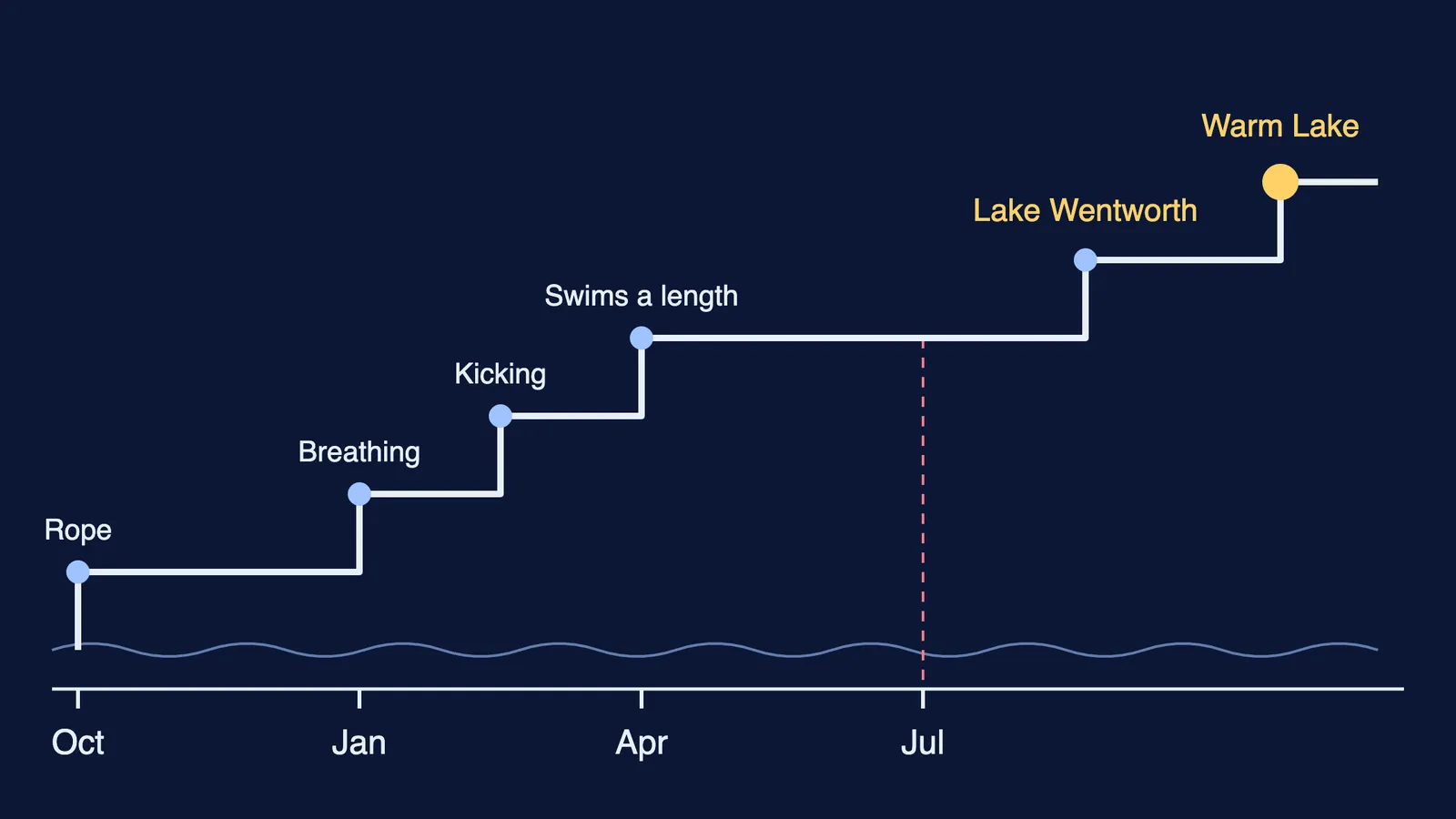
Learn it as a ladder. Each step below is from the NCERT text.
October: an hour a day, five days a week, in a belt tied to a rope that runs through a pulley on an overhead cable, held by the instructor.
After three months the tension begins to ease. He puts his face under water to exhale and raises his nose to inhale, hundreds of times.
For weeks the instructor holds him at the side of the pool while he kicks, until he can command his legs.
April: he dives in and swims a length, crawl stroke.
Until July: he swims alone, talking back to the leftover terror.
He swims two miles across Lake Wentworth; the fear returns once, "in miniature", and flees.
Finally he swims across Warm Lake and back, one of the places where the old terror had gripped him.
The pattern is small steps, repeated, each a little harder than the last. If a fear is stopping you from everyday life, talk to a parent, school counsellor or doctor.
Which Deep Water questions are likely in the board exam?
In CBSE's English Core syllabus for 2026-27, Deep Water is a prescribed Flamingo prose chapter. Flamingo short answers are 40-50 words each, five out of six for 2 marks each, and one Flamingo long answer of 120-150 words (one of two choices) carries 5 marks.
Practise these, based on the NCERT exercises:
What is the "misadventure" that William Douglas speaks about?
How did the instructor "build a swimmer" out of Douglas?
How did Douglas make sure that he conquered the old terror?
How does Douglas make the panic of nearly drowning vivid?
Why does Douglas as an adult recount a childhood experience of terror? (long answer)
Worked example, question 2 (about 45 words): The instructor put a belt and rope on Douglas and pulled him back and forth across the pool for three months. Then he taught him to breathe with his face under water, and later to kick at the side. Finally he joined each skill into one stroke.
For the long answer, use four moves: say what happened in one line; name the larger meaning (fear of death is worse than death); quote Roosevelt's line; end with what he gained, the freedom "to brush aside fear".
If physics or chemistry revision is competing for the same evening, Fermi's AI tutor can work out what you already know and build a plan for the session.