On this page
If you have just learned Hückel's rule, cyclooctatetraene (COT) looks like a trap. It is a ring of eight carbons with four alternating double bonds, so it has 8 π electrons: a 4n number, with n = 2. By the rule it should be antiaromatic and unstable. Yet COT is a colourless liquid at room temperature that is sold commercially (Wikipedia: Cyclooctatetraene). The reason is its shape.
Why is cyclooctatetraene not antiaromatic?
Antiaromaticity needs the same set-up as aromaticity: a cyclic, planar ring of p orbitals that overlap all the way round. Take away planarity and the 4n count stops mattering.
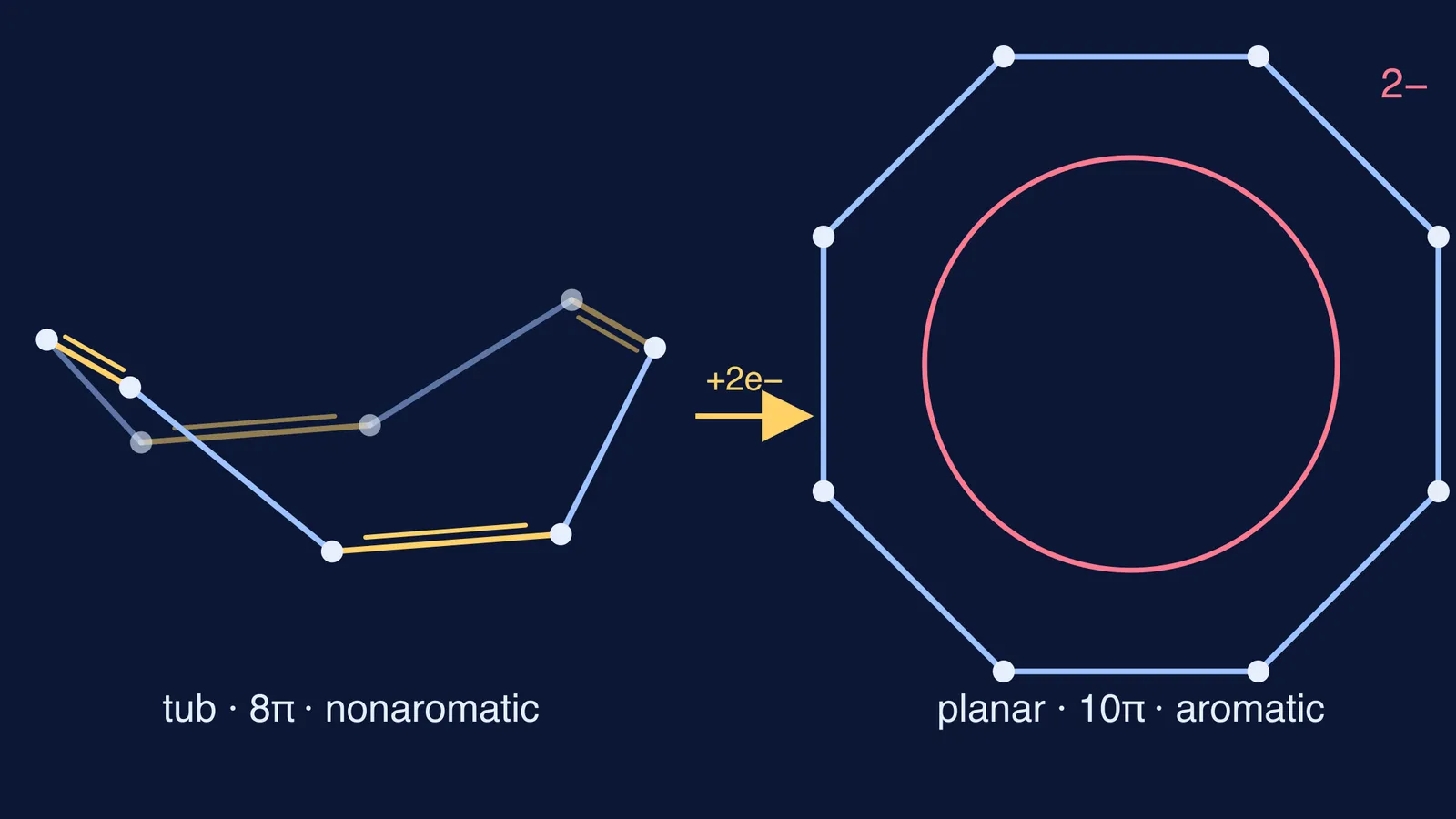
COT has a non-planar tub conformation, which prevents all of its π orbitals from forming a single conjugated system, so it is nonaromatic (Wikipedia: Cyclooctatetraene). A 2010 review in the journal Symmetry says tub-shaped COT "behaves as a nonaromatic polyene rather than an antiaromatic compound" (Nishinaga, Ohmae and Iyoda, 2010). The same review notes that COT rings held planar do show considerable antiaromatic character. So COT is not breaking Hückel's rule. It is avoiding the situation the rule describes.
The bond lengths show it. In tub-shaped COT the C–C single bonds are 1.470 Å and the C=C double bonds 1.337 Å, gas-phase values from spectroscopy combined with theory, quoted in a 2017 PNAS paper by Li, Hoffmann and colleagues that also describes the molecule's nonplanar D2d tub shape (Li et al., PNAS 2017). Two clearly different lengths mean four separate double bonds, not electrons spread evenly round a ring.
Why doesn't cyclooctatetraene stay flat?
Geometry helps. A flat regular octagon has interior angles of 135°, because (8 − 2) × 180° ÷ 8 = 135°. An sp2 carbon prefers about 120°, so a flat COT would strain every ring angle. In the tub, the C=C–C angle relaxes to 126.1° (Wikipedia: Cyclooctatetraene).
The tub wins twice: less angle strain, and no flat ring of 8 π electrons.
Does cyclooctatetraene react like benzene or like an alkene?
Like an alkene. The π bonds in COT react as usual for olefins rather than as an aromatic ring system, for example forming epoxides with peroxy acids (Wikipedia: Cyclooctatetraene). That is the opposite of benzene, which prefers substitution and keeps its ring intact.
How does the COT dianion become aromatic?
COT reacts readily with potassium metal to form the salt K2COT, which contains the dianion C8H8 2− (Wikipedia: Cyclooctatetraene). Thomas J. Katz described this dianion in the Journal of the American Chemical Society in 1960 (Katz, 1960).
The two extra electrons change the count from 8 to 10 π electrons, which is 4n + 2 with n = 2. The dianion is planar, octagonal and aromatic (Wikipedia: Cyclooctatetraene). It stays planar even though that forces its C–C–C angles to 135° (University of Missouri, Glaser group notes). Aromatic stabilisation pays for the angle strain the neutral molecule avoids. The dication C8H8 2+, with 6 π electrons, also appears to be planar (LibreTexts: Some conjugated cyclic polyenes).
The same charge logic explains other ions, as in our post on why the cyclopentadienyl anion and tropylium ion are aromatic.
A checklist for planarity traps
Run these checks, in order, before you write "antiaromatic" in an exam.
Does every ring atom carry a p orbital? One sp3 carbon (a CH2) breaks the loop, and the ring is nonaromatic.
Could the ring really be flat? Work out the flat interior angle, (n − 2) × 180° ÷ n. The further it is from 120°, the more strain a flat ring carries.
Would flat mean antiaromatic? If the count is 4n and the ring is flexible, as in COT, expect it to pucker and call it nonaromatic.
Do the bond lengths alternate? Distinct single and double bonds (1.470 Å and 1.337 Å in COT, per Li et al.) mean the π electrons are localised.
How does it react? Addition across C=C, like an alkene, points away from aromatic.
Is there a charge? Recount π electrons for the ion, then re-check the shape: COT 2− has 10, COT 2+ has 6.
Worked example: classify C8H8, C8H8 2− and C8H8 2+. Step 1 passes for all three (every carbon is sp2). Neutral COT has 8 π electrons and fails step 3, so it puckers: nonaromatic. The dianion has 10 π electrons, a 4n + 2 count, and is planar and aromatic. The dication has 6, also 4n + 2, and is reported to appear planar, as that count predicts. For a longer version of this method, see aromatic, antiaromatic or neither: a four-check method.
If the difference between antiaromatic and nonaromatic still feels slippery, the Fermi Concept Library gives every chemistry concept its own lesson and its place in the map, so you can see how aromaticity links to hybridisation and resonance. To practise, the Fermi Problem Library has worked problems with a step-by-step solver that explains the reasoning rather than printing an answer.
Next time a ring has 4n π electrons, ask first whether it can bend before you call it antiaromatic.