

On this page
"How many sigma and pi bonds are in this molecule?" looks like an easy question. Two common slips trip students up: forgetting the C–H bonds hidden inside a condensed formula, and counting a triple bond as three pi bonds. A fixed routine and a built-in check stop both.
What are sigma and pi bonds?
The definitions below come from Chapter 4, Chemical Bonding and Molecular Structure, of the NCERT Class 11 Chemistry textbook.
A sigma (σ) bond forms by head-on overlap of orbitals along the internuclear axis, the line joining the two nuclei.
A pi (π) bond forms by sidewise overlap of orbitals whose axes stay parallel to each other and perpendicular to the internuclear axis, giving electron clouds above and below the plane of the atoms.
The same chapter explains that a sigma bond is stronger because its orbitals overlap to a larger extent, and that when two atoms form a multiple bond, the pi bonds form in addition to a sigma bond. In ethene, NCERT describes the carbon–carbon double bond as one sigma and one pi bond. In ethyne, it describes the triple bond as one sigma and two pi bonds.
How do you count sigma and pi bonds in a molecule?
Draw the full structure with every hydrogen shown. If you only have a formula, find the structure first.
Count every pair of bonded atoms once. That number is the sigma count.
Add one pi bond for each double bond and two for each triple bond.
Check the sigma count. In any single connected molecule, sigma bonds = number of atoms − 1 + number of rings, because a chain of n atoms needs n − 1 links and each ring adds one more.
Check the pi count. The degree of unsaturation, (2C + 2 + N − H − X) ÷ 2, equals rings plus pi bonds, as set out in this LibreTexts guide to degree of unsaturation/Alkenes/Properties_of_Alkenes/Degree_of_Unsaturation). Subtract the rings and you have the pi bonds.
Worked example 1: benzene
PubChem lists benzene as C6H6, drawn as a six-carbon ring with alternating double bonds.
Sigma: 6 C–C bonds in the ring + 6 C–H bonds = 12.
Pi: 3 double bonds × 1 = 3.
Atom check: 12 atoms − 1 + 1 ring = 12 sigma.
Unsaturation check: (12 + 2 − 6) ÷ 2 = 4, which is 1 ring + 3 pi.
In real benzene, those 6 pi electrons are spread evenly around the ring, which is why all six C–C bonds are the same length. Our post on the structure of benzene and how it differs from cyclohexane covers that picture. For counting, the answer is still 12 sigma and 3 pi.
Worked example 2: acrylonitrile
PubChem gives acrylonitrile (IUPAC name prop-2-enenitrile) as C3H3N, with the structure CH2=CH–C≡N.
Sigma: 3 C–H + 1 (C=C) + 1 (C–C) + 1 (C≡N) = 6.
Pi: 1 from C=C + 2 from C≡N = 3.
Atom check: 7 atoms − 1 = 6 sigma, no rings.
Unsaturation check: (6 + 2 + 1 − 3) ÷ 2 = 3, all of them pi.
The nitrile nitrogen is sp hybridised, which also helps explain why nitriles are weak bases; see why sp³ amines are more basic than imines and nitriles.
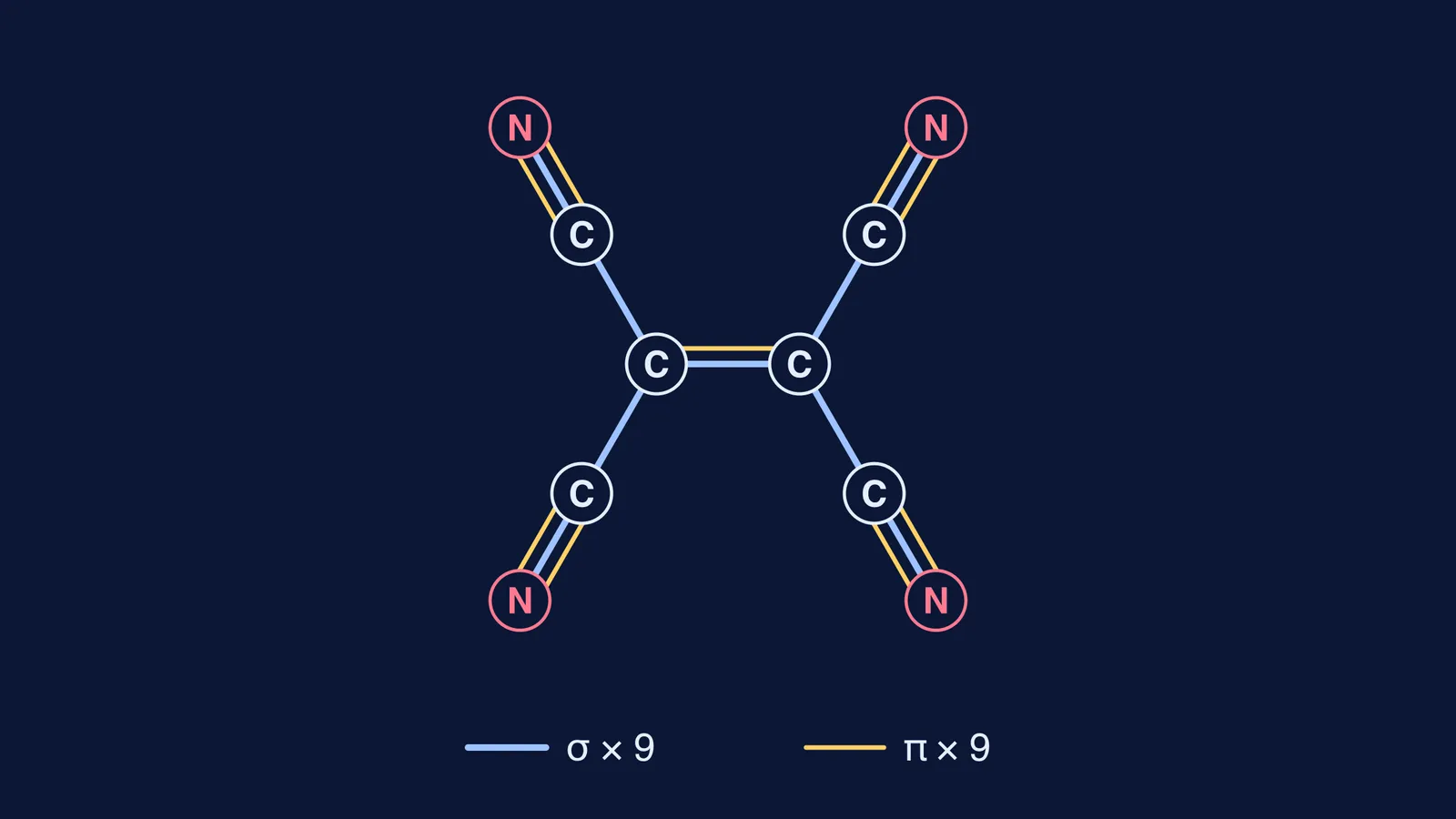
Worked example 3: tetracyanoethylene
Tetracyanoethylene, or TCNE, is C6N4 in PubChem: a central C=C with two C≡N groups on each carbon, and no hydrogen at all.
Sigma: 1 (C=C) + 4 (C–CN) + 4 (C≡N) = 9.
Pi: 1 from C=C + 4 × 2 from the C≡N groups = 9.
Atom check: 10 atoms − 1 = 9 sigma.
Unsaturation check: (12 + 2 + 4 − 0) ÷ 2 = 9, all of them pi.
The tempting wrong answer is 13 pi bonds, which comes from counting each triple bond as three pi.
Which mistakes cost marks when counting sigma and pi bonds?
Counting from a condensed formula like CH2=CHCN without drawing the hydrogens.
Calling a double bond "two sigma" or a triple bond "three pi".
Forgetting the bond that closes a ring.
Mixing up resonance and counting: benzene still has 3 pi bonds in any single Kekulé structure.
Missing a triple bond in a long name. Our guide to IUPAC numbering for enynes helps you read the structure correctly first.
If your count keeps disagreeing with the answer key, the Fermi Problem Library has worked problems with a step-by-step solver that explains the reasoning rather than printing an answer, so you can see which bond you missed. If the idea of sideways overlap is still hazy, the Fermi Concept Library covers every concept in chemistry, each with its own lesson.
Try the routine on ethyne next: you should get 3 sigma and 2 pi bonds.


