

On this page
This is a classic Class 11 trigonometry proof. It looks like it needs a lot of expanding. It doesn't. Two identities from your textbook do all the work, and once you see why, you can handle the whole family of "shifted angle" sums.
What is cos²x + cos²(x + π/3) + cos²(x − π/3)?
It is the sum of three cos² terms whose angles sit π/3 (60°) apart. The surprise is that the sum is a constant: it equals 3/2 whatever x is. Plug in x = 0 and you get 1 + 1/4 + 1/4 = 3/2, because cos(π/3) = 1/2. Plug in x = π/4 and you get roughly 0.5 + 0.067 + 0.933, which is 1.5 again.
A few numbers don't make a proof, though. To prove it you need two identities, both in the NCERT Class 11 Mathematics chapter on trigonometric functions:
Identity 14: cos 2x = 2cos²x − 1, which rearranges to cos²x = (1 + cos 2x)/2.
Identity 20(i): cos x + cos y = 2cos((x + y)/2)cos((x − y)/2).
How do you prove the sum is 3/2 step by step?
Here is the full working, laid out the way you would write it in an exam.
Convert every square. Using cos²θ = (1 + cos 2θ)/2, the left side becomes (1 + cos 2x)/2 + (1 + cos(2x + 2π/3))/2 + (1 + cos(2x − 2π/3))/2.
Collect the constants. The three halves add up to 3/2, so the left side is 3/2 + ½[cos 2x + cos(2x + 2π/3) + cos(2x − 2π/3)].
Pair the two shifted cosines. Put A = 2x + 2π/3 and B = 2x − 2π/3. Then (A + B)/2 = 2x and (A − B)/2 = 2π/3, so cos A + cos B = 2cos 2x · cos(2π/3).
Evaluate cos(2π/3). Since cos(π − x) = −cos x, cos(2π/3) = −cos(π/3) = −1/2. So cos A + cos B = −cos 2x.
Finish. The bracket is cos 2x − cos 2x = 0, so the left side is 3/2. Proved.
The identity cos(π − x) = −cos x in step 4 is listed in the same NCERT chapter, alongside the sum and difference formulas.
Is there a second way to check the answer?
Yes. Expanding takes longer, but it is a good way to check your work. Using cos(x ± y) = cos x cos y ∓ sin x sin y with y = π/3:
cos(x + π/3) = ½cos x − (√3/2)sin x
cos(x − π/3) = ½cos x + (√3/2)sin x
Square both and add. The cross terms, ±(√3/2)sin x cos x, cancel, which leaves ½cos²x + (3/2)sin²x. Add the first term, cos²x, and you get (3/2)cos²x + (3/2)sin²x = 3/2, since sin²x + cos²x = 1.
If both routes give 3/2, you can trust the result. In an exam, use the cos 2x route because it is shorter. Keep the expansion in mind as a check when you have a minute left.
Why does the answer not depend on x?
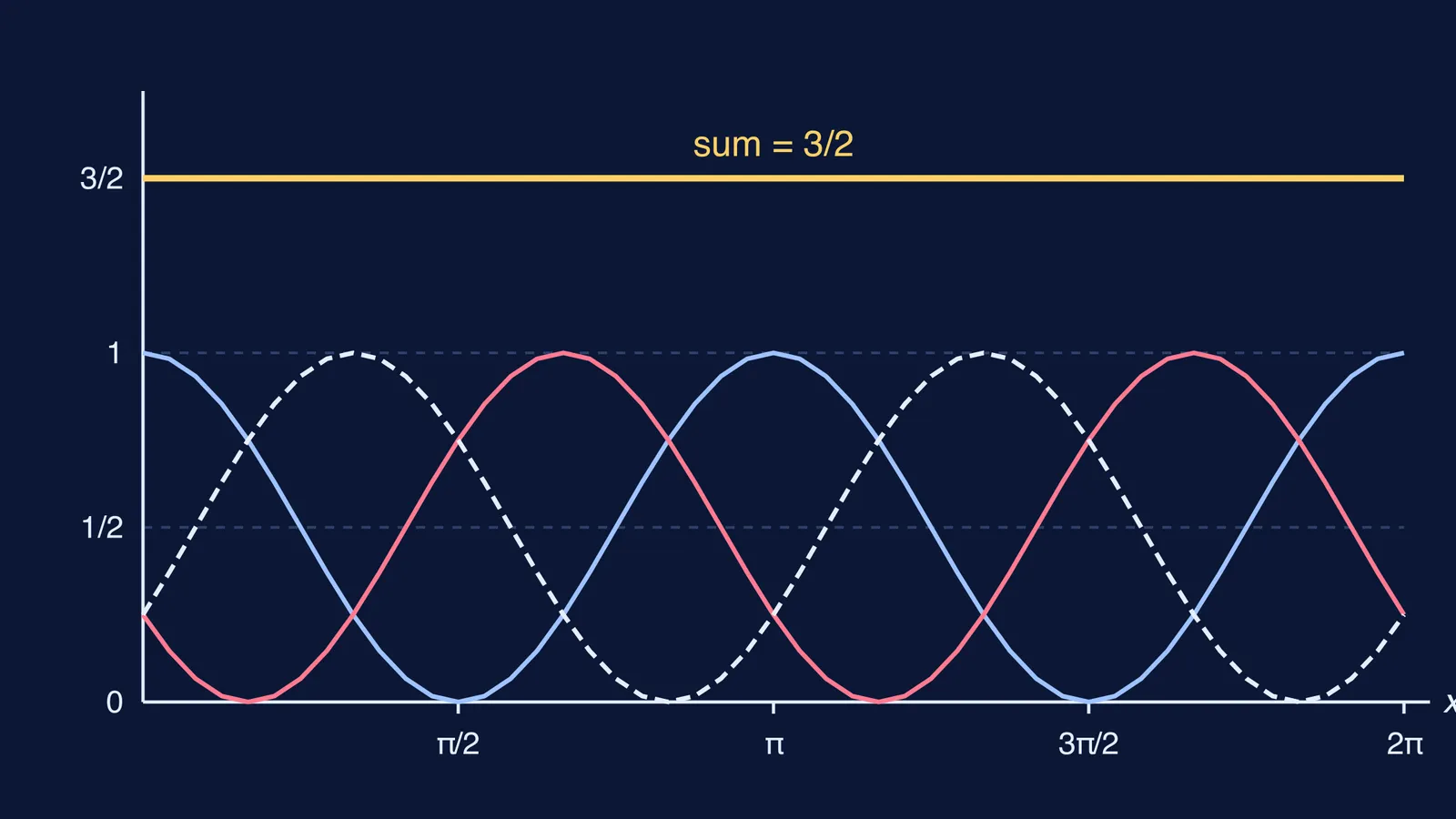
The graph above shows it. Each cos² curve rises and falls between 0 and 1, but the three are shifted against each other, so whatever one gains, the other two lose. Their total never moves off the line at 3/2.
The same reasoning gives you two related results:
sin²x + sin²(x + π/3) + sin²(x − π/3) = 3/2, because each sin² is 1 minus the matching cos², and 3 − 3/2 = 3/2.
cos²x + cos²(x + 2π/3) + cos²(x − 2π/3) = 3/2 as well. The doubled shift is now 4π/3, and cos(4π/3) is also −1/2.
If you'd like more practice pairing cosines this way, our guide to sum-to-product formulas in trigonometry works through the four standard forms. The 60° shift also powers the sin A sin(60° − A) sin(60° + A) identity, and sums of sines and cosines with angles in AP extend the cancellation idea to longer sums.
What mistakes cost marks on this question?
Check your working against this list before you move on:
Splitting the square: cos²(x + π/3) is not cos²x + cos²(π/3). The square applies to the whole cosine.
Forgetting to double the shift: after converting, the angles are 2x ± 2π/3, not 2x ± π/3.
Getting the sign of cos(2π/3) wrong: 2π/3 is in the second quadrant, where cosine is negative, so the value is −1/2.
Halving twice: the ½ in front of the bracket belongs to all three cosines. Write the 3/2 down before you simplify anything else.
If you get the right identities but keep picking the wrong first move, working through similar problems with someone who explains why each step comes next helps more than reading answers. The Fermi Problem Library has worked problems with a step-by-step solver that explains the reasoning rather than printing an answer. If the shaky part is the identities themselves, the Fermi Concept Library gives each mathematics concept its own lesson.
Try it now: without looking, prove the sin² version, then the 2π/3 version, and check both at x = 0.


