

On this page
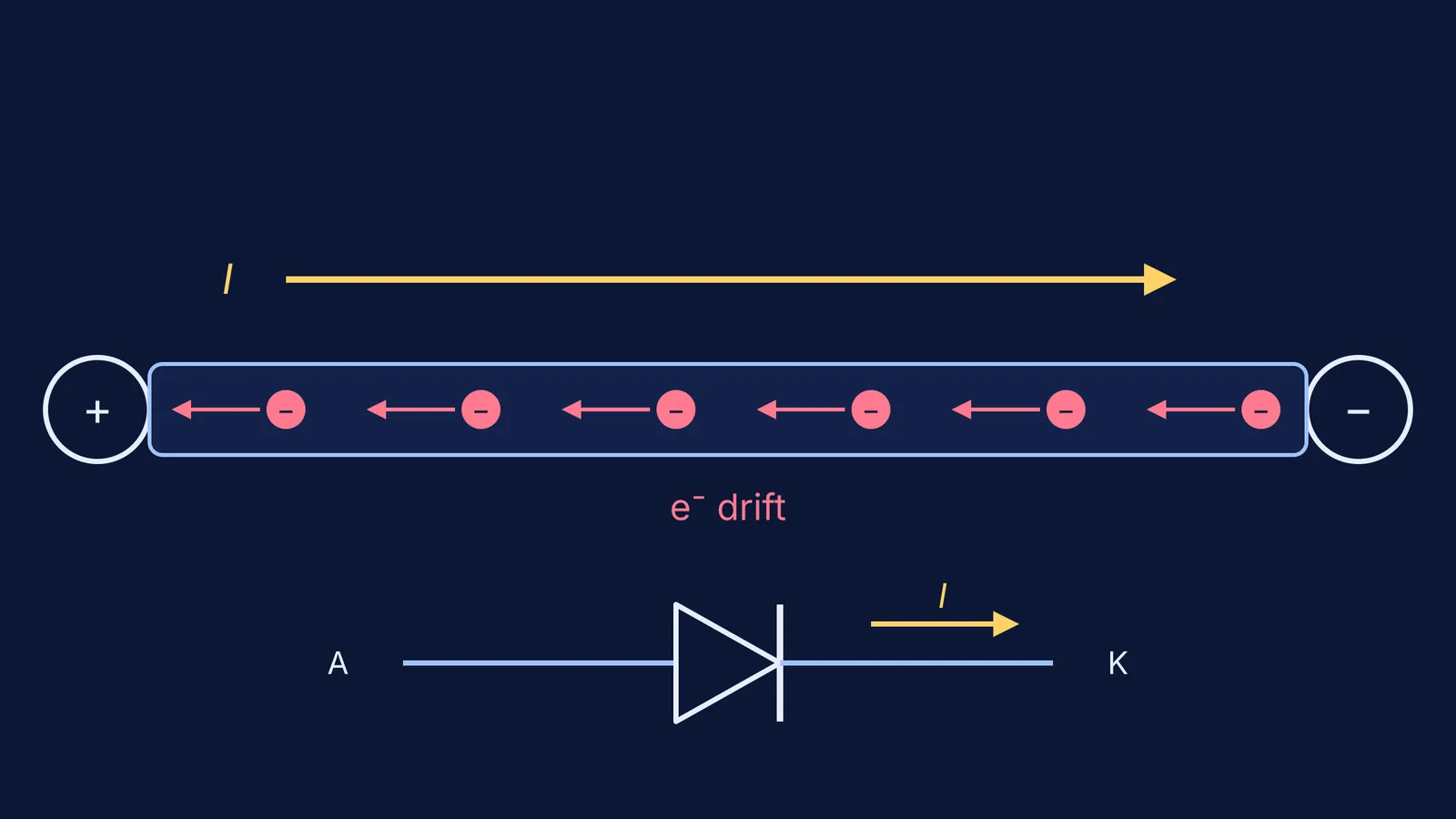
Your circuit diagrams draw current leaving the positive terminal of the cell. Your physics chapter also says the moving charges in a copper wire are electrons, which are negative. Both are true, and the gap between them is an easy place to lose marks in boards and JEE. Here is where the convention came from, and when you must flip a sign.
Why is current taken opposite to electron flow?
The labels came first, the particle much later. In a letter to Peter Collinson dated 28 July 1747, Benjamin Franklin described one part of a charged bottle as "electrised positively or plus" and the other as "negatively or minus" (Franklin, Experiments and Observations on Electricity, Letter I). In a second letter in the same book, dated 1 September 1747, he explained that a body electrised plus has an "over quantity" of electrical fire, while bodies electrised minus had "less electrical fire in them than things in common", so the fire was pictured passing from plus to minus.
The electron came 150 years later. On 30 April 1897, J. J. Thomson announced that cathode rays were negatively charged particles he called corpuscles, later renamed electrons, according to historian Isobel Falconer's account in the British Journal for the History of Science.
By then the plus-to-minus convention was long established, and nothing in the physics forced a change.
Does the direction of current change any answer?
For almost everything in a circuit, no. A positive charge moving right and a negative charge moving left transfer charge the same way, so Ohm's law, Kirchhoff's laws and power come out identical. HyperPhysics notes that the convention is used partly because it makes no difference whether you consider positive or negative charge to be moving in most common electrical applications. If you want to see how slow that electron drift actually is, our walkthrough of drift velocity, current density and resistivity works the numbers.
The convention is baked into two things you use daily:
Right-hand rules. The force on a wire is F = I L × B, with I along conventional current. Point your fingers along I, never along the electrons.
Diode symbols. The triangle points from anode to cathode, and SparkFun's guide states that current flows in the direction that the triangle/arrow is pointing, but it can't go the other way. That is conventional current; in forward bias, electrons enter at the cathode bar and leave at the anode. Our guide to reading p-n junction forward and reverse bias curves uses the same convention throughout.
When does the sign actually matter?
The sign bites whenever a question follows one charged particle instead of a current in a wire. For a single charge the magnetic force is F = q v × B, and HyperPhysics states plainly that the force is in the opposite direction for a negative charge moving the same way.
Watch for these cases:
An electron, beta particle or cathode ray moving through a magnetic field.
An electron accelerated or deflected by an electric field (F = qE points against E).
The Hall effect, where HyperPhysics notes the Hall voltage has a different polarity for positive and negative charge carriers. It reveals the sign of the carriers.
Holes versus electrons in a semiconductor, where both carriers move but in opposite directions.
How do you find the force on an electron in a magnetic field?
An electron moves east (+x) through a magnetic field pointing north (+y), with +z pointing up. Which way is the force?
Pretend it is a positive charge: v × B = x̂ × ŷ = ẑ, so the force would be upward.
The charge is negative, so flip it: the force on the electron is downward.
Cross-check with conventional current. An electron moving east is the same as a current flowing west. Using F = I L × B with L along −x̂: (−x̂) × ŷ = −ẑ, downward again.
Two methods, one answer. If your two methods disagree, you have flipped the sign twice or not at all. This exact slip is the subject of our post on right-hand-rule mistakes with magnetic force on charges and wires.
A quick checklist before you draw an arrow
Current in a wire or circuit? Use conventional current.
One particle with charge q? Keep q's sign in the formula.
Given electron motion but asked about current, or the reverse? Reverse the arrow exactly once.
A diode? The triangle points along conventional current in forward bias.
Hall effect? Do not assume the carriers are electrons.
If sign errors keep costing you marks, practise on worked problems where each step is shown. The Fermi Problem Library has a step-by-step solver that explains the reasoning rather than printing an answer, so you can see exactly where the minus sign enters. To revise the idea itself, the Fermi Concept Library gives each physics concept its own lesson.
Next time you draw a cell, add two arrows, one for current and one for electrons, pointing opposite ways.


