

On this page
Most mistakes with complex conjugates come from expanding too early. If you know four rules and one test, you can often prove a result in two lines instead of a page of algebra.
What is the conjugate of a complex number?
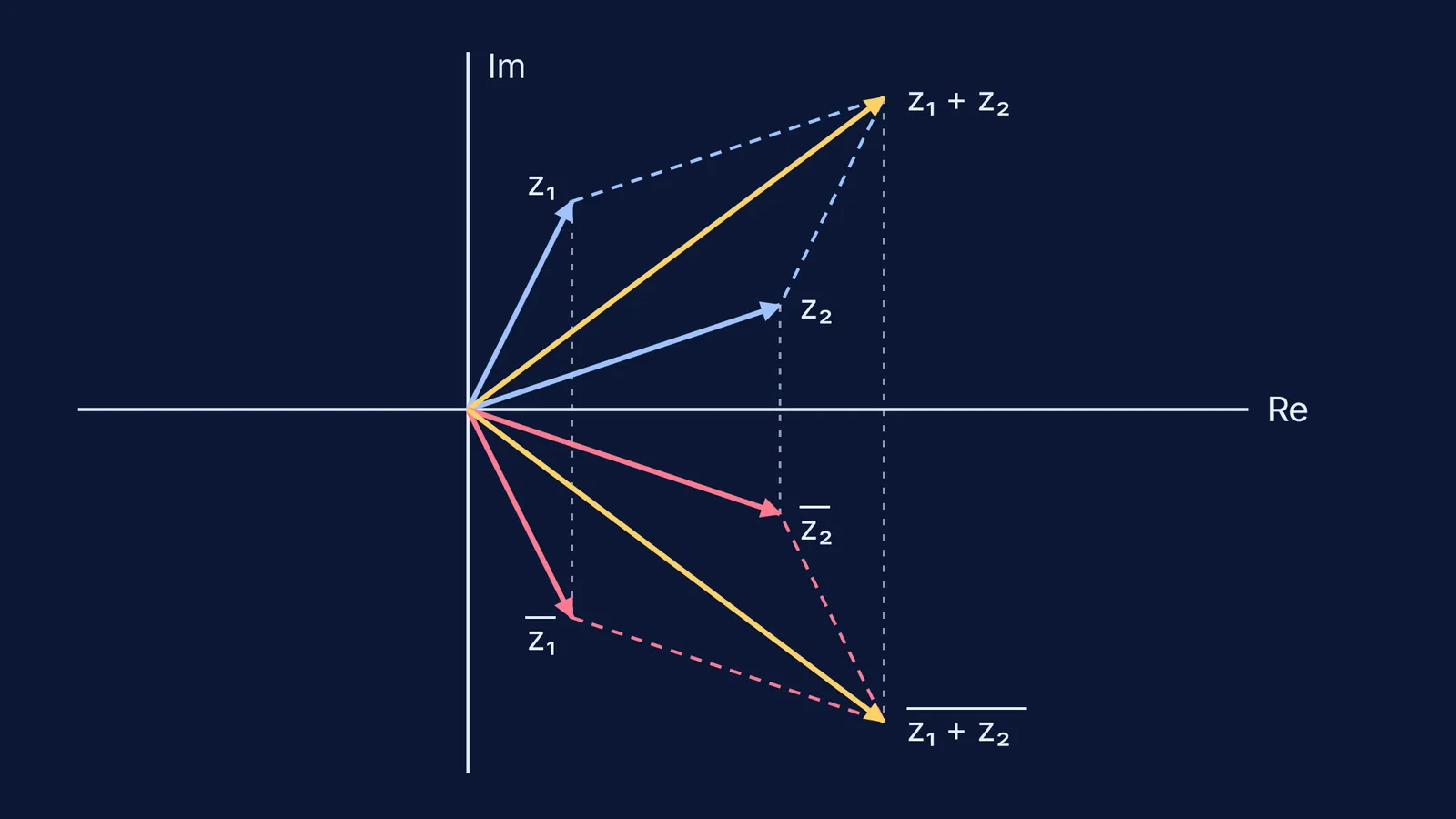
The conjugate of a complex number keeps the real part and flips the sign of the imaginary part, so the conjugate of z = x + iy is z̄ = x − iy (Wikipedia: Complex conjugate). On the Argand plane, z̄ is the mirror image of z in the real axis. That picture explains the properties below: reflecting a whole figure gives the same result as reflecting each piece first.
Two identities you will use constantly: z + z̄ = 2 Re(z), and z · z̄ = |z|². The second is why multiplying by the conjugate clears a denominator.
What are the properties of the conjugate of z1 + z2, z1z2 and z1/z2?
Write conj(…) for the conjugate of a longer expression. For any complex numbers z₁ and z₂:
Sum: conj(z₁ + z₂) = z̄₁ + z̄₂ (ProofWiki: Sum of Complex Conjugates).
Difference: conj(z₁ − z₂) = z̄₁ − z̄₂, by the same argument.
Product: conj(z₁z₂) = z̄₁ · z̄₂ (ProofWiki: Product of Complex Conjugates).
Quotient: conj(z₁/z₂) = z̄₁ / z̄₂, provided z₂ ≠ 0 (ProofWiki: Quotient of Complex Conjugates).
The sum proof is short enough to write in an exam. Let z₁ = x₁ + iy₁ and z₂ = x₂ + iy₂. Then z₁ + z₂ = (x₁ + x₂) + i(y₁ + y₂), so its conjugate is (x₁ + x₂) − i(y₁ + y₂) = (x₁ − iy₁) + (x₂ − iy₂) = z̄₁ + z̄₂. The product proof expands in the same way.
Now check with z₁ = 1 + 2i and z₂ = 3 + i.
Sum: z₁ + z₂ = 4 + 3i, conjugate 4 − 3i; and (1 − 2i) + (3 − i) = 4 − 3i.
Product: z₁z₂ = 3 + 7i + 2i² = 1 + 7i, conjugate 1 − 7i; and (1 − 2i)(3 − i) = 3 − 7i + 2i² = 1 − 7i.
Quotient: z₁/z₂ = (1 + 2i)(3 − i)/10 = 0.5 + 0.5i, conjugate 0.5 − 0.5i; and (1 − 2i)(3 + i)/10 = 0.5 − 0.5i.
How do you prove z is real if and only if z = z̄?
"If and only if" means two proofs, one in each direction (ProofWiki: Complex Number equals Conjugate iff Wholly Real).
If z is real, then z = x + 0i, so z̄ = x − 0i = x = z.
If z = z̄, write z = x + iy. Then x + iy = x − iy, so 2iy = 0 and y = 0. So z is real.
The companion test: z̄ = −z exactly when z is purely imaginary or zero, because z + z̄ = 2 Re(z) is zero only when the real part is zero. See our guide to when a complex number is purely real or purely imaginary.
How do you use these properties in JEE problems?
Stop expanding into x and y. Take the conjugate of the whole expression and see whether you get it back.
Example 1: show that z₁z̄₂ + z̄₁z₂ is real
Let w = z₁z̄₂. By the product rule, w̄ = z̄₁z₂, since conjugating z̄₂ gives back z₂. So the expression is w + w̄ = 2 Re(w), a real number.
Example 2: if |z| = 1 and z ≠ −1, show that (z − 1)/(z + 1) is purely imaginary
Since z · z̄ = 1, z̄ = 1/z. Let w = (z − 1)/(z + 1). By the quotient and difference rules, w̄ = (1/z − 1)/(1/z + 1). Multiply top and bottom by z: w̄ = (1 − z)/(1 + z) = −w. So w is purely imaginary, or zero when z = 1.
Both moves come back in locus and complex rotation problems on squares and triangles. If your working keeps ending in a tangle of x's and y's, the Fermi Problem Library has worked problems with a step-by-step solver that explains the reasoning rather than printing an answer.
A checklist before you expand anything
Show something is real? Show it equals its own conjugate.
Show it is purely imaginary? Show its conjugate is its negative.
Is |z| given and non-zero? Replace z̄ with |z|²/z.
A quotient? Check the divisor is not zero first.
Expand into x + iy only if none of the above applies.
Reflecting the parallelogram of z₁, z₂ and z₁ + z₂ in the real axis gives the parallelogram of their conjugates, the geometry covered in the geometric meaning of adding complex numbers. If a complex number as a point still feels shaky, the Fermi Concept Library gives every concept in mathematics its own lesson and its place in the map.


