

On this page
What is the formula for the canvas required for a conical tent?
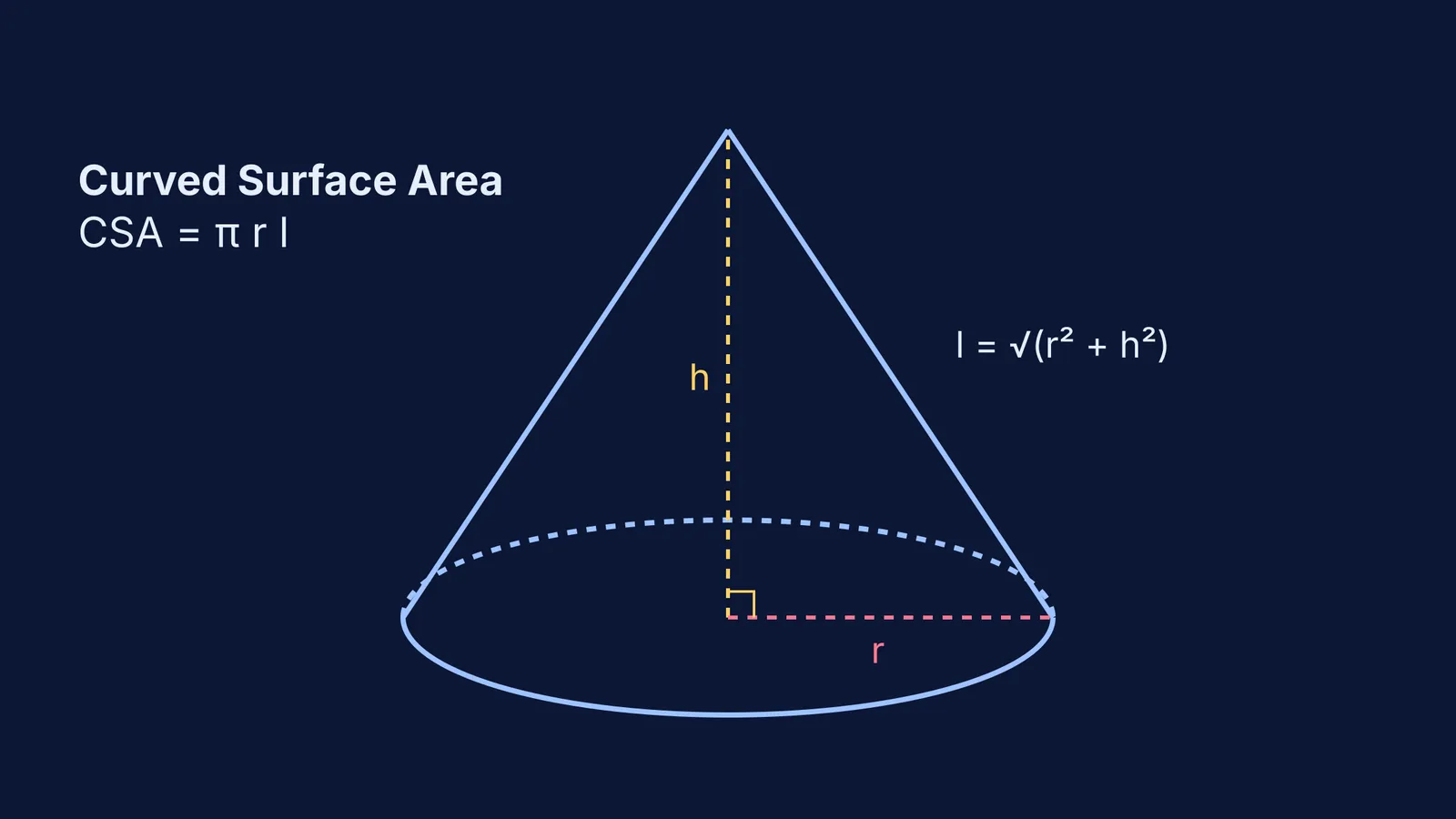
When you make a conical tent, the canvas forms the curved outer surface (also called the lateral surface), while the ground forms the base. Therefore, the area of canvas required is exactly the curved surface area of the cone.
The formula for the curved surface area (CSA) of a cone is:
CSA = π r l
Here, r is the radius of the circular base, and l is the slant height (the straight-line distance from the edge of the base up to the apex). According to standard geometric definitions of lateral surfaces, the canvas area does not include the floor unless specifically asked for (Cone).
How do you calculate the slant height?
Often, you will be given the vertical height (h) of the tent rather than the slant height (l). The height, radius and slant height form a right-angled triangle. You can use the Pythagorean theorem to find the slant height:
l = √(r² + h²)
For example, a famous historical case of a conical tent is the Sibley tent, which was patented in 1856. During the American Civil War, the Union Army produced nearly 44,000 of these tents, which typically stood 3.7 m high and had a base diameter of 5.5 m (Sibley tent). The Sibley tent design differed from other conical tents because it was supported by a central pole that telescoped down into a supporting tripod, saving space. Because of its practical design and ample floor area, it could comfortably house about a dozen soldiers at once. Understanding how to find the surface area of such structures not only helps in exams, but also in real-world engineering and historical analysis.
To find the slant height of a Sibley tent, you first halve the diameter to get the radius (r = 2.75 m). Then, apply the formula:
l = √(2.75² + 3.7²)
l = √(7.5625 + 13.69)
l = √21.2525
l ≈ 4.61 m
A step-by-step example: Area and cost of a conical tent
Once you have the radius and the slant height, finding the area and the cost is straightforward. Let us calculate the canvas area for the Sibley tent described above, and work out the cost if the canvas is priced at ₹150 per square metre. (We are assuming no canvas is wasted in stitching).
Step 1: Calculate the curved surface area
Use the formula CSA = π r l.
Area = π × 2.75 × 4.61
Area ≈ 3.14159 × 12.6775
Area ≈ 39.8 square metres
The tent requires about 39.8 square metres of canvas.
Step 2: Calculate the total cost
To find the cost, multiply the total area by the rate per square metre.
Cost = Area × Rate
Cost = 39.8 × 150
Cost = ₹5,970
If you are stuck on similar problems involving surface area and volume, setting out your variables before you start can help. Writing down r, h and l clearly will prevent you from mixing up the vertical height with the slant height.
What if there are stitching margins and wastage?
Real-world canvas tents are not made from a single piece of fabric. When tailors cut canvas from a rectangular roll (like a tarpaulin) and stitch it into a cone, they must overlap the edges. Some fabric is also lost in cutting.
Many textbook problems account for this by asking you to find the total length of the tarpaulin required, given a fixed width. To solve these problems, follow a simple principle: the usable area of the canvas must equal the curved surface area of the tent.
Let us say you need to make our Sibley tent (curved surface area of 39.8 square metres) using a canvas roll that is 2 metres wide. If we assume there is no wastage, the length of the canvas required is just the total area divided by the width:
Length = Area ÷ Width
Length = 39.8 ÷ 2 = 19.9 m
However, if the tailor wastes 0.5 m of the canvas length during stitching, you must add that 0.5 m to the length of the roll you purchase. In this case, you would need to buy 20.4 m of canvas. By keeping the geometry calculation separate from the real-world wastage calculation, you make the problem much easier to manage.
If you are working through geometry homework and need a hint rather than just the final answer, the Fermi Problem Library is a useful tool. Its AI tutor walks through the steps with you, drawing the cone and pointing out where to apply Pythagoras's theorem.


