

On this page
If you are preparing for aptitude exams, you will likely face word problems asking how long it takes a certain number of workers to finish a task if their hours change. This is a classic test of compound proportion.
When a problem combines multiple shifting variables—like men, days, hours, and the amount of work—you do not need to calculate them one by one. The chain rule, a core part of the mathematics syllabus, lets you balance them all in one step [[1]](https://testbook.com/maths/time-and-work).
What is the men-days-hours formula for compound proportion?
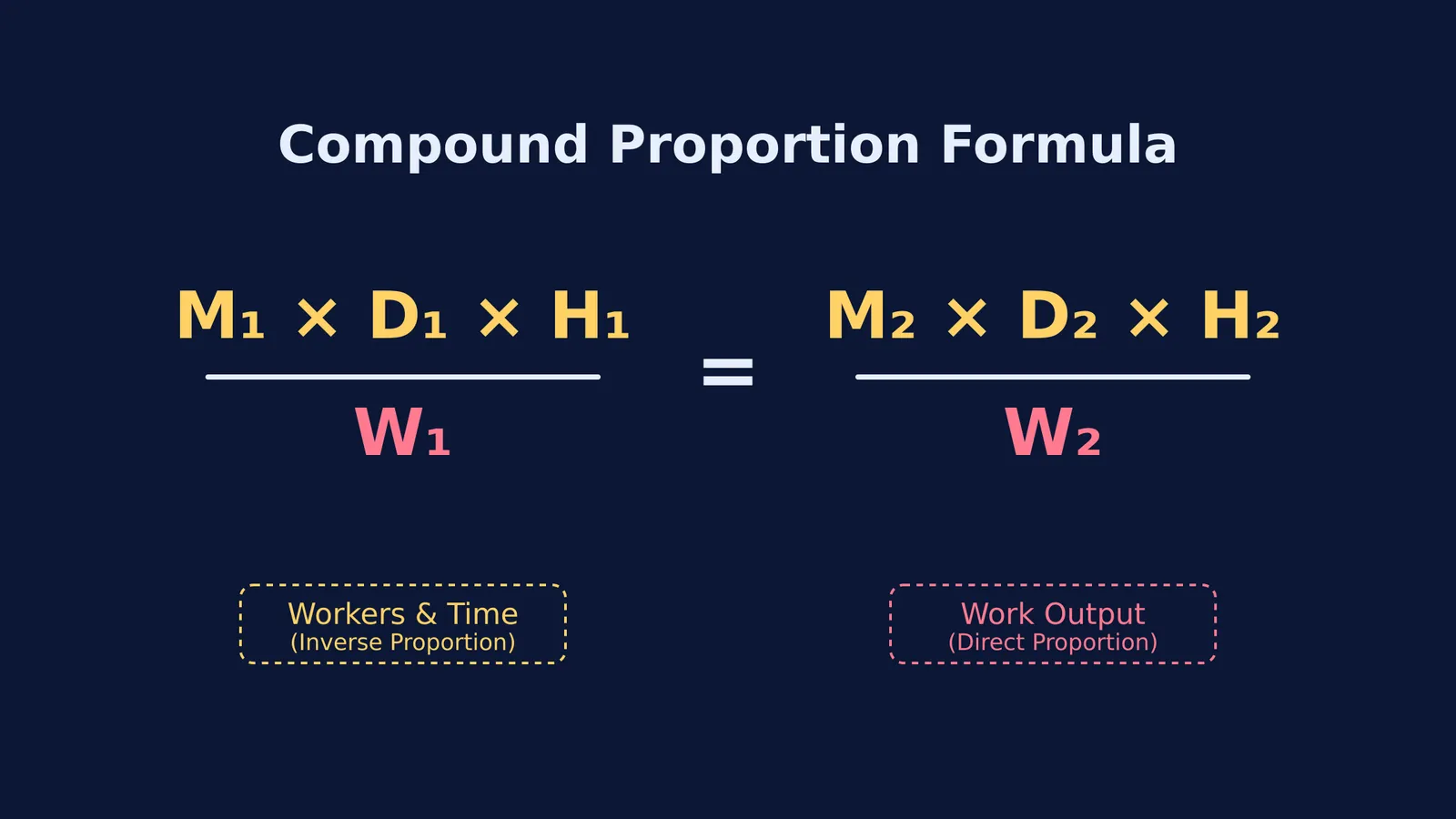
The relationship between workers, time, and output is captured by a single equation known as the chain rule formula:
(M₁ × D₁ × H₁) / W₁ = (M₂ × D₂ × H₂) / W₂
Here, M stands for the number of men (or workers), D is the number of days, H is the hours worked per day, and W is the amount of work completed [[1]](https://testbook.com/maths/time-and-work). The subscripts 1 and 2 represent the first and second scenarios in your word problem.
This formula works because it respects both direct and inverse variation at the same time. If you struggle to divide an amount in a given ratio, returning to the logic of direct and inverse relationships is the best way to start understanding these problems.
Why do men, days, and hours go in the numerator?
The numerator holds the variables that are inversely proportional to one another [[1]](https://testbook.com/maths/time-and-work).
If you have a fixed amount of work to do, adding more men means the job will take fewer days. Similarly, if those men work more hours each day, they will need fewer days in total. Because these variables move in opposite directions, their product (M × D × H) remains a constant.
Why does work go in the denominator?
The amount of work (W) is directly proportional to the effort put in. More men, more days, or more hours will all result in more work getting done [[1]](https://testbook.com/maths/time-and-work).
In mathematics, when two quantities grow together at a constant rate, their ratio remains constant. That is why the work variable sits in the denominator, balancing the time and effort in the numerator. If the amount of work is identical in both scenarios (e.g., "to build the same wall"), W₁ equals W₂, and you can drop the denominators entirely to leave M₁ × D₁ × H₁ = M₂ × D₂ × H₂.
If you find yourself guessing whether to multiply or divide in aptitude tests, the Fermi Problem Library has worked problems with a step-by-step solver that explains the reasoning rather than printing an answer.
How do you solve a compound proportion problem?
Let us walk through a standard aptitude example where the amount of work remains the same, but the time constraints change.
The Problem: If 15 men can complete a task in 20 days working 8 hours a day, how many men are required to complete the same work in 10 days working 12 hours a day?
List the first scenario (the knowns):
M₁ = 15, D₁ = 20, H₁ = 8.
List the second scenario (the unknowns):
M₂ = x, D₂ = 10, H₂ = 12.
Set up the chain rule:
Since the work is the same, ignore W. 15 × 20 × 8 = x × 10 × 12
Solve for x:
2400 = x × 120 x = 2400 ÷ 120 = 20 men.
You need 20 men to finish the job under the new constraints. Instead of finding out what one man does in one hour (the unitary method), the formula gets you to the answer in seconds.
What happens when the work done also changes?
Word problems often introduce a twist by changing the output required. For instance, a crew might be asked to build a wall twice as long, or to dig a trench three times as deep.
In these cases, W₁ and W₂ represent the different volumes of work. For example, if the second crew must do twice the work of the first, you would set W₁ = 1 and W₂ = 2.
The Problem: 10 men working 6 hours a day take 15 days to build 5 units of a wall. How many days will 12 men take, working 5 hours a day, to build 10 units of the wall?
Set up the variables for both sides:
First side: M₁ = 10, H₁ = 6, D₁ = 15, W₁ = 5
Second side: M₂ = 12, H₂ = 5, D₂ = x, W₂ = 10
Apply the full formula:
(10 × 15 × 6) / 5 = (12 × x × 5) / 10
Simplify the fractions:
900 / 5 = 60x / 10 180 = 6x
Solve for x:
x = 180 ÷ 6 x = 30 days.
This approach prevents the confusion of multiple inverse calculations. If you are comparing strategies for these exam topics, you might also find the time and work LCM method helpful for tackling questions where different groups have varying efficiencies. And when word problems get too tangled, Fermi's AI tutor works out what you already know and builds a plan for the session, teaching you how to set up the proportions yourself.


