

On this page
Most compound interest problems keep one rate every year, so you reach for A = P(1 + R/100)^n. Then a question says “8% for the first year and 10% for the second”, and the power no longer fits. The fix is small: swap the power for a product, with one bracket per year.
Why do you multiply the factors when the rate changes?
Compound interest is interest calculated on the previous year's amount, as the NCERT Class 8 chapter Comparing Quantities puts it. In the same chapter, each year's amount becomes the principal for the next year, and repeating that step n times gives P(1 + R/100)^n.
So the power is shorthand for multiplying the same bracket again and again. The Reserve Bank of India's Financial Awareness Messages booklet shows it plainly: ₹100 invested at 10% compounded yearly becomes ₹121 in 2 years, which is 100 × 1.1 × 1.1.
If the rate changes, only that year's bracket changes:
A = P(1 + r1/100)(1 + r2/100)(1 + r3/100) ...
Each bracket is a growth factor. A rate of 8% means ×1.08, 10% means ×1.10, and a 5% fall (depreciation) means ×0.95.
How do you calculate compound interest with a different rate each year?
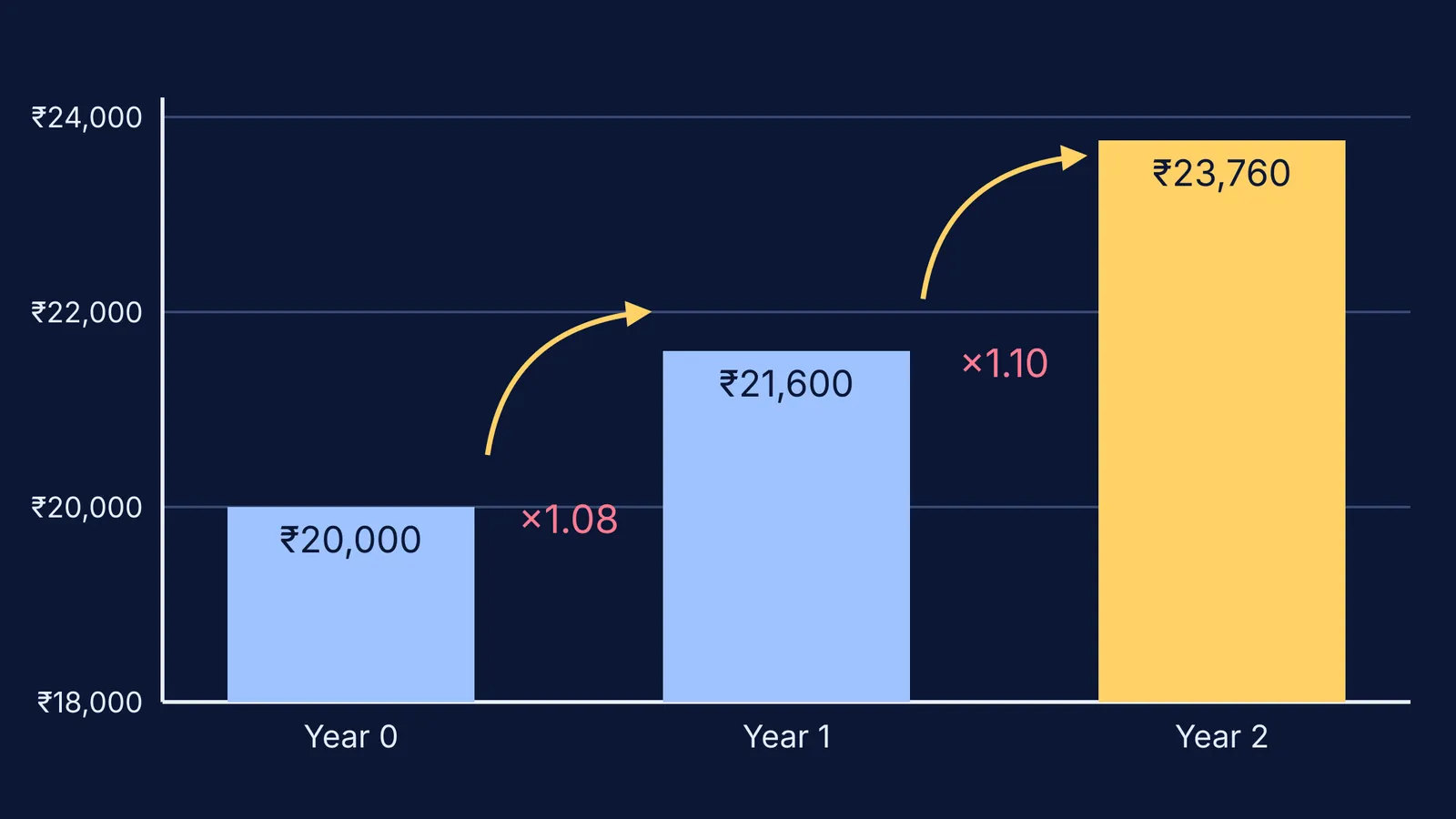
Take ₹20,000 at 8% for the first year and 10% for the second, compounded annually.
Turn each rate into a factor: 1.08 and 1.10.
Multiply in order: 20,000 × 1.08 = 21,600, then 21,600 × 1.10 = 23,760.
Amount A = ₹23,760.
Compound interest = A − P = ₹3,760.
Now check it year by year, the way the NCERT chapter does for Heena's ₹20,000 loan. Year 1 interest is 8% of ₹20,000, which is ₹1,600. Year 2 interest is 10% of ₹21,600, which is ₹2,160. The total is ₹3,760, the same answer.
Three years work the same way. For ₹15,000 at 4%, 5% and 6%: 15,000 × 1.04 = 15,600, then × 1.05 = 16,380, then × 1.06 = 17,362.80. The compound interest is ₹2,362.80.
To see where the formula itself comes from, read our post on building the compound interest formula from yearly steps.
Can you just average the rates?
No, though the error is easy to miss. Averaging 8% and 10% to 9% gives 20,000 × 1.09 × 1.09 = ₹23,762, which is ₹2 more than the true ₹23,760. The gap grows as the rates spread apart: for 2% and 20%, the average gives 1.11 × 1.11 = 1.2321, while the true factor is 1.02 × 1.20 = 1.224.
Two other slips land further from the right answer:
Adding the rates to 18% and using simple interest gives ₹23,600, which leaves out the interest on interest.
Using the last rate for both years gives 20,000 × 1.10 × 1.10 = ₹24,200.
In a multiple-choice question, watch for numbers like these among the options.
Which word problems need this product?
Look for these signals:
“R1% for the first year and R2% for the second year”, or “the rate was revised after one year”.
A quantity that rises by one percentage and then falls by another. A population that grows 10% and then drops 10% ends at 1.10 × 0.90 = 0.99 of where it began, a 1% fall overall.
Price rises, salary hikes or discounts given year by year.
Reverse questions. If ₹20,000 grows to ₹23,760 with 8% in year 1, the second-year factor is 23,760 ÷ 21,600 = 1.10, so the rate is 10%.
Population growth and depreciation use the same brackets; see population growth and depreciation with the compound formula. For a picture of why a rise and a fall of the same percentage do not cancel, read successive percentage change, visualised.
When not to use it: if the question says simple interest, each year's interest is on the original principal only. If interest is compounded half-yearly, each bracket uses half the annual rate and there are two brackets per year.
What should you check before writing the final answer?
Write one bracket per period, in order, before putting in numbers.
Turn each rate into a factor; falls give factors below 1.
Multiply step by step and note each year's amount.
Subtract P only if the question asks for interest rather than amount.
Sanity check: the answer must sit between what the lowest and highest rate alone would give. Here that is ₹23,328 (8% both years, the amount the NCERT chapter finds for Heena) and ₹24,200 (10% both years).
If you keep reaching for the wrong method, the Fermi Problem Library has worked problems with a step-by-step solver that explains the reasoning rather than printing an answer. If percentages themselves feel shaky, the Fermi Concept Library gives each maths concept its own lesson.


