

On this page
In coordinate geometry, three distinct points A, B, and C are collinear if they lie along a single straight line. While Class 10 introduces collinearity through the distance formula or triangle area, comparing slopes is far faster. According to the NCERT Class 11 Mathematics textbook, three points A, B, and C are collinear if and only if the slope of segment AB equals the slope of segment BC.
Why does equal slope prove three points are collinear?
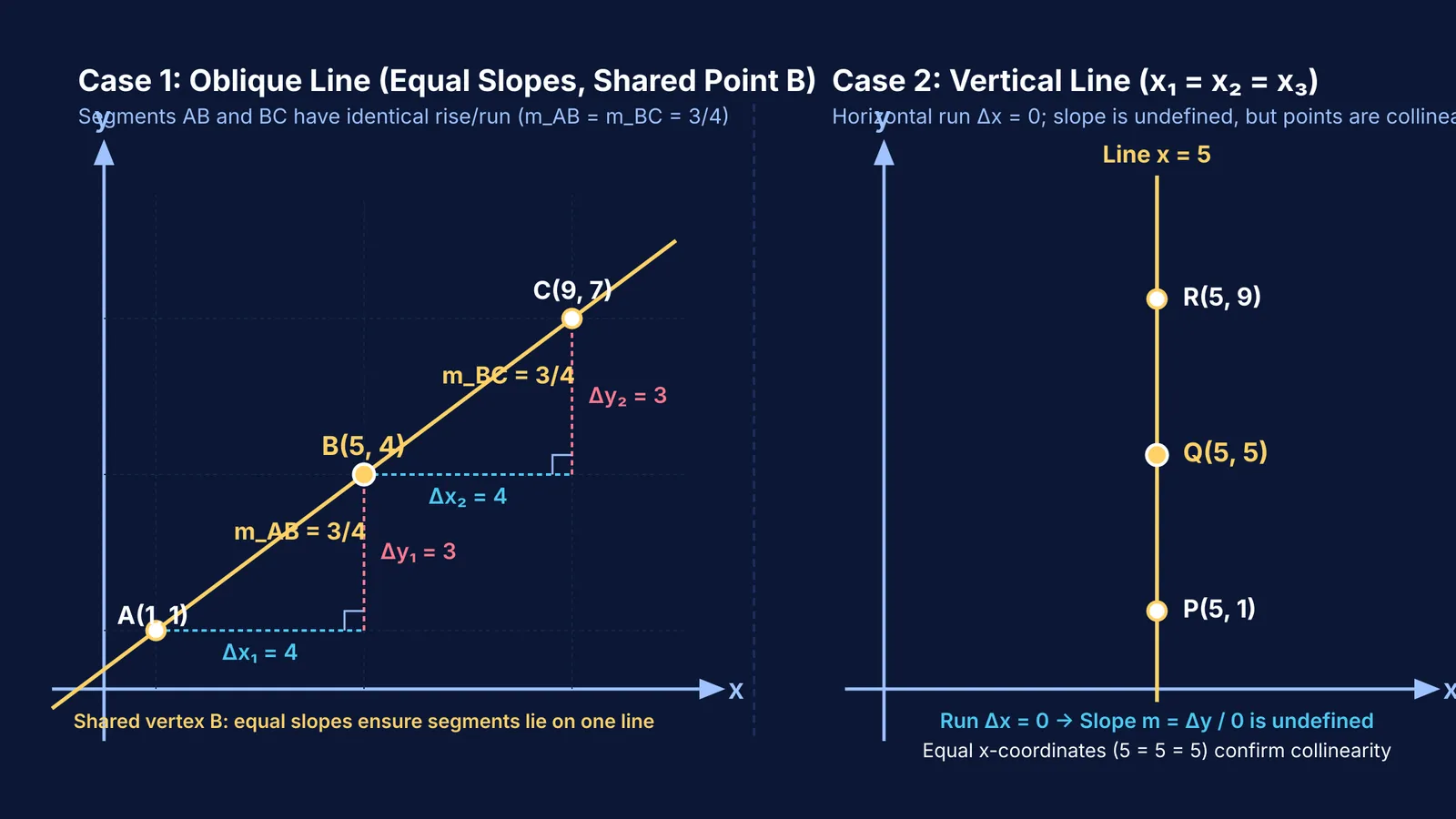
The geometric proof connects inclination with a shared vertex. The slope m = tan θ measures the angle θ that a line makes with the positive x-axis. When two line segments have equal slopes (m_AB = m_BC), the lines containing them have identical inclinations and are parallel.
However, segments AB and BC meet at point B. Euclid's parallel postulate implies that through a given point, only one line can exist in a given direction. Because lines AB and BC are parallel and share point B, they cannot be separate parallel lines—they must coincide into one line.
How do you check if three points are collinear using slopes?
To test three points A(x₁, y₁), B(x₂, y₂), and C(x₃, y₃), compute the slope of two consecutive segments:
Slope of AB: m_AB = (y₂ − y₁) / (x₂ − x₁)
Slope of BC: m_BC = (y₃ − y₂) / (x₃ − x₂)
If m_AB = m_BC, the three points are collinear.
Consider an example with A(−2, −2), B(1, 3), and C(4, 8):
Compute the slope of segment AB:
m_AB = (3 − (−2)) / (1 − (−2)) = 5 / 3.
Compute the slope of segment BC:
m_BC = (8 − 3) / (4 − 1) = 5 / 3.
Compare the slopes:
Because m_AB = m_BC = 5/3 and both pass through point B, points A, B, and C are collinear.
The Fermi Problem Library has worked problems with a step-by-step solver that explains the reasoning rather than printing an answer, making it easy to spot calculation slips.
What happens when three collinear points form a vertical line?
The standard slope formula encounters an issue when a line is vertical. A vertical line has an inclination of θ = 90°. Because tan 90° is undefined, m = (y₂ − y₁) / (x₂ − x₁) yields a denominator of zero whenever x₁ = x₂.
For points A(3, 1), B(3, 5), and C(3, 9), both segments yield 4 / 0. In arithmetic, division by zero is undefined, and treating two undefined expressions as equal is invalid.
Instead, apply the vertical-line test: if x₁ = x₂, segment AB is vertical. For C to be collinear with A and B, it must lie on that same vertical line x = 3. Because x₁ = x₂ = x₃ = 3, all three points lie on x = 3, confirming collinearity. If C had coordinates (4, 9), then x₃ ≠ 3, so C would not be collinear.
To avoid division by zero entirely, use the cross-multiplied form: (y₂ − y₁)(x₃ − x₂) = (y₃ − y₂)(x₂ − x₁)
For vertical lines, both x₂ − x₁ and x₃ − x₂ equal zero. The equation reduces to 0 = 0, confirming collinearity without undefined terms.
How does the slope method compare with distance and area tests?
In the CBSE Senior Secondary Mathematics curriculum, Unit III (Coordinate Geometry) carries 12 marks. Comparing collinearity tests shows why slopes are preferred in timed exams:
Distance formula (Class 10): Showing AB + BC = AC requires calculating three square roots, √[(x₂ − x₁)² + (y₂ − y₁)²]. Simplifying radicals is slow and error-prone. For an overview of distance methods, see our guide on classifying a triangle using distance formulas.
Triangle area formula: Three points are collinear if triangle area is zero: (1/2)|x₁(y₂ − y₃) + x₂(y₃ − y₁) + x₃(y₁ − y₂)| = 0. While this determinant handles vertical lines naturally, expanding six products takes longer than finding two slopes.
Slope method (Class 11): Evaluating two slopes requires only basic subtraction and division, making it the fastest test for finding unknown coordinates.
Understanding slope relationships—such as why the product of perpendicular slopes is −1—builds intuition across algebra. When tackling unfamiliar geometry problems, sketching coordinate geometry doubts before checking answers prevents false assumptions. The Fermi Concept Library covers every concept in mathematics, each with its own lesson and its place in the map, showing how slope equations connect to line forms and vectors.
A 3-step checklist to check collinearity on exam day
Follow this routine during timed tests:
Scan x-coordinates: If x₁ = x₂ = x₃, the points lie on the vertical line x = x₁ and are collinear immediately. If two match but the third differs, they are not collinear.
Compute slopes or cross-multiply: If x-coordinates differ, compute m_AB = (y₂ − y₁) / (x₂ − x₁) and m_BC = (y₃ − y₂) / (x₃ − x₂), or check if (y₂ − y₁)(x₃ − x₂) = (y₃ − y₂)(x₂ − x₁).
Verify the shared vertex: Confirm that both segments share a common point (such as B). If slopes are equal, the three points are collinear.
Practice verifying the common point across three sample coordinate pairs to master this workflow before your exam.


