

On this page
Coordinate geometry can feel like an endless maze of formulas. Whether you are finding the centre of an ellipse, determining the distance between two intersecting lines, or deducing the equation of trajectory of a projectile, it is tempting to simply plug numbers into an equation and hope for the best.
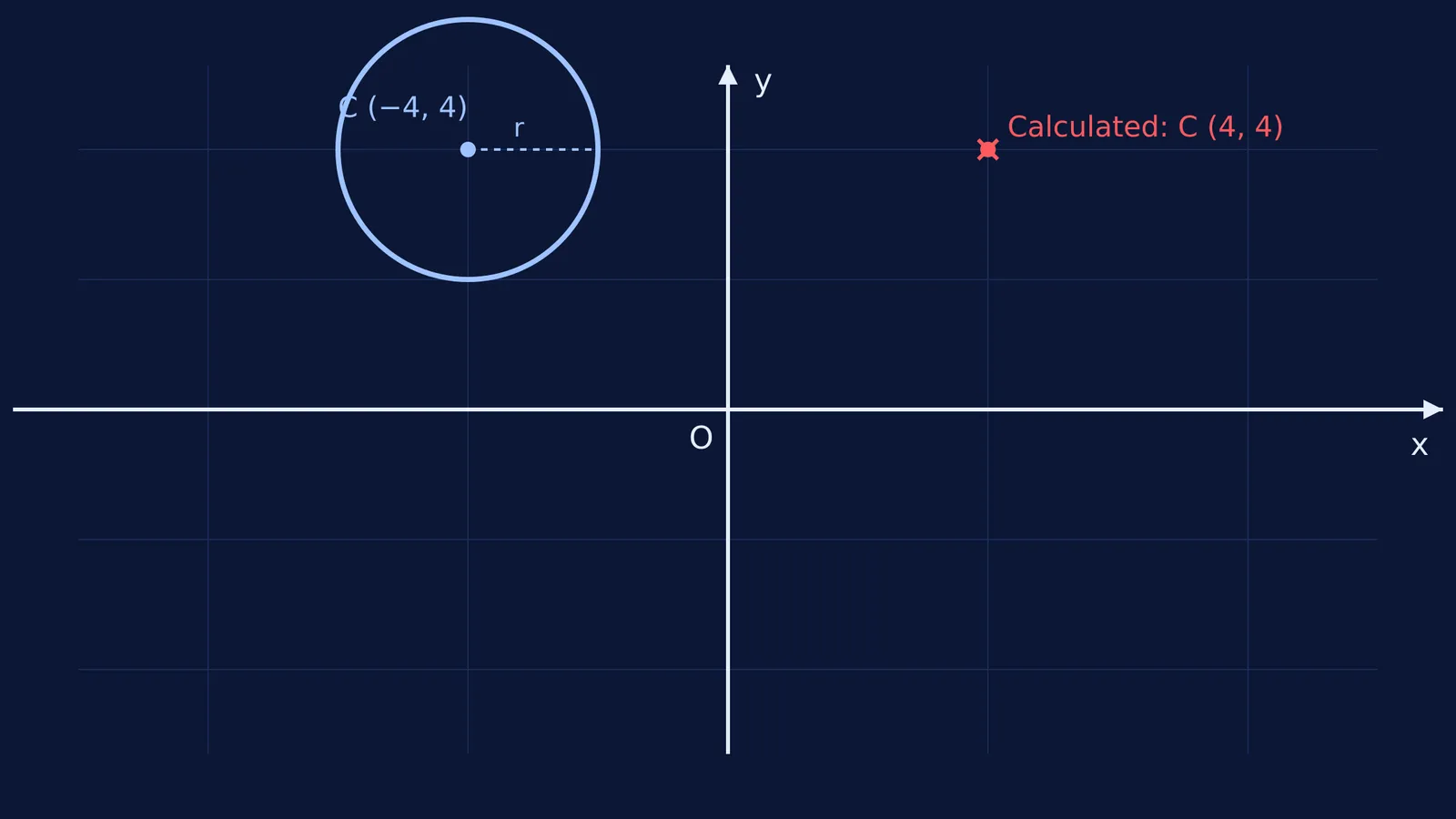
But when you jump straight into the algebra without a visual reference, you are solving blind. A simple sign error—like mistaking a +4 for a −4—can flip a point from the first quadrant into the second, throwing off your entire answer.
If you are preparing for competitive exams like JEE Main and bringing your doubts to an AI tutor, there is a better way to begin: draw a rough sketch first.
Why does a rough sketch matter in coordinate geometry?
When you plot a problem on paper, you translate an abstract algebraic description into a concrete geometric picture. You do not need precise graph paper or a ruler. A schematic diagram—a rough figure that shows the correct spatial relationships, like which quadrant a point sits in or where a line crosses the axes—is entirely sufficient.
Research shows that this simple habit directly impacts your marks. A 2006 study published in the *Journal of Learning Disabilities* investigated how students approach mathematical problem-solving. It found that students who draw schematic diagrams that show spatial relationships score higher in mathematical problem-solving. Conversely, students who draw "pictorial" diagrams—images that focus on surface-level visual details, like drawing a detailed cannon for a physics problem instead of a simple vector—often perform worse.
A quick sketch acts as your early warning system. For example, if your algebra tells you the centre of a circle is at (3, 4), but your sketch shows the circle sitting entirely in the second quadrant (where x must be negative), you instantly know your calculation is wrong. You can stop and fix the error before you waste ten minutes on a doomed calculation.
How do you draw a useful schematic diagram?
You do not need to be an artist to draw an effective schematic diagram. The primary goal is to capture the mathematical structure, not to produce a masterpiece. Your diagram only needs to be accurate enough to verify the basic facts of the problem.
Follow this simple checklist for every coordinate geometry doubt:
Draw and label the axes: Always start with a large, clear x and y axis. Label the origin as O(0, 0).
Plot the givens roughly: Place the given points, focus, or centre in their correct quadrants. For example, if a point has a negative x and a negative y, make sure it sits firmly in the third quadrant.
Sketch the primary shape: Draw the straight line, circle, or parabola described in the problem. If you are applying rules like latus rectum lengths: 4a for a parabola, 2b²/a for an ellipse, keep the proportions roughly accurate so you can visually estimate the length.
Note the symmetry: Coordinate geometry is full of symmetry. If a parabola opens to the right, note that the top and bottom halves mirror each other across the axis of symmetry.
Mark intersections: Identify where curves cross the axes or each other. These are often the roots or solutions to the equations you will eventually solve.
How can AI help with coordinate geometry doubts?
When you get stuck on a difficult coordinate geometry problem, it is very easy to paste the question text into an AI tool and simply read the final answer. But reading a generated solution is not learning.
This is where a dedicated AI tutor makes a real difference in your exam preparation. If you bring your doubt to Fermi's AI tutor, you will find that the platform works differently than a standard chatbot. Instead of just printing an answer and moving on, it holds a line of reasoning across a session, notices where you are stuck, and decides whether to explain, ask, or show.
When you start a session in the Fermi Problem Library, an effective way to interact is to describe your sketch to the tutor. Tell it exactly what you see: "I drew a circle through three given points, and my sketch shows the centre must be in the fourth quadrant, but my equation gives a positive y-value."
By sharing your visual intuition, the AI tutor can pinpoint exactly where your algebraic reasoning broke down. It might point out a sign error in your binomial expansion, help you re-evaluate a negative root, or ask you a guiding question about the tangent line.
Drawing a sketch first does much more than just catch silly mistakes. It gives you a firm, intuitive grasp of the problem's geometry. By the time you ask the AI for help, you are already halfway to the solution, ensuring you learn the method rather than just memorising formulas.


