

On this page
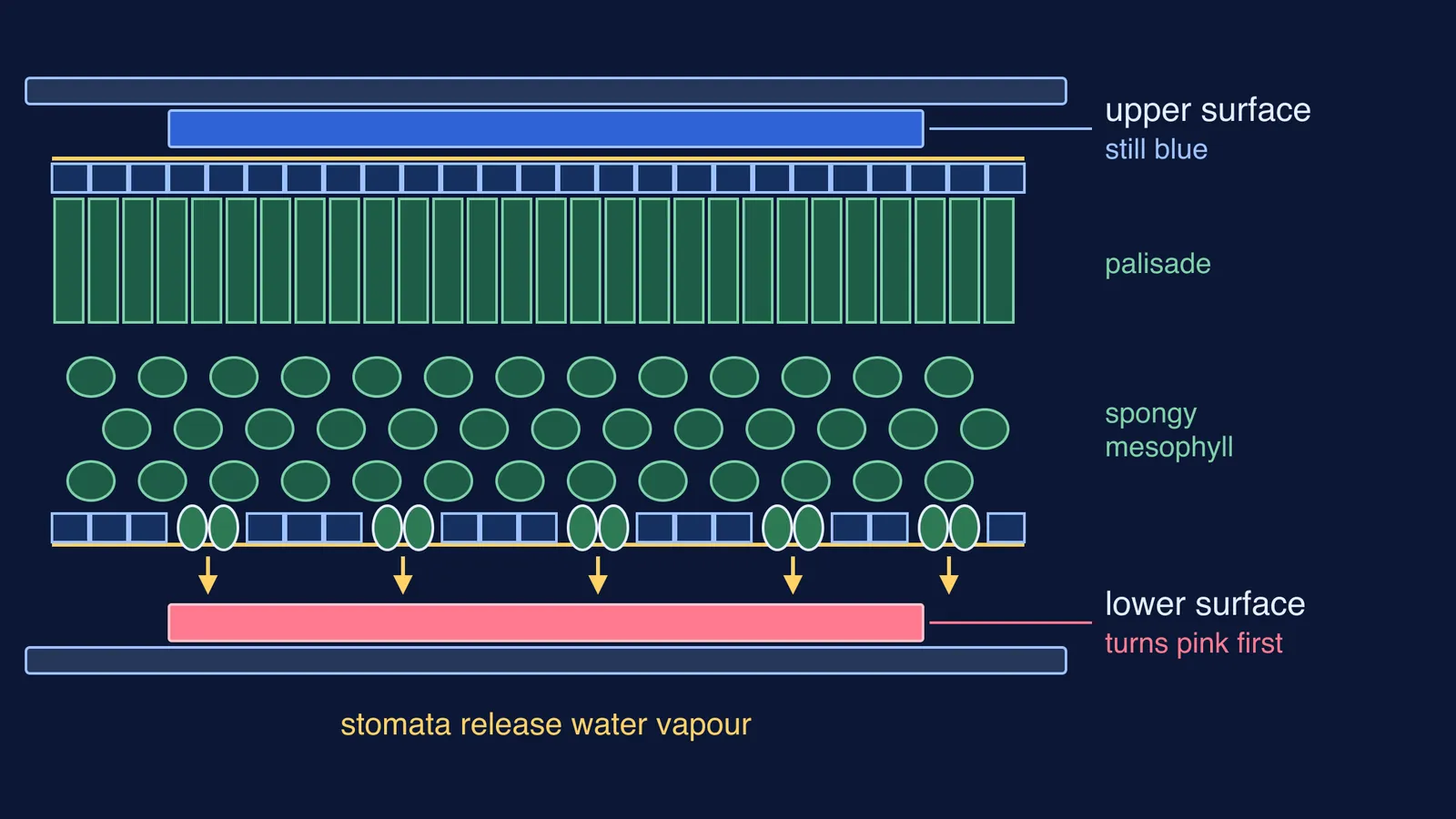
To compare water loss from the two surfaces of a leaf, clip a strip of dry, blue cobalt chloride paper to each side and watch which turns pink first. On most broad leaves the lower strip wins, and your result only counts if the comparison is fair.
What does the cobalt chloride paper test show?
Cobalt chloride paper is filter paper soaked in cobalt chloride solution and dried: blue when dry, pink once it takes up water. One university practical protocol (GSFC University, Experiment 6) soaks filter-paper strips in a 3% cobalt chloride solution for 3-5 minutes, then dries them until they turn from pink to blue. The colour change is a reversible hydration equilibrium, explained in why cobalt chloride switches between pink and blue.
On a leaf, the paper works as a water-vapour detector. Water leaves the leaf as vapour, mostly through stomata, so the strip that collects vapour faster turns pink sooner. The time to change colour is a rough comparison of the two surfaces, not a measured rate.
Why does the lower surface of a leaf turn pink first?
In a dorsiventral (dicot) leaf, the lower (abaxial) epidermis generally bears more stomata than the upper (adaxial) epidermis, which may even lack stomata, according to the NCERT Class 11 Biology chapter Anatomy of Flowering Plants (NCERT Class 11 Biology, Chapter 6). Both surfaces also carry a cuticle, the waxy layer that slows water loss from the rest of the surface. More pores below means more routes for vapour, so the lower strip gets wet first.
A 2024 paper in the Journal of Experimental Botany by Pirko Jalakas and colleagues at the University of Tartu notes that most plants are hypostomatous, with stomata only in the lower epidermis (Jalakas et al., 2024). The same paper notes that many herbs, including the model plant Arabidopsis, have substantial numbers of stomata on both surfaces.
Exceptions belong in your answer. NCERT notes that an isobilateral (monocot) leaf, such as a grass, has stomata on both surfaces, so the two strips may change at similar times. If you are unsure which type you picked, see dorsiventral vs isobilateral leaves.
How do you set up the cobalt chloride paper test?
These steps follow the GSFC protocol above, with fairness checks added.
Dry the strips until fully blue and keep them in a closed, dry container until use.
Choose a healthy dicot leaf still on the plant and wipe both surfaces dry.
With forceps, place one strip on the upper surface and one directly opposite on the lower surface.
Cover each strip with a glass slide and clip the slides together around the leaf.
Start a stopwatch as the clip closes and note when each strip turns pink.
The International Chemical Safety Card for cobalt(II) chloride, prepared for the ILO and WHO, warns that it may cause cancer if inhaled and that repeated or prolonged contact may cause skin sensitisation (ICSC 0783).
How do you time and record it fairly?
Pink is a judgement, so set your rules before you start, not after you see a result.
One endpoint: decide what counts as changed, such as no blue left on the strip, and use it for both.
Same batch, same size: cut both strips from the same dried sheet so neither starts wetter.
Same leaf, same moment: both strips then share the same light, temperature and air.
A control strip: clip one strip between slides with no leaf. If it turns pink as fast as the leaf strips, the paper or room air is damp; redo the test.
Repeat: test several leaves and record every pair of times, not just the neatest.
For your record, write one line per leaf: leaf number, upper-strip time, lower-strip time, and which changed first. Then add an observation sentence ('On every leaf, the lower strip turned pink sooner') and, separately, the reason ('The lower epidermis of a dorsiventral leaf has more stomata'). Keep what you saw apart from why it happened.
If the upper strip wins or nothing changes, record it honestly and check the usual causes: paper not fully dry, a damp leaf, a gap at the slide edge, or an isobilateral leaf.
What might the viva ask?
Why are the slides needed? They keep room air off the strip, so the moisture comes from the leaf.
Why does the lower surface lose more water? It has more stomata.
Would a grass leaf give the same result? Probably not, as it has stomata on both surfaces.
Does this measure the rate of transpiration? No. It compares two surfaces and gives no amount of water per unit time.
To see the stomata behind your result, make a leaf peel mount of stomata from the same plant. If terms like abaxial, palisade and guard cell still blur together, the Fermi Concept Library gives every concept in biology its own lesson and its place in the map, so you can close the gap before your practical exam.


