

On this page
The charcoal cavity test is a quick dry test in the salt analysis practical. It can point you towards a cation, but its colours are not proof. Here is how to read them, and where the test lets you down.
What is the charcoal cavity test?
In this test the salt is converted into a metal carbonate in a charcoal cavity, which decomposes on heating to the metal oxide or even to the metal, and the cation can be judged from the colour of the bead, the residue in the cavity, or the deposit outside it, called the incrustation, according to an Al-Mustaqbal University analytical chemistry practical handout.
The same handout writes the zinc case as two steps: ZnSO4 + Na2CO3 gives ZnCO3, and ZnCO3 gives ZnO, yellow when hot, plus CO2. Frederick Getman's 1899 textbook The Elements of Blowpipe Analysis explains why the soda is there: many metal compounds are hard to reduce with the flame alone.
How do you do the charcoal cavity test step by step?
One school practical write-up on Vedantu gives these amounts; follow your own lab manual if it differs.
Scoop a small cavity in a charcoal block.
Fill it with about 0.2 g of the salt and about 0.5 g of anhydrous sodium carbonate.
Moisten with one or two drops of water.
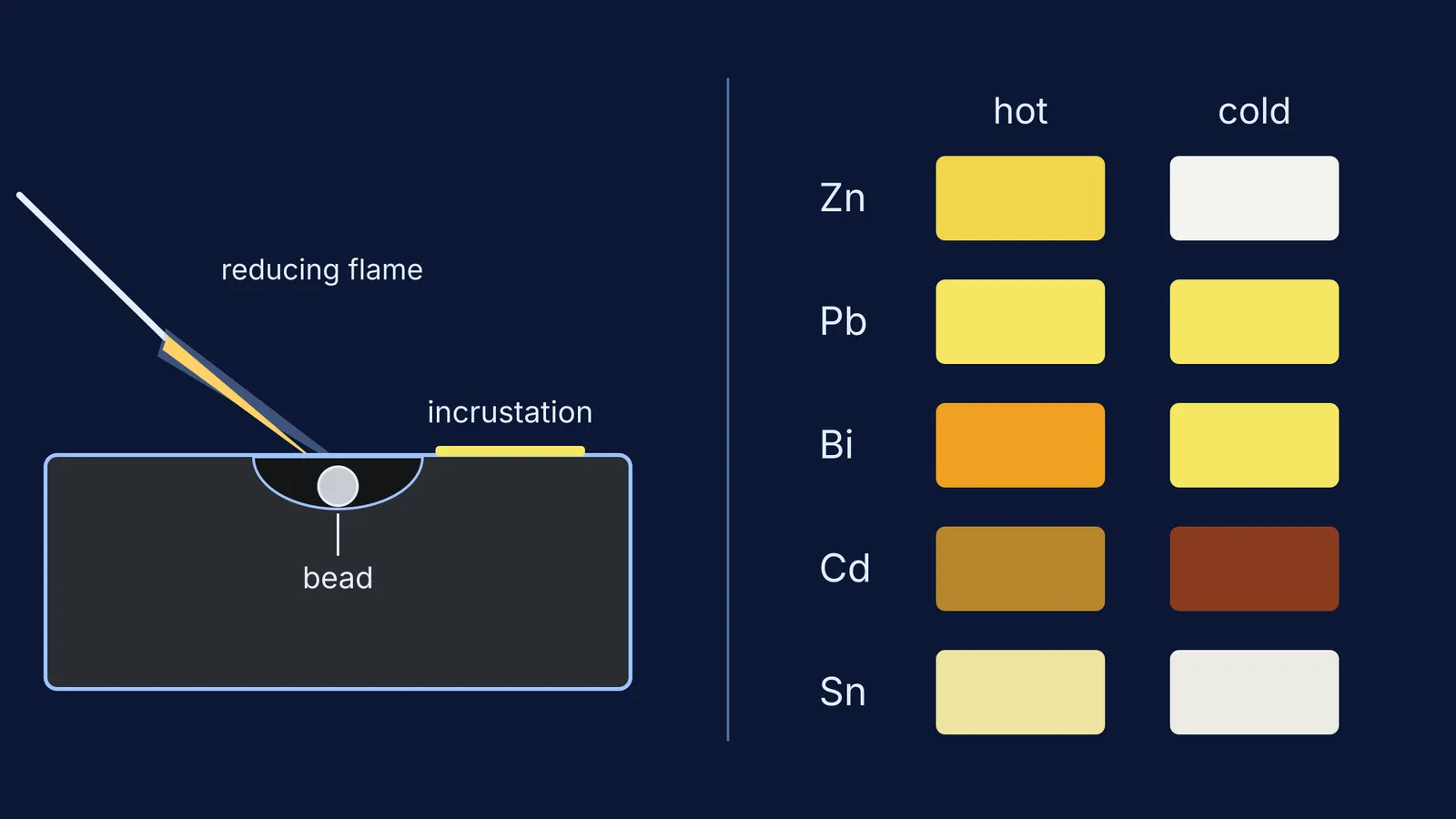
Use a blowpipe to direct the luminous (reducing) flame into the cavity.
Note the colour of the residue or bead while hot, and again when cold.
The luminous cone is the reducing part of the flame and the outer envelope the oxidising part, as Getman describes, so aim the luminous cone at the salt.
What do the residue colours mean?
The Vedantu practical lists four standard school inferences:
Yellow residue when hot, grey metal when cold: Pb2+
White residue with a garlic odour: As3+
Brown residue: Cd2+
Yellow residue when hot, white when cold: Zn2+
Getman's table of coatings on charcoal adds detail. Lead gives a lemon-yellow coating, bismuth orange-yellow when hot and lemon-yellow when cold, cadmium brownish-yellow when hot and reddish-brown when cold, and tin faint yellow when hot and white when cold, per The Elements of Blowpipe Analysis. He also describes the beads: tin gives a white, hard, malleable bead, bismuth a yellow brittle bead, and copper a red, malleable bead.
Crystalline zinc oxide is thermochromic: white to yellow when heated, white again on cooling, because it loses a little oxygen at high temperature, per Wikipedia's zinc oxide page.
Worked example: reading two results
Salt A is white. In the cavity the residue glows yellow while hot and turns white as it cools. Your suspect is Zn2+. Tin also leaves a whitish coating, so add a drop of cobalt nitrate and heat again: Getman reports a green mass for zinc and a greenish-blue colour for tin. Then confirm zinc in Group IV of the wet analysis, the group listed for Zn2+ in the Al-Mustaqbal handout.
Salt B leaves a yellow crust and a small metal bead. Lead and bismuth both give yellow coatings, so press the bead with a spatula. A soft grey bead points to lead; a yellowish bead that breaks points to bismuth. Write "Pb2+ may be present" and confirm with the wet test.
What are the limits of the charcoal cavity test?
Colours overlap. Lead and bismuth coatings are both lemon-yellow when cold, and zinc and tin are both whitish when cold, in Getman's table.
Only some metals give a clear sign. A plain white residue only narrows the field: the Al-Mustaqbal handout reads it as possibly Al3+, Ca2+, Ba2+ or Mg2+.
Mixtures blur. Two cations can lay one colour over another.
Technique matters. The wrong part of the flame or looking only when cold can hide the result.
It was never meant to stand alone. Getman himself wrote that any doubt should be settled by a few tests in the "liquid way".
Treat the result as a lead for your wet analysis, not as your answer. Never sniff the cavity on purpose for the garlic smell; arsenic compounds are toxic, so follow your teacher's safety instructions.
How should you revise it for the practical?
Learn each inference as a triple (hot colour, cold colour, ion), plus its clash and the test that settles it. Then see this test alongside the others: read our guides to the dry heating test in salt analysis and to borax bead test colours, then use retrieval practice for salt analysis to fix the tables.
If the chemistry behind the colours, such as why a carbonate decomposes or how carbon reduces an oxide, still feels shaky, the Fermi Concept Library has every concept in chemistry with its own lesson and its place in the map. For written questions on salt analysis, the Fermi Problem Library has worked problems with a step-by-step solver that explains the reasoning rather than printing an answer.


