

On this page
Qualitative salt analysis is a rite of passage in the chemistry laboratory, but memorising the intricate flowchart of cation and anion tests is notoriously difficult. If you find yourself repeatedly forgetting which reagent isolates Group III or what a brown ring test indicates, you are not alone. Reading your lab manual from cover to cover might feel productive, but it often creates an illusion of competence that vanishes the moment you are faced with an unknown salt in an exam.
Here is why traditional revision falls short, and how testing yourself—with or without an AI tutor—can make the colours, smells, and precipitates stick in your memory.
Why is qualitative salt analysis hard to remember?
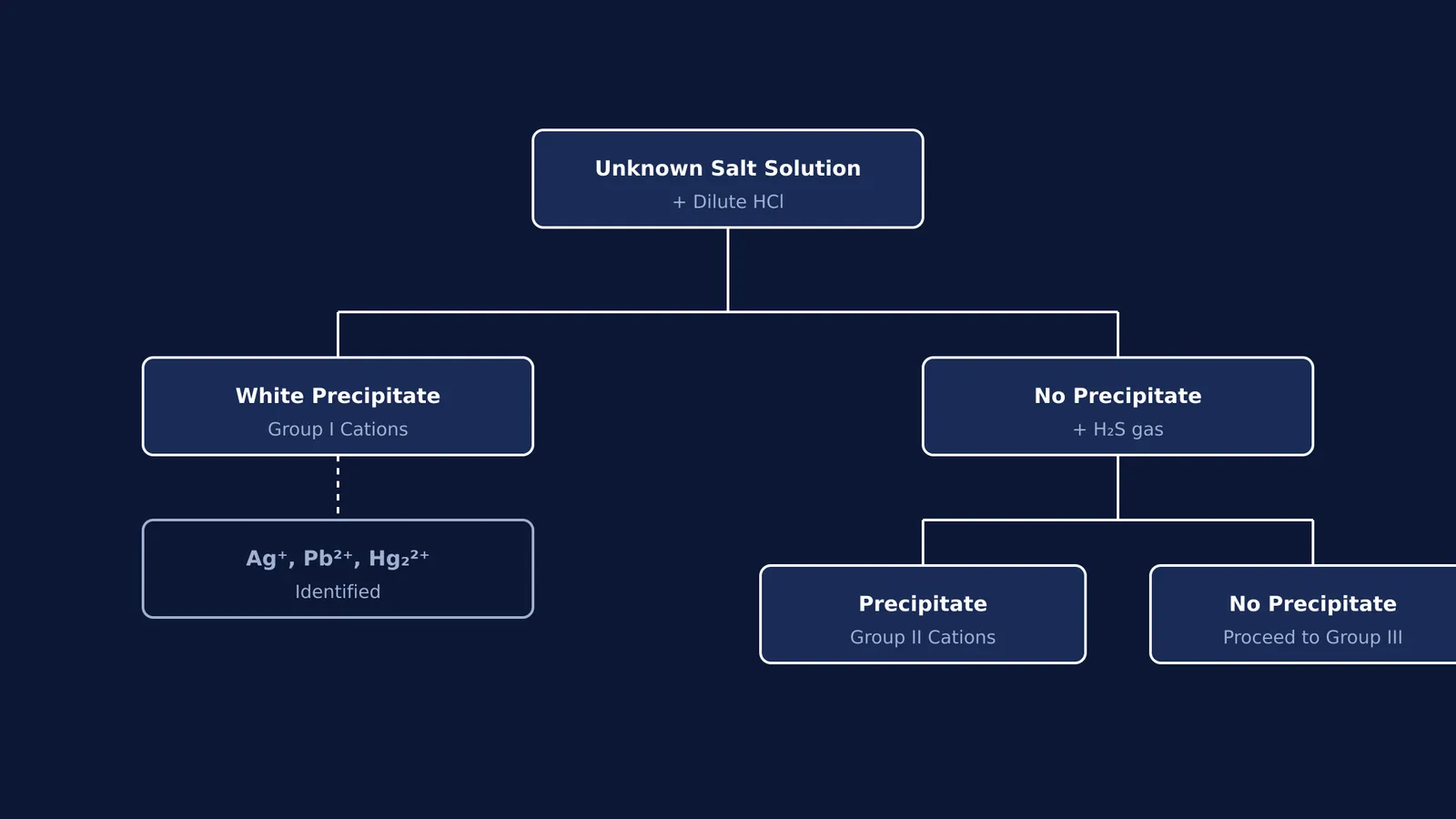
The chemistry practical syllabus requires you to hold a vast, branching decision tree in your head. A systematic approach to salt analysis involves tracking the presence or absence of a precipitate across six distinct cation groups. You must remember that Group I requires dilute hydrochloric acid, while Group II needs hydrogen sulphide gas (H₂S) passed through an acidic medium. At the same time, you are distinguishing between carbonate, chloride, sulphate, and nitrate anions using a separate series of dilute and concentrated acid tests.
When you simply read this flowchart, your brain processes the information fluently. This fluency tricks you into believing you have learnt the material. However, reading does not build the neural pathways required to retrieve that information on demand. When you are standing at the bench with a test tube, the lab manual is not there to prompt you. Memorisation through repetition alone rarely survives the stress of a timed practical examination.
How do you use retrieval practice for chemistry practicals?
The alternative to passive reading is retrieval practice: forcing yourself to recall facts from memory.
A 2021 study by Tullis and Qiu explored how students remember abstract chemistry information. They compared the effectiveness of students reading provided mnemonics against generating their own study cues. The researchers found that actively generating a response involves "deep and effortful processing." This effort is the actual engine of memory formation. The struggle to recall whether H₂S is added in an acidic or alkaline medium for Group II cations is precisely what ensures you remember it next time.
To apply this to your studies, close your lab manual. Write out the cation group reagents from memory on a whiteboard or a piece of scrap paper. When you make a mistake or draw a blank, check the manual and correct your work in a different colour. This active recall is far more effective than re-reading the table, and it applies just as well to memorising the tests for organic functional groups.
Can AI help qualitative salt analysis revision?
While self-testing with flashcards works, it can become repetitive and predictable. An AI tutor can act as a dynamic quizmaster, simulating the unpredictable nature of an unknown salt and forcing you to apply your knowledge sequentially.
Instead of writing your own quizzes from scratch, you can bring a topic or a scanned assignment to Fermi's AI tutor. Fermi works out what you already know, builds a plan for the session, and teaches through it—asking you to predict the precipitate colour before confirming it. It holds the context of a full experiment, behaving like a virtual unknown salt that responds to the reagents you suggest.
For instance, the AI might tell you that adding dilute sulphuric acid produced a colourless, odourless gas that turned limewater milky. You must then retrieve the fact that this indicates a carbonate anion, before the AI moves on to test your cation knowledge. While this mental rehearsal does not replace the tactile experience of a real lab, research on virtual chemistry labs shows they are highly effective tools for pre-lab preparation.
What is a practical plan for your next revision session?
To move from passive reading to active retrieval, try this step-by-step sequence before your next chemistry practical exam:
The Blank Page Test: Take a blank sheet of paper and draw the flowchart for Groups I to VI from memory. Include the group reagents and the expected precipitate colours.
The Anion Grid: Create a two-column table. In the left column, list the observations (for example, "brisk effervescence", "white precipitate soluble in excess NH₄OH"). In the right column, write the corresponding anion from memory.
The AI Simulation: Open your AI tool of choice and run a simulated experiment. Use this exact prompt to start the session:
By forcing your brain to retrieve the facts and apply them to a simulated unknown, you transform salt analysis from a frustrating memorisation chore into a logical puzzle that you are well-equipped to solve.


