

On this page
Here is the version for your exam answer: a cation is smaller than its parent atom because it has fewer electrons while the nuclear charge stays the same, and an anion is larger because the extra electron adds repulsion and lowers the effective nuclear charge. That is close to how the NCERT Class 11 Chemistry textbook, Unit 3 puts it. Below is the why, with numbers.
How much smaller is Na⁺ than Na?
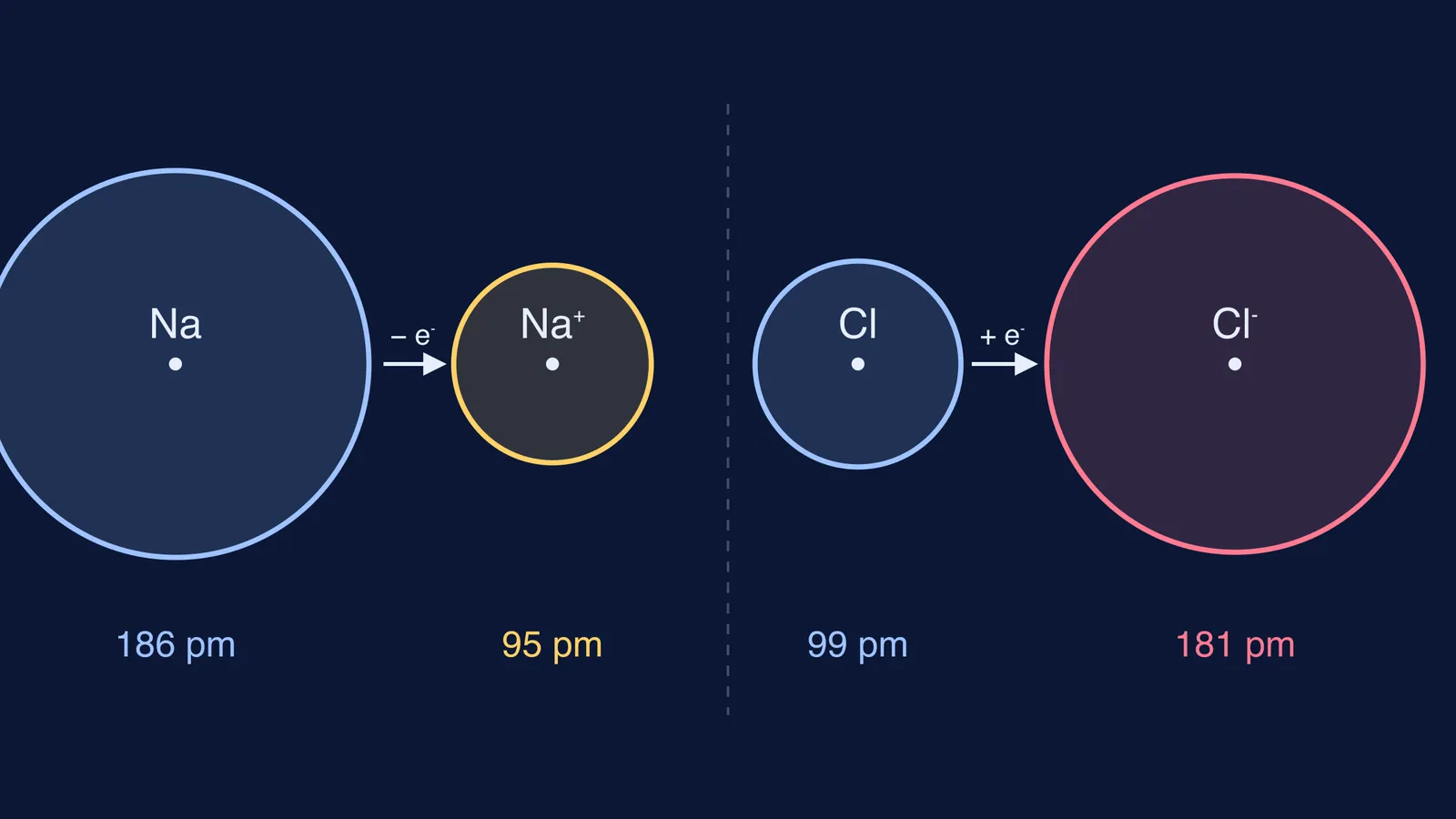
NCERT gives the atomic radius of sodium as 186 pm and the ionic radius of Na⁺ as 95 pm (NCERT Unit 3). Losing one electron roughly halves the radius.
Two things happen at once when sodium loses its 3s electron:
A whole shell disappears. Sodium is 2,8,1. Remove the single 3s electron and the outermost electrons are now in the second shell, which sits much closer to the nucleus.
The pull per electron goes up. The nucleus still has 11 protons, but now only 10 electrons share that pull.
A bigger positive charge shrinks an ion further: in NCERT's Problem 3.5, Mg is the largest of Mg, Mg²⁺, Al and Al³⁺, and Al³⁺ the smallest (NCERT Unit 3).
Why is Cl⁻ bigger than Cl?
NCERT takes the atomic radius of chlorine as 99 pm, half the 198 pm bond length in a Cl₂ molecule (NCERT Unit 3). The chloride ion with six neighbours in a crystal has a radius of 181 pm in R. D. Shannon's standard table of effective ionic radii (Shannon, 1976, Acta Crystallographica A; value as tabulated by KnowledgeDoor).
No new shell is added here. The extra electron goes into the same 3p subshell. But 17 protons now hold 18 electrons, and the newcomer pushes against the seven electrons already in the third shell. The electron cloud spreads out until attraction and repulsion balance again.
What is effective nuclear charge, and how do you calculate it?
Effective nuclear charge (Zeff) is the net positive charge an outer electron actually feels, which is less than the full nuclear charge because inner electrons shield it (NCERT Unit 3).
A quick way to estimate it is Slater's rules, from J. C. Slater's 1930 paper on atomic shielding constants (Slater, Physical Review). For an electron in an s or p orbital, each other electron in the same ns, np group shields 0.35, each electron in shell n−1 shields 0.85, and each deeper electron shields 1.00 (summary of Slater's rules). Then Zeff = Z − S, where S is the total shielding.
Worked example: four species, one method
Na, a 3s electron. Z = 11. Shielding: 8 electrons in shell 2 × 0.85 = 6.80, plus 2 in shell 1 × 1.00 = 2.00. S = 8.80, so Zeff = 2.20.
Na⁺, a 2p electron. Z = 11. Shielding: 7 other 2s and 2p electrons × 0.35 = 2.45, plus 2 in shell 1 × 0.85 = 1.70. S = 4.15, so Zeff = 6.85.
Cl, a 3p electron. Z = 17. Shielding: 6 other 3s and 3p electrons × 0.35 = 2.10, plus 8 in shell 2 × 0.85 = 6.80, plus 2 in shell 1 × 1.00 = 2.00. S = 10.90, so Zeff = 6.10.
Cl⁻, a 3p electron. Z = 17. Shielding: 7 other 3s and 3p electrons × 0.35 = 2.45, plus 6.80, plus 2.00. S = 11.25, so Zeff = 5.75.
In sodium, the outermost electrons go from feeling about +2.2 to about +6.9, in a smaller shell: a big squeeze. In chlorine, Zeff falls from 6.10 to 5.75, so each outer electron is held a little less tightly: a modest swell. Slater's rules are approximate, so trust the direction, not the decimals.
How do you rank isoelectronic ions by size?
Isoelectronic species have the same number of electrons; NCERT's example is O²⁻, F⁻, Na⁺ and Mg²⁺, which all have 10 (NCERT Unit 3). With the electron count fixed, only the nuclear charge changes, so more protons means a smaller ion. The order is O²⁻ > F⁻ > Na⁺ > Mg²⁺.
A three-step check for any size question:
Write the electron configuration of each species, not just of the neutral atom.
If the outermost shells differ, the species with more shells is larger.
If the shells are the same, compare protons per electron, or work out Zeff with Slater's rules as above.
To see these trends across the table, try plotting periodic trends yourself. For more, read about Victor Goldschmidt's ionic radii and how shielding shapes the first ionisation enthalpy graph.
If shielding still feels like a word rather than an idea, the Fermi Concept Library gives every chemistry concept its own lesson and its place in the map, so you can step back to electron configuration first. For practice, the Fermi Problem Library has worked problems with a step-by-step solver that explains the reasoning rather than printing an answer.


