

On this page
A medicine capsule is a classic example of a combined solid: a cylinder in the middle, capped with a hemisphere on each end.
If you are following the NCERT Class 10 mathematics syllabus, you will find this shape in the Surface Areas and Volumes chapter. While most students calculate the cylinder and the hemispheres separately, there is a simple shortcut that saves time and cuts down on calculation errors.
What is a capsule shape in geometry?
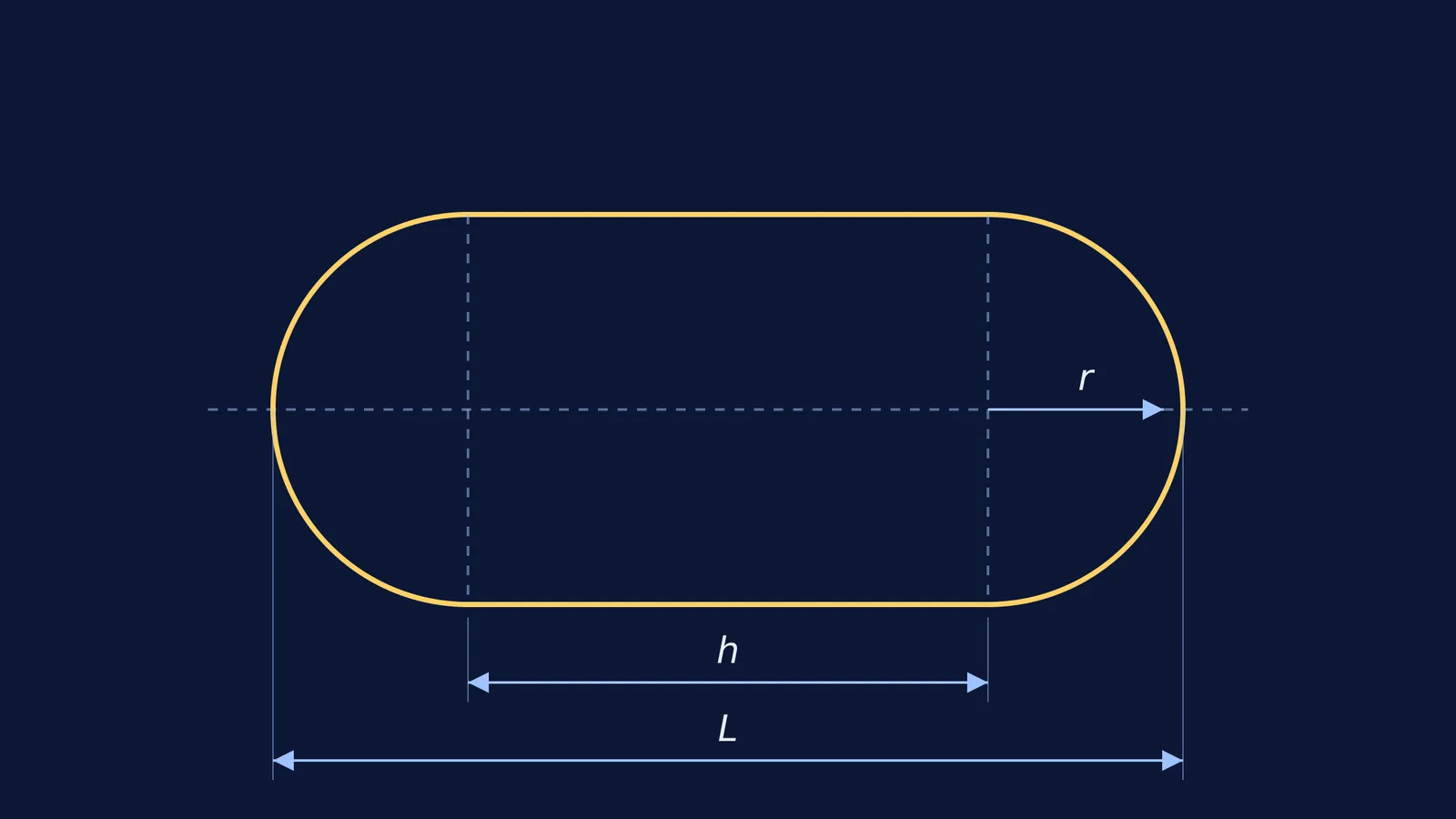
In geometry, a capsule (or stadium) is a three-dimensional shape consisting of a central right circular cylinder with a hemisphere attached to each of its two flat ends.
Because the hemispheres sit flush against the cylinder, the radius of the cylinder (r) and the radius of both hemispheres are exactly the same.
A classic exam question asks you to find the surface area of a medicine capsule whose total length is 14 mm and whose diameter is 5 mm [[1]](https://www.tiwariacademy.com/ncert-solutions/class-10/maths/chapter-13/exercise-13-1/). To solve it, we need to look at how the surface area formula breaks down.
How do you find the surface area of a capsule cylinder with two hemispheres?
The standard way to find the total surface area of a capsule is to add the curved surface areas (CSA) of its three parts.
Curved surface area of the cylinder: 2πrh, where h is the length of the straight cylindrical section.
Curved surface area of two hemispheres: Each hemisphere is 2πr². Together, they form a complete sphere with an area of 4πr².
Adding them gives the total surface area formula: Total Surface Area = 2πrh + 4πr² Factoring out 2πr, we get: Total Surface Area = 2πr(h + 2r)
The total length shortcut
Here is how the substitution works. The total length of the capsule (L) is made up of the cylinder's height (h) plus the radius of the left hemisphere (r) and the radius of the right hemisphere (r).
Therefore, L = h + 2r.
If we substitute L into our factored formula, the (h + 2r) term is replaced completely: Total Surface Area = 2πrL
This means the total surface area of a capsule is exactly the same as the curved surface area of a simple open cylinder that has the same total length.
How do you solve the medicine capsule problem?
Let us apply this to the 14 mm medicine capsule from the NCERT textbook [[1]](https://www.tiwariacademy.com/ncert-solutions/class-10/maths/chapter-13/exercise-13-1/).
The given dimensions are:
Total length (L): 14 mm
Diameter (d): 5 mm
Radius (r): 2.5 mm
Method 1: The long way First, find the cylinder's height: h = 14 - (2.5 + 2.5) = 9 mm.
Cylinder CSA: 2 × π × 2.5 × 9 = 45π
Hemispheres CSA: 4 × π × 2.5² = 25π
Total Area = 45π + 25π = 70π ≈ 220 mm²
Method 2: The shortcut We already know r = 2.5 and L = 14.
Total Area = 2 × π × 2.5 × 14 = 70π ≈ 220 mm²
Both methods give the same result, but the shortcut skips the intermediate addition and subtraction. This logic is similar to Melting and recasting problems: a Class 10 method with checks, where simplifying your variables before you calculate is the key to speed.
What is the volume of a capsule cylinder with two hemispheres?
Unlike surface area, the volume formula for a capsule does not simplify down to a single L term, because volume scales with the cube of the radius.
To find the volume, add the volume of the central cylinder and the volume of the two hemispheres (one full sphere).
Volume of the cylinder: πr²h
Volume of the two hemispheres: 4/3 πr³
Total Volume = πr²h + 4/3 πr³ Factoring out πr² gives: Total Volume = πr²(h + 4/3 r)
For our 14 mm medicine capsule (r = 2.5, h = 9): Volume = π × 2.5² × (9 + 4/3 × 2.5) Volume = 6.25π × (9 + 3.33) = 6.25π × 12.33 = 77.08π ≈ 242.16 mm³
If you want to explore more volume concepts, see how this compares to the Volume of a Hollow Cylinder Pipe: Formula and Flow Rate or try Finding the maximum volume of a cylinder inscribed in a sphere.
When you are practicing for boards or entrance exams, getting stuck on the geometry of combined solids is common. The Fermi Problem Library has worked problems with a step-by-step solver that explains the reasoning rather than printing an answer. If you bring a difficult shape to Fermi, the AI tutor works out what you already know, builds a plan for the session, and teaches through it—drawing the figure and checking understanding as it goes.


