

On this page
Your teacher adds a few drops of ammonia to a white precipitate and it turns black or dark grey. That colour change is one of the clearest confirmatory tests in salt analysis, and one redox idea explains it: disproportionation.
What happens when ammonia meets mercurous chloride?
Mercurous chloride, Hg₂Cl₂, is the white solid called calomel, and its mercury is in the +1 state as a linked Hg₂²⁺ pair held together by an Hg–Hg bond 253 pm long (Wikipedia: Mercury(I) chloride_chloride)).
The balanced equation, as written in a group 1 cation lab manual from National Taiwan University, is Hg₂Cl₂(s) + 2NH₃(aq) → Hg(l) + HgNH₂Cl(s) + NH₄⁺(aq) + Cl⁻(aq).
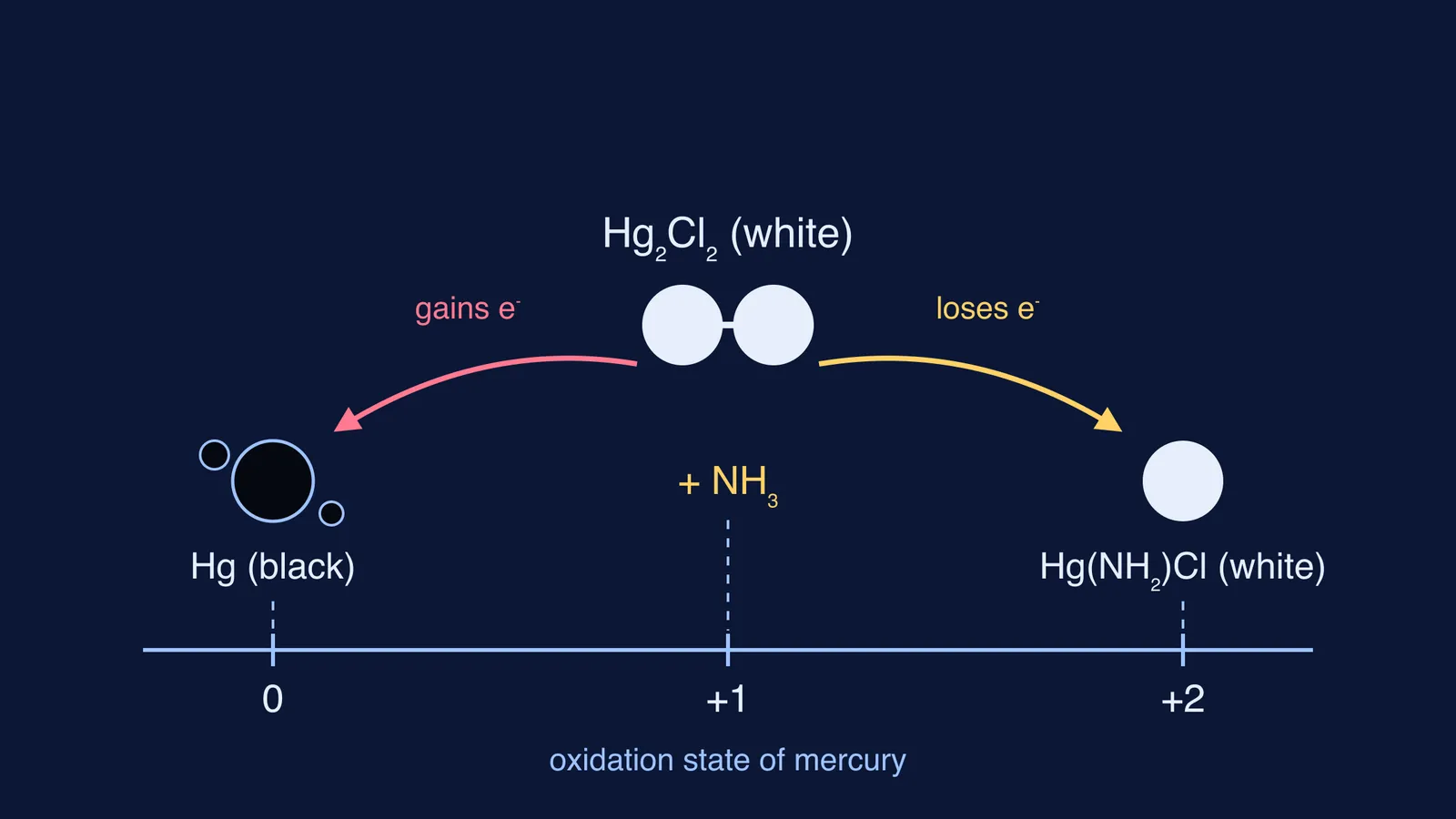
Disproportionation is a reaction in which one species is both oxidised and reduced. In each Hg₂²⁺ unit, one mercury atom drops from +1 to 0 (mercury metal) and the other rises from +1 to +2 (in Hg(NH₂)Cl, mercury(II) amido chloride). The LibreTexts qualitative analysis text by Muhammad Arif Malik/3:_Group_I_cations/3.2:_Separation_and_confirmation_of_Pb2__ion) splits it into two steps: Hg₂²⁺ → Hg(l) + Hg²⁺, then Hg²⁺ + 2NH₃ + Cl⁻ → HgNH₂Cl(s) + NH₄⁺.
If assigning oxidation numbers still feels shaky, our guide on how to tell if a reaction is redox by tracking every element walks through the method.
Why does the precipitate look black and not white?
Hg(NH₂)Cl is white, so the colour comes from the other product. The reaction gives “a spectacular black coloration due to the finely dispersed metallic mercury formed” (Wikipedia: Mercury(I) chloride_chloride)). It is the same element as the shiny liquid in an old thermometer (see why you shake a mercury clinical thermometer), but split into tiny droplets spread through a white solid.
LibreTexts describes the mixture of white HgNH₂Cl and black Hg as appearing grey (LibreTexts/3:_Group_I_cations/3.2:_Separation_and_confirmation_of_Pb2__ion)). So “black”, “grey” and “grey-black” in your record all describe the same positive result.
The name itself is a memory hook: calomel is thought to come from the Greek words for “beautiful” and “black”, though Wikipedia also gives “beautiful” and “honey”, from its sweet taste (Wikipedia_chloride)).
How does this test confirm Hg₂²⁺ in group 1?
Group 1 cations are Hg₂²⁺, Ag⁺ and Pb²⁺, the only common cations that form insoluble chlorides with hydrochloric acid (NTU lab manual). The scheme then separates them like this:
Add HCl: a white precipitate of Hg₂Cl₂, AgCl and PbCl₂ forms.
Add hot water: PbCl₂ dissolves, because its solubility rises about three-fold to roughly 3.2 g per 100 mL at 100 °C while AgCl and Hg₂Cl₂ stay almost insoluble (LibreTexts/3:_Group_I_cations/3.2:_Separation_and_confirmation_of_Pb2__ion)). Potassium chromate then gives yellow PbCrO₄.
Add ammonia to the leftover solid: AgCl dissolves as [Ag(NH₃)₂]⁺, while Hg₂Cl₂ turns black.
Acidify that solution with nitric acid: white AgCl comes back, confirming Ag⁺.
Steps 2 to 4 follow the NTU flow chart. Notice that ammonia does two jobs at once: it pulls silver into solution and marks mercury(I) with a colour you cannot miss. For more on silver halides and ammonia, see how to distinguish chloride, bromide and iodide with silver nitrate.
Worked example: how to answer it in an exam
Question: A group 1 precipitate is treated with ammonia. Part dissolves and the rest turns black. What does this show? Write the equation and prove it is disproportionation.
Black residue: Hg₂²⁺ is present.
Dissolved part: possibly Ag⁺. Confirm by acidifying with HNO₃ and looking for white AgCl.
Oxidation state of Hg in Hg₂Cl₂: two Cl⁻ give −2, shared by two Hg, so each is +1.
In Hg metal: 0. In Hg(NH₂)Cl: NH₂⁻ is −1 and Cl⁻ is −1, so Hg is +2.
One Hg gains one electron (+1 to 0), the other loses one (+1 to +2). The same element is reduced and oxidised, so it is disproportionation.
Equation: Hg₂Cl₂ + 2NH₃ → Hg + Hg(NH₂)Cl + NH₄Cl.
To practise more salt-analysis and redox questions, the Fermi Problem Library has worked problems with a step-by-step solver that explains the reasoning rather than printing an answer. If the gap is the idea of oxidation states itself, the Fermi Concept Library gives each concept its own lesson and its place in the map.
What mistakes cost marks on this test?
Writing mercurous chloride as HgCl. Mercury(I) exists as the Hg₂²⁺ pair, so the formula is Hg₂Cl₂.
Calling the black product an oxide. It is mercury metal mixed with white Hg(NH₂)Cl.
Dropping NH₄Cl (or NH₄⁺ and Cl⁻) from the products, which leaves the equation unbalanced.
Writing “white precipitate dissolves” for mercury. Only the silver chloride dissolves; the mercury residue stays and darkens.
Forgetting safety. Calomel is toxic (Wikipedia_chloride)), and the NTU manual asks for gloves, heating in a fume hood, and pouring residues into a heavy-metal waste container (NTU). Follow your teacher's instructions and never handle these salts at home.
Before your practical, write the four-step group 1 scheme from memory once, with the colour at each step.


