

On this page
A burette reading takes two seconds, and a small slip in it can throw off your whole titre. Get three habits right (where your eye is, which edge of the liquid you read, and how many decimals you write) and your titres start agreeing with each other.
The glass itself is usually precise enough. A 50 mL Class A burette made to ISO 385 has 0.1 mL subdivisions and a tolerance of ±0.05 mL, according to this supplier's specification. A glance from the wrong height can cost you more than that.
Why do you read the bottom of the meniscus?
Water in a glass tube curves up where it touches the wall, and that curved surface is called the meniscus. Volumetric glassware is calibrated so that reading the bottom of the meniscus, viewed at eye level, gives the accurate volume (Harper College lab technique guide).
Two details matter. A burette's scale runs downward, with 0.00 at the top (LibreTexts burette guide, University of Arkansas at Little Rock), so the numbers grow as liquid leaves. And the same guide suggests keeping a dark piece of paper behind the burette, so the bottom of the meniscus stands out.
What is parallax error in a burette reading?
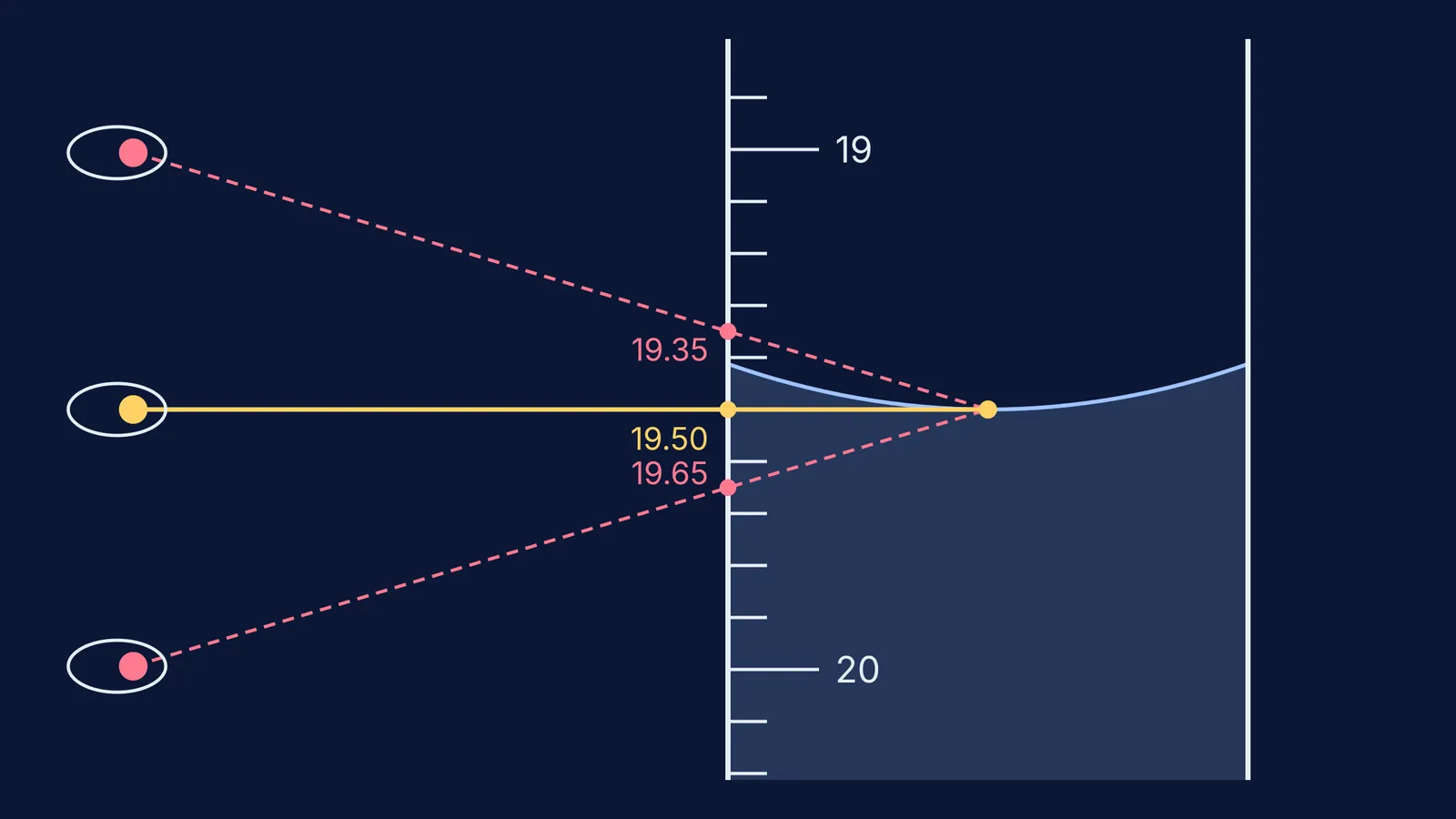
Parallax error is the wrong reading you get when your eye is above or below the liquid level instead of level with it (Phoenix College buret guide). The scale is on the outside of the glass, while the bottom of the meniscus sits in the middle of the tube, so a tilted line of sight meets the scale at the wrong mark.
Because burette numbers increase downward, the error is predictable: look from above and you read too low; look from below and you read too high. Labster's burette guide shows one meniscus giving 19.42 mL from above, 19.50 mL at eye level and 19.62 mL from below. The diagram at the top of this post shows the same geometry.
The fix: move your head, not the burette. Bend your knees or stand up until the bottom of the meniscus is level with your eye.
How do you read a burette with KMnO4?
Potassium permanganate solution is so deep purple that the bottom of the meniscus can be impossible to see. Then you read the top edge instead, and the Phoenix College guide notes that as long as you read it this way each time, the error is negligible. BYJU'S write-up of the oxalic acid practical puts it simply: "Potassium permanganate is dark in colour, so always read the upper meniscus" (BYJU'S oxalic acid and KMnO4 practical).
Why the error disappears: your titre is the final reading minus the initial reading. Reading the top edge shifts both readings by about the same amount, and that shift cancels when you subtract. It only bites if you switch edges between readings.
For the Class 12 redox practical, our guide to the KMnO4 and Mohr's salt titration walks through the full calculation.
How many decimal places should a burette reading have?
Record each reading to the nearest 0.05 mL, with two decimals, such as 22.05, 23.00 or 23.05 mL (Labster burette guide). With 0.1 mL graduations, the second decimal is your estimate: on a line, it ends in 0; clearly between two lines, it ends in 5. Write 23.00, not 23.
Some university courses ask for more. Florida State University's analytical chemistry lab asks students to estimate burette readings to the nearest 0.01 mL (FSU lab procedure). Follow your teacher's convention and keep it the same for every reading.
How do you work out the titre from two readings?
You are titrating with KMnO4, so you read the top edge each time.
Initial reading: the top edge sits midway between the 0.3 and 0.4 lines. Record 0.35 mL.
Final reading: the top edge sits exactly on the 18.6 line. Record 18.60 mL.
Titre: 18.60 − 0.35 = 18.25 mL.
Had you read the final level at the bottom of the meniscus instead, the titre would carry the height of the meniscus as an error. Slips like this stop readings agreeing; see how to take concordant readings in a titration.
What should you check before writing a reading?
Burette clamped vertical, funnel removed.
No air bubble in the tip; rinse and fill as in our burette and pipette rinsing rules.
Liquid on the walls has drained; the FSU procedure allows about 30 s.
Dark card behind the burette.
Eye level with the meniscus.
Same edge as last time.
Two decimals, ending in 0 or 5, written straight into the table.
When the readings are clean but the mole calculation still goes wrong, the Fermi Problem Library has worked problems with a step-by-step solver that explains the reasoning rather than printing an answer. For the redox chemistry behind the end point, the Fermi Concept Library gives each chemistry concept its own lesson.
Before your next practical, write "edge: bottom" or "edge: top" above your table, then take your first reading at eye level.


