

On this page
Most trees hold up their crown on a single trunk. The banyan, *Ficus benghalensis*, grows its own pillars. That trick explains how a single tree in Howrah can spread across about 18,918 square metres, almost two hectares, and still stand a century after losing its trunk.
How does a banyan tree spread?
A banyan spreads by growing roots from its branches. As the Oxford Botanic Garden's Plants 400 profile of *Ficus benghalensis* puts it, aerial roots grow down from the branches to the ground.
Once an aerial root's tip reaches the soil it roots and starts to thicken. Botany Brisbane's guide to fig growth forms defines a banyan as a fig tree with many secondary or prop trunks that develop from aerial roots growing down from the branches.
Each new prop trunk holds up the branch above it, so the branch can keep growing outwards, drop more roots, and repeat. The tree moves sideways, pillar by pillar.
Biologists call these prop roots, and they count as a root modification for support. If the difference between a taproot and the roots a banyan grows is fuzzy, our guide to taproot vs fibrous root systems sorts out the basic types first.
How does a banyan start life on another tree?
Many banyans do not begin in soil at all. Birds and mammals eat the figs and scatter the seeds, according to the Oxford profile.
A seed dropped in the fork of another tree can sprout there. Botany Brisbane describes such figs as starting as an epiphyte with aerial roots that, on reaching the ground, root and thicken into trunks. *Ficus benghalensis* is on its list of strangler figs, because those roots can form a network around the host that gradually strangles it.
Why does a banyan need one tiny wasp?
A fig is not really a fruit at first. It is a hollow ball lined with tiny flowers, sealed except for one small opening called the ostiole, as Renee Borges explains in a 2021 review in Frontiers in Ecology and Evolution.
The banyan's pollinator is a fig wasp, the agaonid *Eupristina masoni*, according to the Oxford profile. The cycle, as the Borges review describes it for pollinating fig wasps, runs like this:
A female, called a foundress, carries pollen from her birth fig into a new one through the ostiole.
Inside, she lays eggs in some flowers and leaves pollen on the stigmas, then dies in that fig.
Her young grow inside the flowers. The males are usually wingless and never leave the fig.
The new females exit through the ostiole carrying pollen to a fig on another tree.
The two depend on each other: usually one wasp species pollinates one fig species, the Oxford profile notes. A study in Systematic Biology by Astrid Cruaud and colleagues sampled nearly 200 interacting fig and wasp species pairs and called the partnership an extreme case of long-term co-diversification among plant-insect interactions. Our post on the yucca and its moth shows another flower that depends on one insect.
How did the Great Banyan survive losing its trunk?
The Great Banyan grows in the Acharya Jagadish Chandra Bose Indian Botanic Garden in Howrah, which Col. Robert Kyd started in 1787. Every figure in this section comes from the Botanical Survey of India's page for the garden.
The tree is over 270 years old. Two great cyclones, in 1864 and 1867, broke some of its main branches and opened it to fungus. In 1925 its main trunk, 16 m in girth, had to be removed after it was infected by wood-rotting fungus.
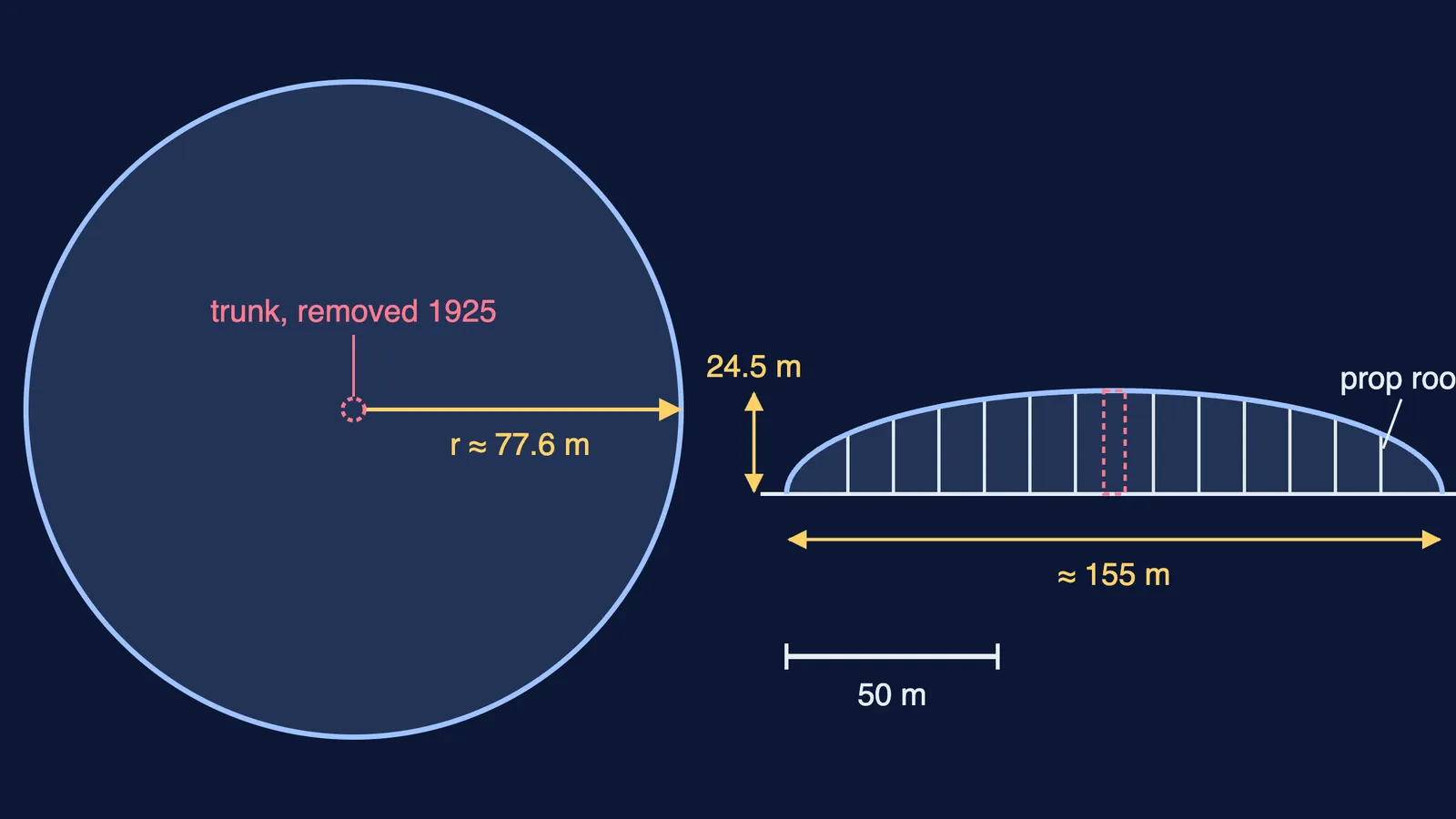
The tree survived because by then it no longer depended on that trunk. The Botanical Survey of India counts 4,033 aerial roots now reaching the ground as prop roots. The crown has a circumference of 486 m, the highest branch rises to 24.5 m, and the tree covers about 18,918 square metres. What looks like a grove from the path is one tree.
Worked example: check the Great Banyan's size yourself
You can test the official numbers with Class 7 circle formulas. Treat the crown as a circle with circumference C = 486 m.
Radius: r = C / 2π = 486 / 6.283 ≈ 77.4 m.
Area: A = πr² = 3.1416 × 77.4² ≈ 18,800 m².
Compare: the official area is 18,918 m², so the circle model is within 1%.
Shape: the crown is about 155 m across but its highest branch is only 24.5 m up, so it is roughly six times wider than it is tall.
Notice the gap's direction. For a fixed perimeter a circle encloses the most area, so an irregular crown 486 m round should cover less than 18,800 m², not more. The gap most likely comes from how the two figures were measured or rounded. To revise root modifications or mutualism before an exam, the Fermi Concept Library gives every concept in biology its own lesson and its place in the map.
Next time you pass a banyan, look for roots that have not yet touched the ground. Those are the tree's next trunks.


