

On this page
You can almost watch some bamboo grow. A 2022 study in The Plant Cell reports Moso bamboo (Phyllostachys edulis) growing at 114.5 cm per day (Chen et al., 2022). That is more than a metre between one breakfast and the next, from a plant that is, botanically, a grass.
How fast does bamboo grow?
Moso bamboo can grow 114.5 cm in a day, according to the 2022 study (Chen et al., 2022, The Plant Cell). Treat it as a rate for fast-growing shoots, not something every bamboo does every day. To study how, the team examined more than 12,750 internodes (the segments between the joints) on more than 510 culms from 17 Moso populations.
Bamboos form the grass subfamily Bambusoideae, inside the grass family Poaceae (Calderón and Soderstrom, Smithsonian Contributions to Botany, 1980). Our explainer on why bamboo counts as a grass covers the basics.
How can a plant grow a metre in a day?
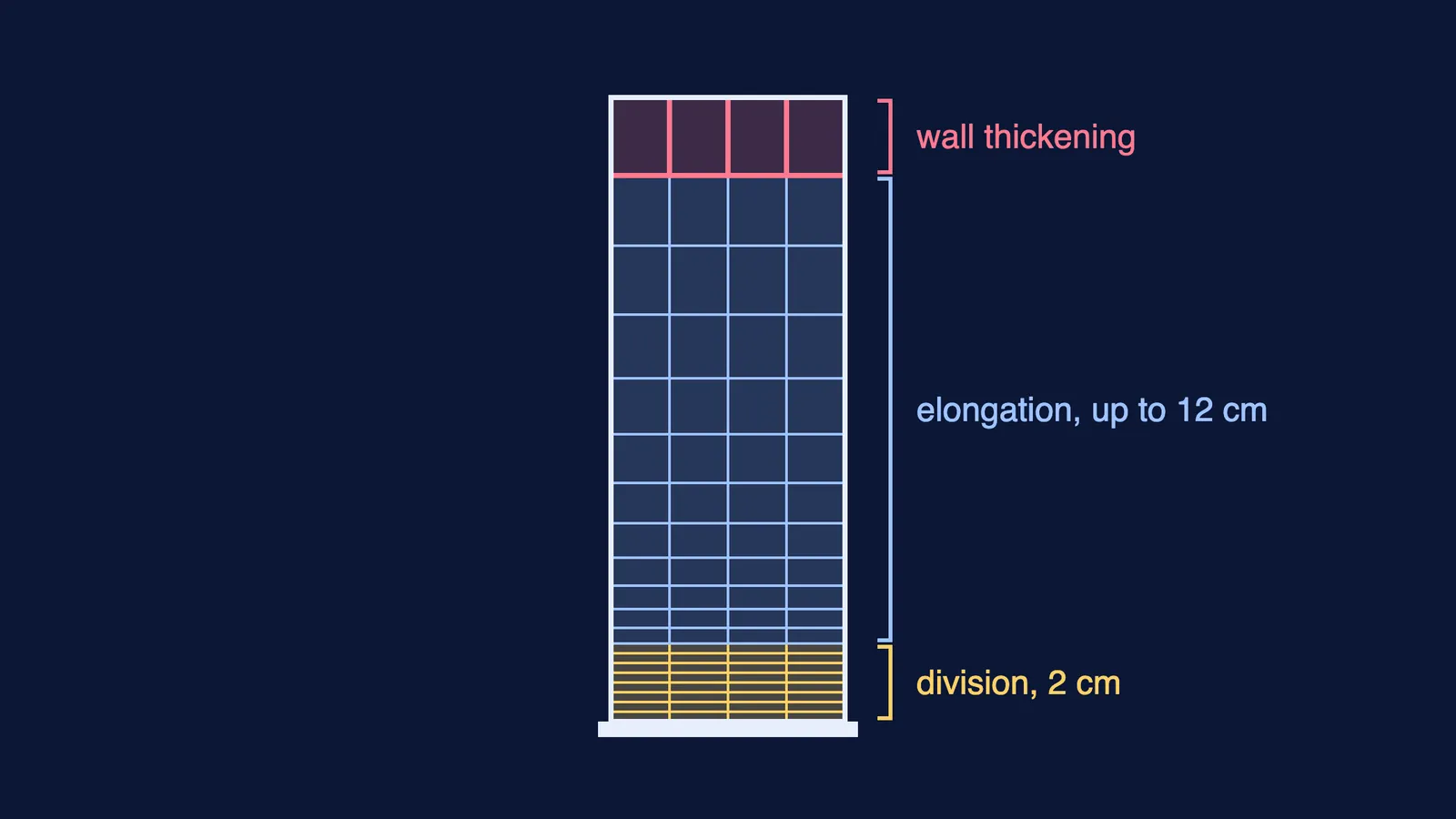
Bamboo does not build its height one new cell at a time at a single tip. Chen's team picked internode 18 as representative of rapid growth and found three zones inside it: a 2 cm cell division zone, a cell elongation zone of up to 12 cm, and a zone where the cell walls thicken (Chen et al., 2022).
In a single day those zones lengthened by 11.8 cm and produced about 570,000,000 cells (Chen et al., 2022).
Cells divide in a short band, lengthen in the elongation zone, then are locked into shape as lignin and cellulose build up in their walls. A plant cell stretches as water pressure pushes on its wall; our post on turgor pressure and why plants wilt explains that pressure.
The hormones are still being worked out. The study's results suggest gibberellin may directly trigger the rapid growth of Moso shoots, and that falling cytokinin with rising auxin may set off elongation (Chen et al., 2022). Note the word may: these are leads, not a settled mechanism.
Worked example: what 114.5 cm a day means
Take the rate from Chen et al., 2022 and break it into smaller units.
Per hour: 114.5 cm divided by 24 hours is about 4.8 cm every hour.
Per minute: 4.8 cm divided by 60 is about 0.8 mm a minute, or 8 mm in ten minutes.
Per second: 1,145 mm divided by 86,400 seconds is about 0.013 mm, or 13 micrometres, each second.
Cells: 570,000,000 cells divided by 86,400 seconds is about 6,600 new cells every second in one internode.
Segments: one internode lengthened 11.8 cm in a day, and 114.5 divided by 11.8 is about 10. If every growing internode kept pace with internode 18, about ten would need to be lengthening at once, like a telescope opening. That last step is our arithmetic, not a figure from the paper.
Why does bamboo flower only once in decades?
Many bamboo species flower and seed together at long, regular intervals, some as long as 120 years (Veller, Nowak and Davis, 2015, Ecology Letters).
The same paper gives the two usual explanations for these mass seedings, called masts: they are thought to overwhelm seed predators with more seed than they can eat, or to raise pollination rates (Veller et al., 2015).
Their mathematical model proposes how such long intervals could evolve in two steps. First, a population that flowers mostly every year synchronises onto a short interval of a few years. Then that interval is multiplied in successive small steps until it becomes very long. Historical flowering records strongly support the model's prediction that intervals break into small prime factors (Veller et al., 2015).
What happens when bamboo flowers in Mizoram?
In Mizoram, the flowering of Melocanna baccifera, locally called mautuk, and the destruction that follows are known as mautam, from mau (bamboo) and tam (death) (Mongabay India, March 2026). The species makes up nearly 90% of the bamboo growing stock there, and it flowers, fruits and dies after a lifespan of 48 to 50 years.
The nutrient-rich fruit sets off a boom in rats, which then damage crops in the fields. The same report counts 130,621 households across 769 villages affected in the 2007-08 mautam, with paddy losses of 89.76%.
How do you use bamboo in a biology answer?
A checklist for a test answer or project:
Name the plant correctly: bamboo is a grass (Poaceae, subfamily Bambusoideae).
Separate division from elongation: the height comes mostly from cells lengthening in many internodes at once.
Name hormones carefully: for bamboo, say the 2022 study suggests a role for gibberellin rather than proves one.
Quote a number with units and source: 114.5 cm per day, Moso bamboo, Chen et al. 2022.
For flowering, give both ideas (overwhelming seed predators, better pollination) and one Indian example, mautam.
If gibberellins, auxins and cytokinins blur together, the Fermi Concept Library lets you check what each one does. If conversions trip you up, Fermi's AI tutor can work out what you already know and build a plan for the session.
Next time you pass a bamboo grove, try it yourself: how many millimetres has it grown since you left home?


