

On this page
Many mistakes with the area of a parallelogram don't come from the formula. They come from multiplying the right base by the wrong length. This post shows you how to pair each base with its height, how to find the second height when a question asks for it, and why the slanted side is not the height.
Which height do you use with which base?
The rule comes in two parts. First, Illustrative Mathematics' Grade 6 lesson on bases and heights says "we can choose any of the four sides of a parallelogram as the base." Second, the same lesson says "a base and its corresponding height must be perpendicular to each other."
The height is the perpendicular distance from the base to the side opposite it. Henry Africk's open geometry text on LibreTexts/06%3A_Area_and_Perimeter/6.02%3A_The_Area_of_a_Parallelogram) gives the theorem in one line: the area of a parallelogram equals its base times its height, A = bh.
In practice:
Pick a side and call it the base.
Find the segment that meets that side (or the line it lies on) at 90° and reaches the opposite side.
Multiply those two. Don't use any other length.
A parallelogram has two pairs of parallel sides, so it has two base-height pairs. Both pairs give the same area, because it's the same shape.
Why is the slant side not the height?
Picture a stack of notebooks pushed sideways so it leans. The stack is just as tall as before, and each notebook still covers the same patch of table. But the slanted edge is now longer than the stack's height. A parallelogram behaves the same way. The slanted side measures the lean. The height measures the gap between the two parallel sides, and that gap is what sets the area.
In trigonometry terms, if the angle between the base and the slanted side is θ, the height is slanted side × sin θ. Since sin θ is less than 1 for any angle other than 90°, the height is always shorter than the slanted side, except in a rectangle.
The Illustrative Mathematics lesson adds a point that catches students on flatter shapes: a height can sit outside the parallelogram, as long as it is drawn at 90° to the base. You then measure it to the line the base lies on, extended.
How do you find the other height of a parallelogram?
Use the area twice. Since A = bh works for either pair (Africk's theorem/06%3A_Area_and_Perimeter/6.02%3A_The_Area_of_a_Parallelogram) applies to any side you choose as the base), you get:
base 1 × height 1 = base 2 × height 2
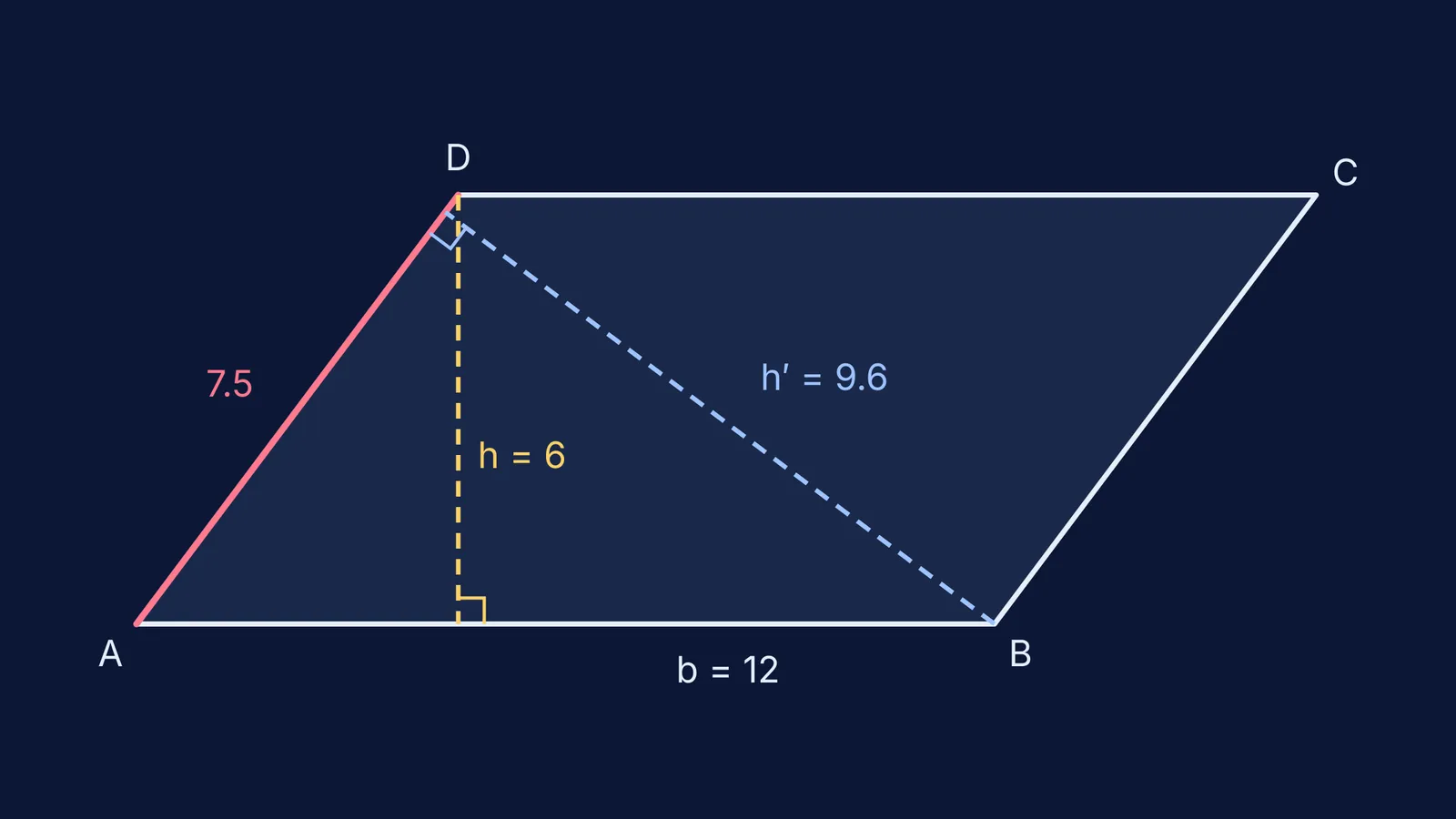
Worked example. Parallelogram ABCD has AB = 12 cm and AD = 7.5 cm. The perpendicular from D to AB is 6 cm. Find the area and the height onto AD.
Pair base AB with its own height: area = 12 × 6 = 72 cm².
Now treat AD as the base. Its height h′ satisfies 7.5 × h′ = 72.
So h′ = 72 ÷ 7.5 = 9.6 cm.
Check: the shorter side has the longer height (7.5 cm pairs with 9.6 cm, 12 cm pairs with 6 cm). That always happens, because the two products must match.
Check against the callout: 6 < 7.5 and 9.6 < 12, so both heights pass.
The slant-side trap gives 12 × 7.5 = 90 cm², which is 18 cm² too much. Nothing in that wrong working looks wrong, which is why it costs marks.
The same habit of pairing helps elsewhere. Our post on comparing triangle areas when the height is shared uses the same idea in reverse, and splitting a regular hexagon into triangles needs each triangle's height chosen correctly.
A 30-second checklist before you multiply
Mark the base you are using and underline it.
Draw the height as a dashed line with a right-angle box where it meets the base.
If the dashed line falls outside the shape, extend the base and measure from there.
Make sure your height is shorter than the slanted side next to it.
Asked for a second height? Divide the area by the other base.
Write the units as cm² or m², and convert before multiplying if the sides use different units. Our guide to why 1 square metre is 10,000 cm² covers the common slips.
If the pairing still feels shaky, it helps to see the steps written out with the reasoning, not just the answer. The Fermi Problem Library has worked problems with a step-by-step solver that explains the reasoning rather than printing an answer. If the gap is the idea of perpendicular distance itself, the Fermi Concept Library gives each mathematics concept its own lesson.
Next time you see a parallelogram, find the right angle first, then multiply.


