

On this page
Atoms are too light to weigh in kilograms. A single carbon-12 atom has a mass of about 0.0000000000000000000000000199 kg. Instead of carrying around these tiny numbers, chemists and physicists measure atoms using a relative scale.
But until 1961, there was a quiet debate over what that scale should be. Physicists based their measurements on the pure oxygen-16 isotope, while chemists used the average mass of natural oxygen. This discrepancy caused a headache for high-precision calculations. The solution was a compromise that defined the atomic mass unit we use today.
What is the unified atomic mass unit?
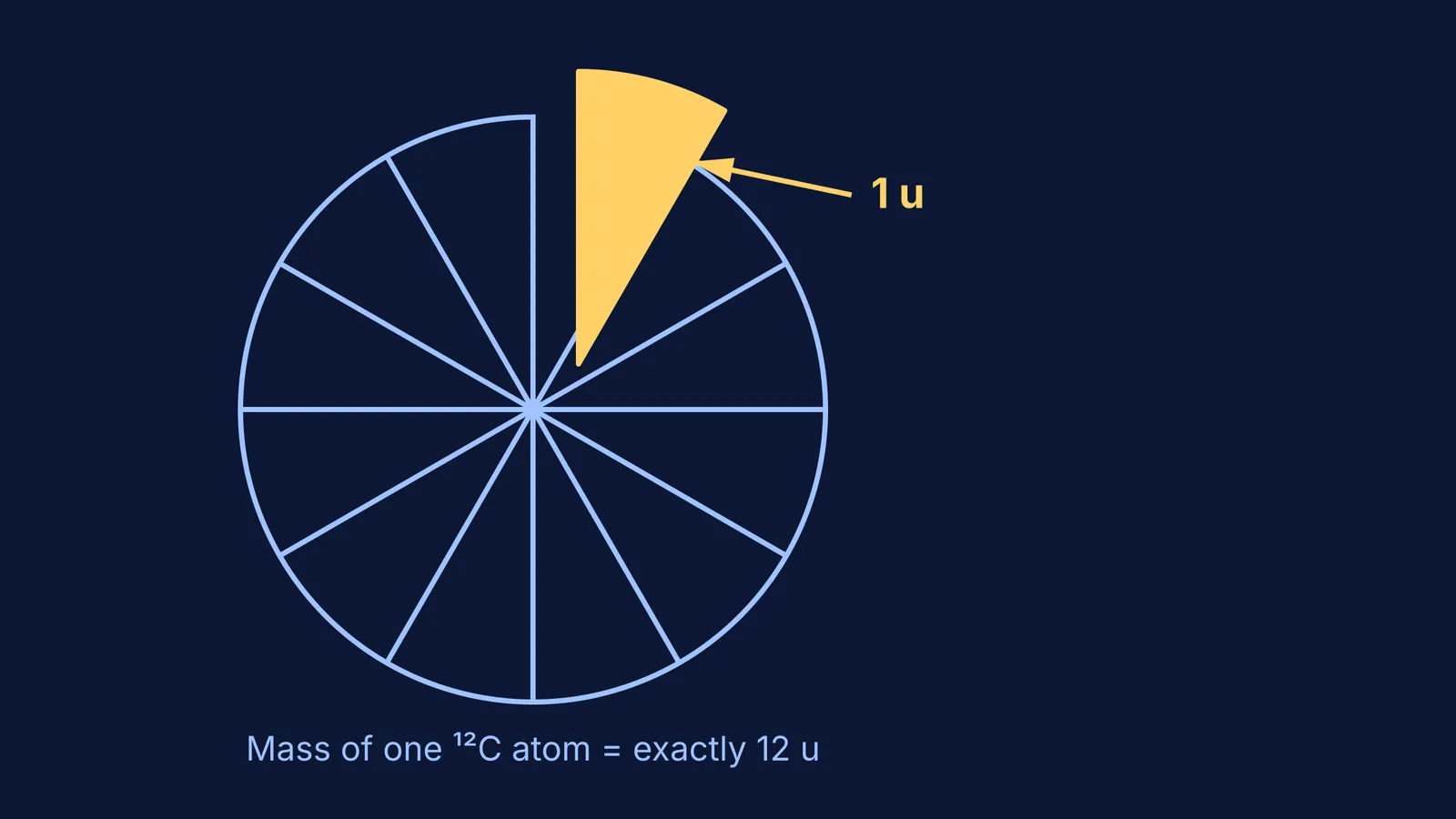
The unified atomic mass unit (symbol: u), also known as the dalton (Da), is the standard unit of mass for atoms and molecules. It is defined as exactly one-twelfth of the mass of an unbound neutral atom of carbon-12 at rest and in its ground state (IUPAC Gold Book, 2014).
Because a single carbon-12 atom is defined to weigh exactly 12 u, the mass of one unit in standard metric units must be found by experiment. The current recommended value for the unified atomic mass unit is 1.66053906892 × 10^{−27} kg (CODATA/NIST, 2022).
Why was carbon-12 chosen as the standard?
Before 1961, the "oxygen scale" was used, but it had a fatal flaw. Physicists defined one atomic mass unit as exactly 1/16 of the mass of a pure oxygen-16 atom. Chemists, however, defined it as 1/16 of the average mass of natural oxygen, which contains trace amounts of the heavier isotopes oxygen-17 and oxygen-18.
Because the two scales were based on different references, they disagreed by about 275 parts per million (Cameron & Wichers, Journal of the American Chemical Society, 1962). A molecular weight measured by a physicist was numerically different from the same weight measured by a chemist.
To resolve this, scientists proposed a new scale based on carbon-12. As noted in the official 1961 report that implemented the change, adopting the carbon-12 scale required the old chemical atomic weights to be decreased by only 42 parts per million. This 42 ppm shift was so small that nearly all existing chemical data and laboratory procedures could remain unchanged, while still giving physicists the pure isotopic standard they needed for mass spectrometry.
How does relative atomic mass follow from the carbon-12 scale?
While the atomic mass unit gives us a way to measure the absolute mass of a single particle, chemistry usually deals with bulk substances. For this, we use relative atomic mass, commonly known as atomic weight.
Relative atomic mass is defined as the ratio of the average mass of an atom of an element to the atomic mass constant, m_u (IUPAC Gold Book, 2014). Because the atomic mass constant is exactly 1 u (or one-twelfth the mass of carbon-12), relative atomic mass simply tells you how many times heavier an average atom is compared to 1 u.
Because it is a ratio of two masses, relative atomic mass has no units.
For example, natural carbon on Earth is a mixture of about 98.9% carbon-12 and 1.1% carbon-13 (CIAAW, 2009). When you average these isotopes together, the relative atomic mass of natural carbon is 12.011.
Which mass unit should you choose for calculations?
When learning physics from first principles or solving mole concept numericals, confusing these terms is a common trap. If you are calculating masses for an exam, use this checklist to pick the right value:
Atomic mass (u): Use this when the problem asks for the mass of a single specific atom or isotope (like in a build an atom simulation).
Relative atomic mass: Use this dimensionless number when dealing with the average mass of an element as found in nature.
Molar mass (g/mol): Use this when calculating the mass of a bulk powder or gas in the laboratory.
If you frequently lose marks because you used the wrong mass, the Fermi Problem Library explains these differences step by step in the context of the problem, so you know exactly which value to use next time.


