

On this page
Drop a piece of sodium into liquid ammonia and it does not fizz the way it does in water. It dissolves, and the liquid turns a deep, inky blue. Add more metal and the blue gives way to a shiny bronze. It is a classic s-block question in school chemistry and JEE practice.
Why is a solution of sodium in liquid ammonia blue?
When an alkali metal dissolves, each atom splits into a cation and an electron, and ammonia molecules crowd around both: M + (x + y)NH3 gives [M(NH3)x]+ and [e(NH3)y]-. The second species is the ammoniated electron. LibreTexts/09%3A_Non-aqueous_media/9.06%3A_Liquid_Ammonia/9.6D%3A_Solutions_of_s-block_Metals_in_Liquid_NH) describes it as an electron not attached to any single atom, loosely held in a cavity in the ammonia that is stabilised by hydrogen bonds.
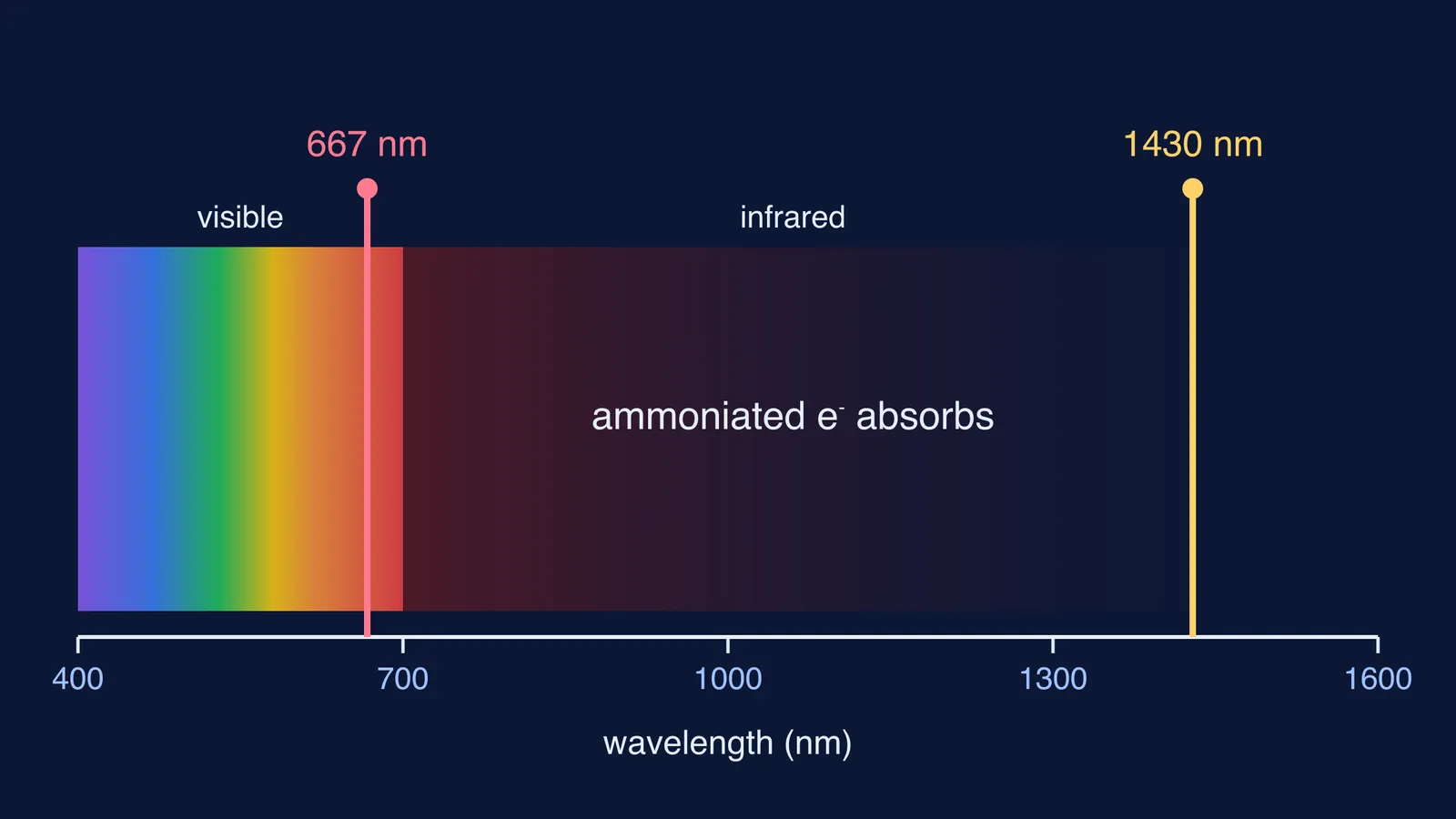
A trapped electron has energy levels, like a particle in a box, so it can absorb light. A 1981 paper on sodium-ammonia solutions in the Bulletin of the Korean Chemical Society, summing up earlier optical spectroscopy, notes two intense absorption bands, at 7,000 and 15,000 cm-1. A 2009 review of lithium-ammonia solutions in Angewandte Chemie by Eva Zurek, Peter Edwards and Roald Hoffmann found from calculations that the absorption has a tail extending into the visible, and that this tail is the source of the "fine blue colour" Humphry Davy first saw just over 200 years before their paper.
How do you turn the absorption bands into a colour?
You can check the colour yourself with one formula, wavelength = 1 / wavenumber, using the two bands from the Lee and Jhon paper.
Band one: 1 / 15,000 cm-1 = 6.67 x 10^-5 cm = 667 nm. That is red light.
Band two: 1 / 7,000 cm-1 = 1.43 x 10^-4 cm = 1,430 nm. That is infrared, which your eye cannot see.
Energy of the red band: E (eV) = 1240 / 667 = 1.86 eV.
The solution removes the red end of white light. What reaches your eye is mostly the other end of the spectrum, so the solution looks blue.
Why is the blue solution paramagnetic?
Paramagnetism needs unpaired electrons, and each ammoniated electron is a lone electron with its own spin. The Lee and Jhon paper states that very dilute solutions show paramagnetism caused by the unpaired electrons, and that the molar paramagnetic susceptibility falls rapidly as concentration rises because diamagnetic species form.
Those diamagnetic species are electron pairs. Two ammoniated electrons can pair their spins; Lee and Jhon argue that a metal cation is probably involved, to reduce the repulsion between them. In the same paper, unpaired solvated electrons dominate below a metal mole fraction of about 0.001, and spin-paired species dominate above it.
The blue solution has two more properties you should know:
It conducts electricity well. LibreTexts/09%3A_Non-aqueous_media/9.06%3A_Liquid_Ammonia/9.6D%3A_Solutions_of_s-block_Metals_in_Liquid_NH) says it conducts about 10 times better than aqueous NaCl, because the solvated electrons move easily.
It is not stable for ever. The metal reacts with ammonia to give hydrogen gas and the metal amide (NH2- salt), as LibreTexts notes.
Why does it turn bronze at high concentration?
According to LibreTexts/09%3A_Non-aqueous_media/9.06%3A_Liquid_Ammonia/9.6D%3A_Solutions_of_s-block_Metals_in_Liquid_NH), solutions of about 3 M or less are deep blue, and above 3 M the colour changes to metallic bronze or gold, with conductivity comparable with that of pure liquid metals.
What changes is where the electrons live: they stop sitting in separate cavities and spread through the liquid, as in a metal. The Lee and Jhon paper sums up the sequence as paramagnetic solvated electrons, then diamagnetic pairs, then metallic free electrons.
In 2020 this change was watched directly. A team led by Pavel Jungwirth reported in Science photoelectron spectra of lithium, sodium and potassium in liquid ammonia microjets. They found a gradual transition from a dilute electrolyte of paired dielectrons to a delocalised metallic structure at the highest concentrations. The Czech Academy of Sciences describes the concentrated bronze solution as having conductivity comparable to a copper wire.
How do you write this up in an exam?
Use this comparison as your short answer.
Dilute solution: deep blue; ammoniated electrons absorb red light; paramagnetic, because the electrons are unpaired; conducts well.
Rising concentration: electrons pair up, so paramagnetism per mole falls.
Concentrated solution (above about 3 M): bronze, metallic lustre; electrons delocalise like a metal; conductivity like a liquid metal.
On standing: hydrogen gas is given off and the metal amide forms.
The key species: [e(NH3)y]-, the ammoniated electron.
If the cavity idea still feels shaky, the Fermi Concept Library has a lesson for each concept in chemistry, so you can revisit electron configuration or light absorption first. To practise problems on these solutions, the Fermi Problem Library has worked problems with a step-by-step solver that explains the reasoning rather than printing an answer.
Next time you see "deep blue" in a question, ask where the electron is and whether it is alone. Answer that and the colour, the magnetism and the bronze all follow.


