

On this page
Degrees of comparison are a standard part of primary-school English grammar, and they keep coming back in later classes. The rules fit on one page, and the same few mistakes come up again and again: "more taller", "gooder", "bigest", or forgetting "than". This guide gives the rules, the irregular words to learn by heart, and a short practice plan you can run at home.
What are the three degrees of comparison?
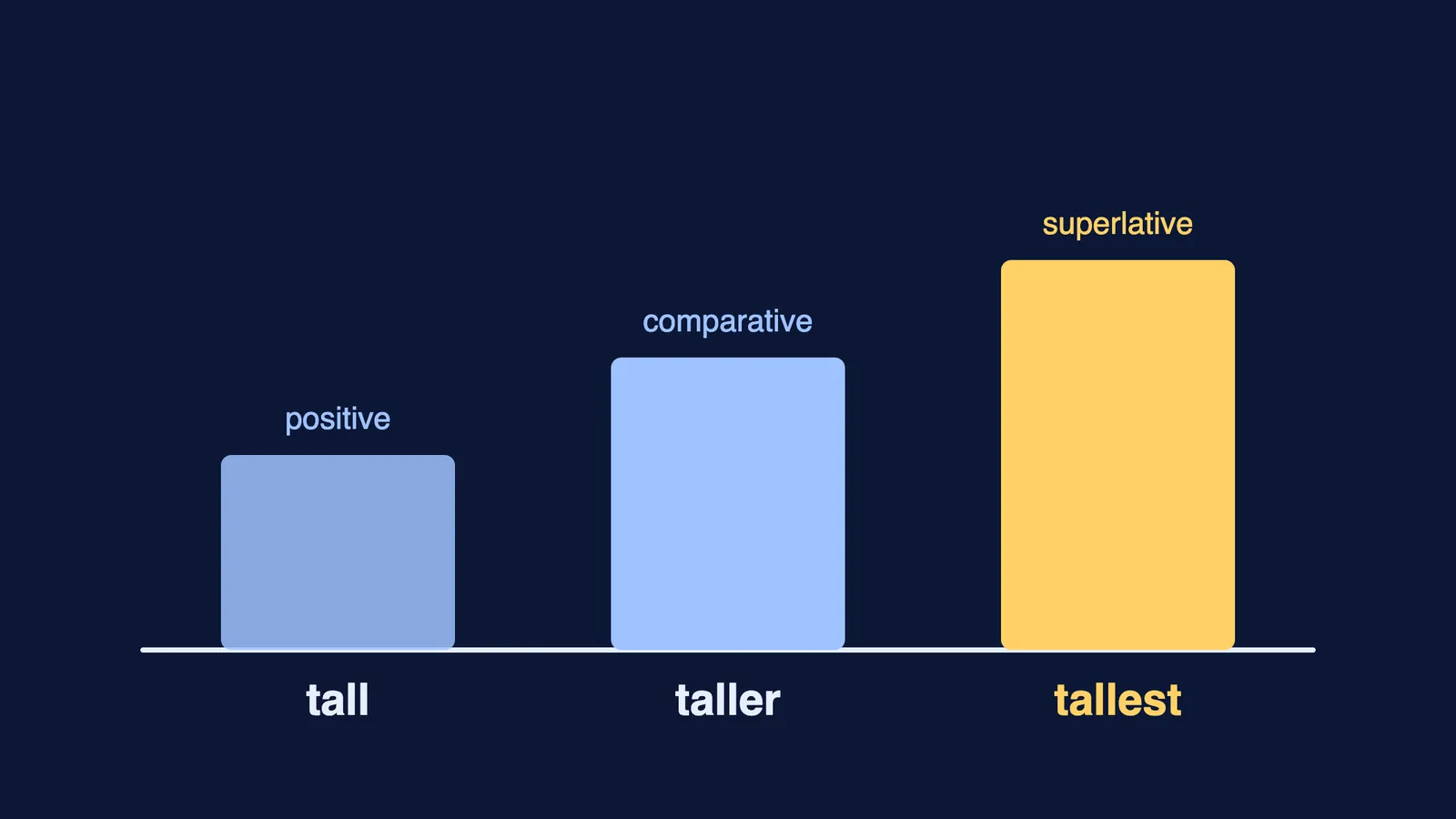
An adjective is a describing word, and it can describe at three levels.
Positive degree: the plain adjective, with no comparison. Meena is tall.
Comparative degree: compares two people or things. Meena is taller than Ravi.
Superlative degree: picks one out of three or more. Meena is the tallest girl in the class.
The British Council's LearnEnglish grammar reference says we use "than" when we compare one thing with another, and "the" with superlative adjectives. So a comparative usually travels with "than", and a superlative with "the".
When do you add er and est, and when do you use more and most?
Count the syllables (the beats) in the adjective first. Then follow these rules, from the British Council's grammar reference and the Cambridge Dictionary blog:
One syllable: add -er and -est. Old, older, oldest. Long, longer, longest.
Ending in -e: add only -r and -st. Large, larger, largest. Nice, nicer, nicest.
One syllable ending in a single short vowel and a consonant: double the consonant. Big, bigger, biggest. Fat, fatter, fattest.
Ending in a consonant and -y: change y to i, then add -er or -est. Happy, happier, happiest.
Most two-syllable adjectives: use more and most. Careful, more careful, most careful.
Three or more syllables: always more and most. Interesting, more interesting, most interesting.
Some two-syllable adjectives can go either way, such as gentle, narrow, simple and polite (gentler or more gentle). The Cambridge Dictionary blog gives a useful tip for these: if you are unsure, more and most are the safest choice for two-syllable words.
Which adjectives are irregular?
A few common adjectives change completely and simply have to be learnt. The British Council's grammar reference lists three:
good, better, best
bad, worse, worst
far, farther or further, farthest or furthest
School grammar books usually add the words of quantity. Wiktionary's entries give many and much as more and most, and little, for an amount, as less and least.
many, more, most (things you can count: many books)
much, more, most (things you cannot count: much water)
little, less, least (an amount: little time)
Put these six lines on a sticky note by the study table.
How do you change the degree of a sentence?
Worksheets at this level often ask you to rewrite one sentence in all three degrees without changing its meaning. Here is a worked example, step by step.
Start with the superlative: Mount Everest is the highest mountain in the world.
Comparative: keep the subject, change the adjective to its comparative and add "than any other". Mount Everest is higher than any other mountain in the world.
Positive: begin with "No other", and put the plain adjective between "as" and "as". No other mountain in the world is as high as Mount Everest.
Note "any other" in the comparative. "Higher than any mountain" would include Everest itself, which makes no sense.
Comparison words come back in maths word problems too ("5 more than", "the greatest number"). If the trouble there is the maths idea rather than the English, the Fermi Concept Library covers every concept in mathematics, each with its own lesson and its place in the map.
How can you practise degrees of comparison at home?
Ten minutes, three times a week, is a manageable routine to start with. You do not need fluent English to run this; our guide on helping your child with English when you are not fluent has more ideas.
Sort (3 minutes). Say ten adjectives (cold, hot, kind, funny, beautiful, useful, good, bad, wide, thin). Your child sorts them into five groups: -er/-est, -r/-st, double the letter, y to i, more/most. Good and bad go in a sixth "learn by heart" group.
Compare real things (4 minutes). Use what is at home: three bottles, three pencils, three family members. "The steel bottle is heavier than the plastic one. The copper one is the heaviest."
Change the degree (3 minutes). One sentence from the textbook, rewritten in all three degrees, out loud first and then written.
A script for when your child writes "more better": "Better already means more good. Do we need both?" Let them fix it themselves.
Watch for comparisons in the stories they read as well; our post on improving your Class 5 child's reading comprehension shows how to turn a chapter into short questions. And if you are deciding how much to sit beside them during homework, see whether a Class 5 child should do homework alone.


