

On this page
When you look closely at a flower, its shape is rarely random. The arrangement of petals and sepals, known as floral symmetry, is a crucial trait that determines how a plant interacts with pollinators. For biology students, understanding the difference between actinomorphic, zygomorphic, and asymmetric flowers is a standard requirement.
But floral symmetry is not just a classification exercise—it is an evolutionary strategy that dictates how long a flower lives and which insects can land on it.
What are actinomorphic and zygomorphic flowers?
The vocabulary of floral symmetry relies on how many ways you can slice a flower to get identical halves.
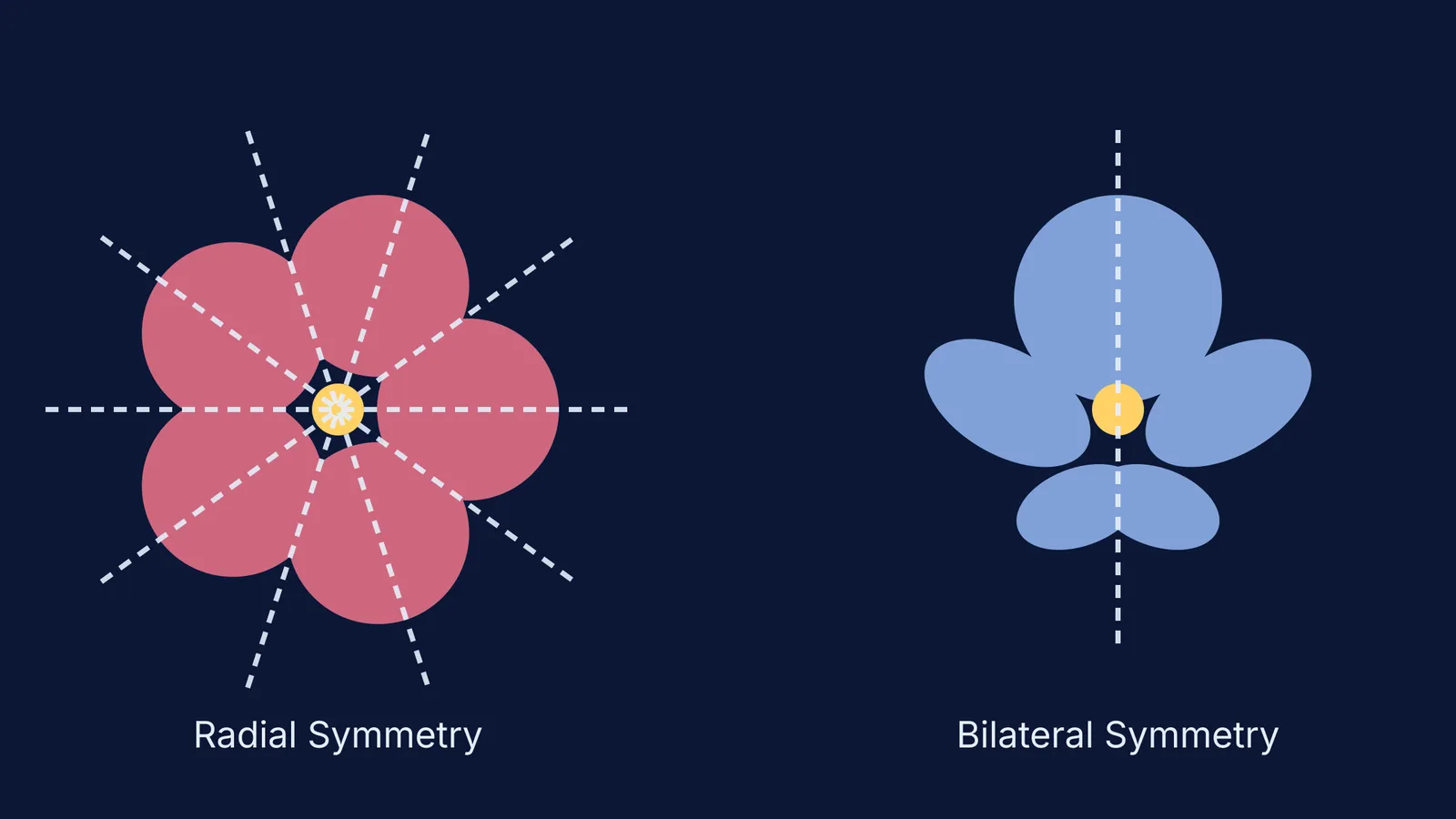
Actinomorphic flowers are radially symmetrical, meaning they can be divided into two equal, mirror-image halves by any vertical plane passing through the center. Think of a wheel with spokes or a star. Because the petals radiate outwards equally, insects can approach an actinomorphic flower from any direction.
Zygomorphic flowers are bilaterally symmetrical, meaning they can be divided into two equal halves by only one specific vertical plane. They have a distinct top and bottom, much like a person's face. This shape forces pollinators to approach from a specific angle, ensuring that pollen is deposited in precisely the right spot on the insect's body.
What are examples of actinomorphic and zygomorphic flowers?
If you are studying plant morphology, knowing the classic examples of each symmetry type is essential.
Common examples of actinomorphic flowers include mustard, datura, and chilli. These plants produce star-shaped blooms that invite a wide variety of unspecialised pollinators to land from any side.
Common examples of zygomorphic flowers include pea, gulmohar, bean, and cassia. The pea flower, for instance, has a large standard petal at the top, two wing petals on the sides, and two fused petals forming a keel at the bottom. This complex structure is a specialised landing pad for specific bees.
Why do zygomorphic flowers last longer?
Because zygomorphic flowers restrict how an insect can land, they are often visited by fewer, but more specialised, pollinators. This evolutionary trade-off means the flower might have to wait longer for the right insect to arrive.
To compensate for this, plants with bilateral symmetry tend to keep their flowers open for a longer duration. A 2024 study published in Biology Letters analysed 1,452 plant species across 168 families. It found that zygomorphic flowers last on average 1.1 days longer than actinomorphic flowers, which represents a 26.5% increase in floral longevity. By staying open longer, these flowers balance the reduced rate of visits against the higher quality of pollen transfer they achieve when the correct pollinator finally lands.
Why is Canna asymmetric?
While most flowers follow radial or bilateral plans, a few refuse to be divided evenly at all. These are called asymmetric or irregular flowers.
A flower is asymmetric if it cannot be divided into two equal halves by any vertical plane passing through the center. The classic example is the canna lily (Canna). Its petals and stamens are unequal in size and arranged in a spiral, meaning no single cut will produce mirror images.
How Fermi can help
When you encounter hundreds of terms and examples in botany, memorisation alone often falls short. If you're revising plant morphology, the Fermi Concept Library has every concept in physics, chemistry, biology, mathematics and computing, each with its own lesson and its place in the map.
Instead of just answering questions, Fermi's AI tutor teaches. If you're confused about how a zygomorphic pea flower's structure relates to its aestivation (how petals are folded in the bud), the tutor works out what you already know and builds a plan for the session, so you sit down to a clear next step. You can ask it to explain the evolutionary reasons behind parthenocarpy or floral symmetry, and it will check your understanding as it goes.


