

On this page
Writing a spelling, formula or definition ten times feels productive and works poorly. Copying keeps the answer in front of you the whole time, so your memory never has to produce it. A better method makes you produce the line from memory, check it, and repeat only the part you got wrong.
Does writing something 10 times help you memorise it?
Less than it feels, because copying is only re-exposure. No study we found tests ten copies directly, but the closest research compares rereading with recalling, and rereading loses once the test is more than a few minutes away.
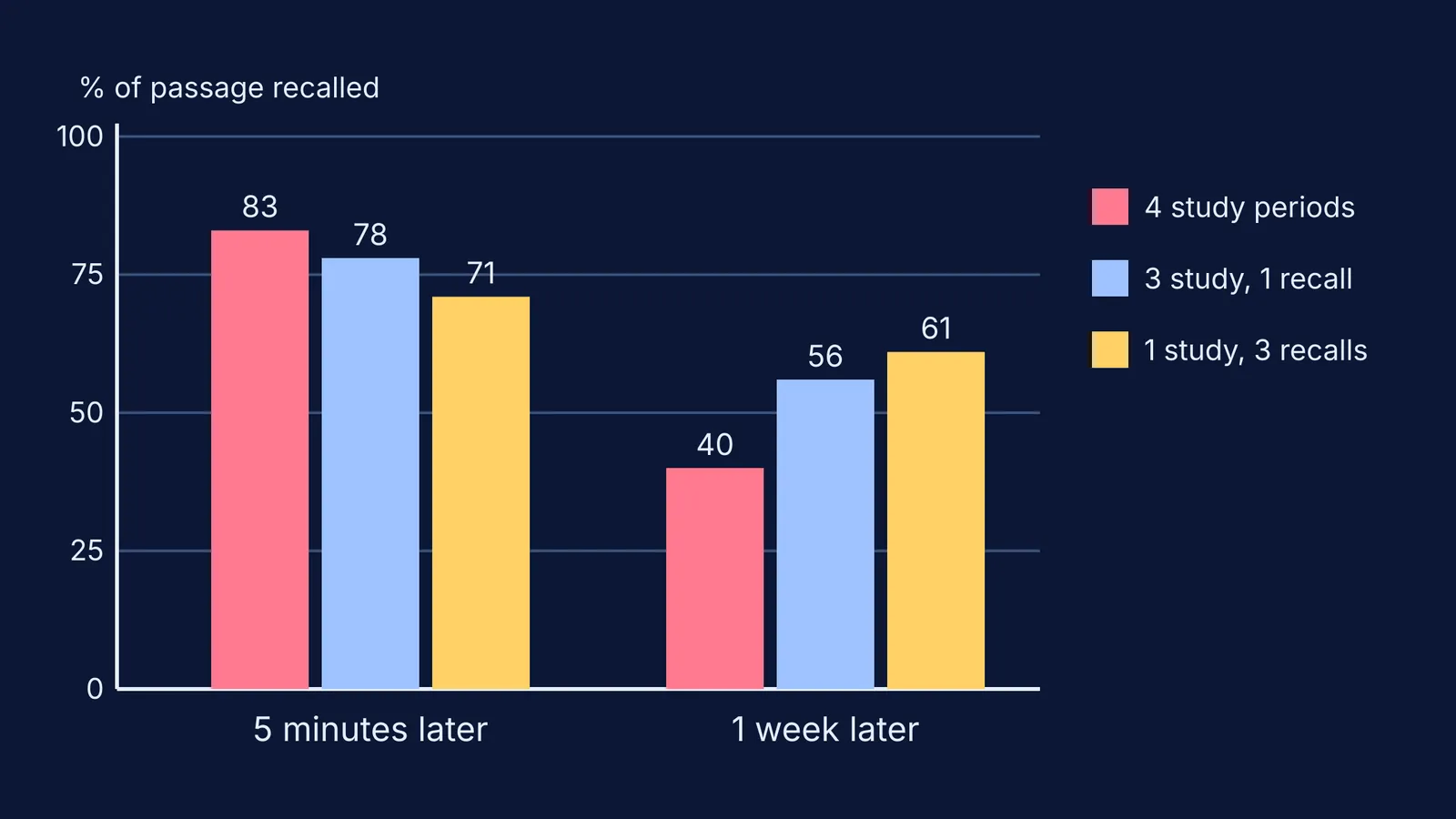
In a 2006 experiment, Henry Roediger and Jeffrey Karpicke had students learn a prose passage either in four reading periods or in one reading period followed by three tests in which they wrote down everything they could remember (Roediger and Karpicke, Psychological Science, 2006). Five minutes later, the readers did better: they recalled 83% of the passage against 71%. One week later the result flipped: the recall group remembered 61% and the reading group 40%. On average the readers had gone through the passage 14.2 times; the recall group only 3.4 times.
The repeated readers were also more confident that they would remember the passage in a week. That is the trap with writing something ten times: by the tenth copy the line looks familiar, and familiarity feels like knowing (more on why students misjudge their own learning).
Why does recalling work better than copying?
In a 2008 study, Karpicke and Roediger had 40 university students learn 40 Swahili-English word pairs. Once a student had recalled a pair correctly, what happened next depended on their group: the pair was studied again, tested again, both, or dropped (Karpicke and Roediger, Science, 2008). Studying a pair again after it was learned had no effect on recall a week later, while testing it again had a large positive effect. The students' predictions of their own scores were uncorrelated with how they actually did.
A 2013 review of ten study techniques by John Dunlosky and colleagues rated practice testing and distributed practice (spreading study out over time) as high utility, and rereading, highlighting and summarising as low utility (Dunlosky et al., Psychological Science in the Public Interest, 2013). Ten copies in one sitting sit much closer to rereading than to testing.
How do you memorise a line with recall instead?
Teachers already use a version of this for spelling and maths facts called copy-cover-compare: look at the item, cover it, write it from memory, then uncover it and check. A 2012 meta-analysis found that copy-cover-compare and its variations helped students with and without disabilities learn and become fluent in skills such as spelling and maths (Joseph et al., Psychology in the Schools, 2012). Here it is for a definition or law.
Read the line once, slowly, for meaning.
Cover it completely and write the whole line from memory.
Uncover it and compare word by word. Underline anything missing, wrong or out of order.
Look only at the underlined parts, cover the line, and write it all again.
Repeat until you write it correctly once. Then do one more full recall a few minutes later.
Recall it again later the same day, the next day and a few days after that.
If the idea behind a definition is unclear, the Fermi Concept Library has a lesson for every concept in physics, chemistry, biology, mathematics and computing, so you can understand it before you memorise it.
A worked example: Ohm's law
The line: the current through a conductor is directly proportional to the potential difference across its ends, provided the temperature and other physical conditions remain the same.
Attempt 1, after one careful read: 'Current is proportional to potential difference.' Missing: most qualifiers and the whole condition.
Attempt 2, after a few seconds on the underlined parts: everything except 'and other physical conditions'.
Attempt 3: the full line, correct.
Next morning, one cover-and-write before school: correct apart from 'directly'. Fix that word only and write the line once more.
That is four or five attempts, each one a recall. Ten copies take longer and never ask you to produce the line yourself.
What can parents say instead of 'write it ten times'?
Keep the goal, change the method:
'Cover it and write it once from memory. Then show me what you missed.'
'Don't look yet. Have a go first, even if it's wrong.'
'Good. Let's see if it is still there tomorrow morning.'
A wrong first try is part of the method, not carelessness. For why the later recalls matter, read what Ebbinghaus's forgetting curve measured, and for many lines at once, see how to make flashcards that work for physics and chemistry.


