

On this page
Every coaching batch has front-row regulars and a back-bench crowd. Researchers have tested whether the front row helps by assigning seats at random, which separates the seat from the student who picks it.
Does sitting in the front of class help you learn?
In one well-known experiment, it did. Katherine Perkins and Carl Wieman randomly assigned seats in a large introductory physics course at the University of Colorado, then swapped front and back halfway through the term (The Physics Teacher, 2005). Students who sat at the back for the first half of the term were nearly six times as likely to receive an F as students who started at the front, despite the instructors' efforts to engage the back of the room.
A repeat of the experiment found nothing of the kind. Steven Kalinowski and Mark Taper randomly assigned seats in an introductory biology class at Montana State University, where 43 students finished the course, and found no link between assigned row and exam scores (Journal of College Science Teaching, 2007). Even at the pessimistic end of their estimate, sitting nine rows further back would cost about 1.5 marks out of 100.
Is it the seat or the student?
Mostly the student. Before Kalinowski and Taper handed out seats, they photographed where students sat on the first day: those who chose the front had significantly higher grade point averages, with the trend line falling from 3.9 at the front to 2.7 at the back on a 4-point scale (Journal of College Science Teaching, 2007).
Mary Ellen Benedict and John Hoag saw the same pattern in large economics lectures: preferring the back, whether or not the student actually sat there, raised the probability of a D or F by 23 percentage points (Journal of Economic Education, 2004). Students who preferred the back but could not get a back seat and were forced forward tended to get higher grades.
Motivation follows the rows too. In a survey of 593 health-sciences students in France, the further students sat from the first row, the lower their intrinsic motivation and their belief that they could do the work (PLOS ONE, 2017). That is a correlation, not an experiment.
Neighbours matter too. With about 154 bioscience students in a Sheffield lecture theatre, David Smith and colleagues found no direct link between seat and marks, but friends sat in clusters that scored at similar levels on a problem-solving task, and students sitting alone did less well (FEBS Open Bio, 2018).
Why can the back row cost you marks?
Kalinowski and Taper offer class size as one possible explanation: the physics course had more than four times as many students as theirs, and the anonymity of a big hall may make it easier to drift (Journal of College Science Teaching, 2007). In a crowded room the everyday causes are familiar: you cannot read the board, nobody sees your confused face, and the phone in your lap goes unnoticed. Our posts on mind wandering in lectures and on whether a phone on your desk hurts focus cover those two.
How do you pick a seat in a crowded school or coaching class?
Run these four checks, in order:
See: can you read the smallest writing on the board or screen without squinting?
Hear: can you follow the teacher at normal volume, including when they face the board?
Be seen: can the teacher see your face and your raised hand?
Neighbours: are the people around you there to work? Sit beside the friend who asks questions, not the one who passes notes.
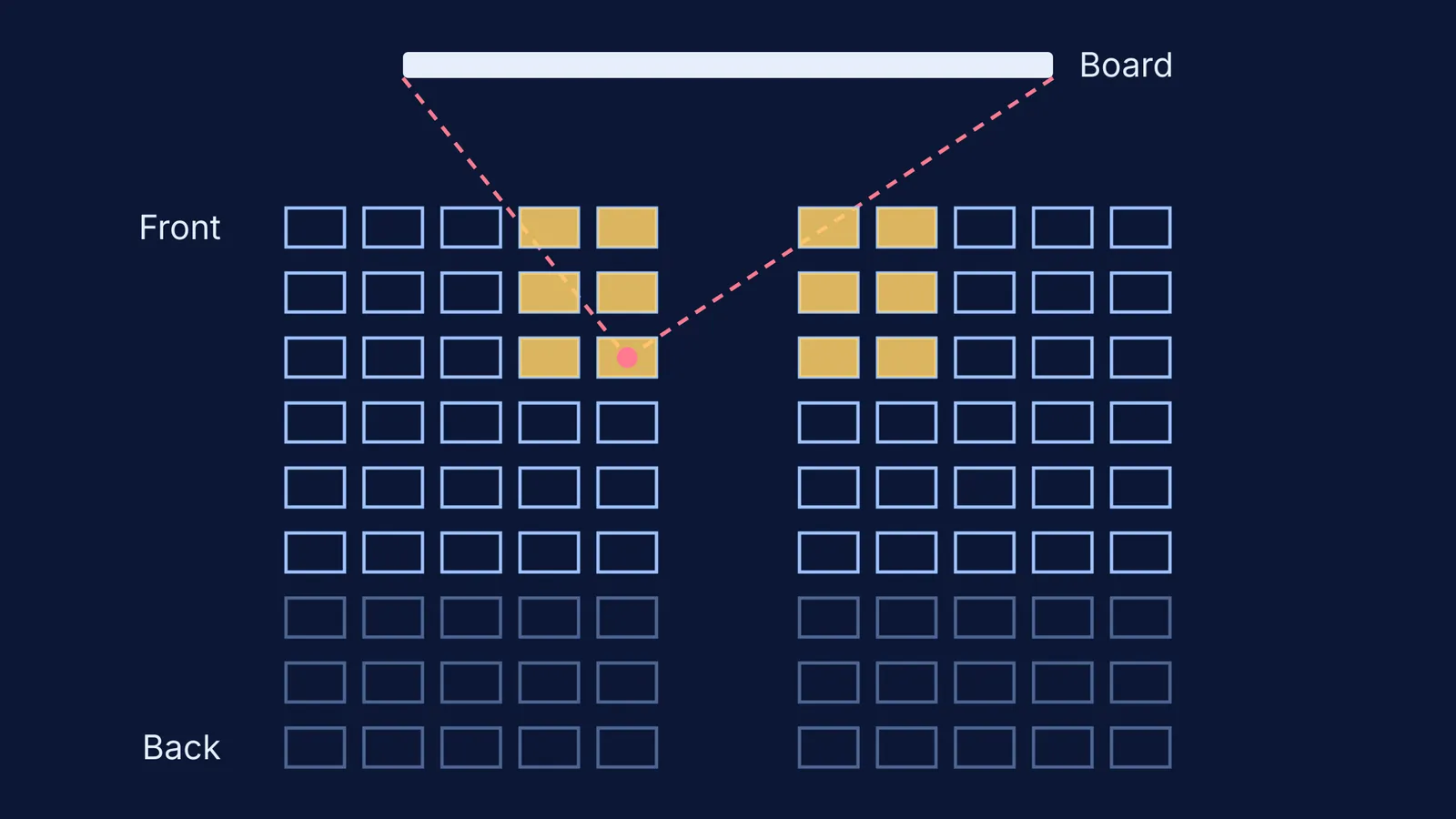
A seat in the first few rows near the centre usually passes all four; one at the far end of a front row or behind a pillar may not.
Say your 5 pm physics batch fills from the front by 4:50 and you arrive at 5:00, landing in a back corner. Leave ten minutes earlier on days with long derivations, when seeing the board matters most. On other days, a central seat in the middle rows beats a side seat that is technically closer.
If seats are assigned, ask once, politely, after class: "Ma'am, I find it hard to read the board from row nine. Could I move nearer the front, or swap with someone who would like to sit further back?"
What if you are stuck at the back?
Do what front-row students do: take notes, write down questions and answer the teacher's questions in your head. Our guide to asking better questions in class helps.
Move forward when seats free up after a break.
Note anything you missed and fill it in the same evening. The Fermi Concept Library has a lesson for every concept in physics, chemistry, biology, mathematics and computing.
If a whole class went past you, Fermi's AI tutor can work out what you already know and build a plan for the session, so you start from a clear next step.
Pick the seat where you can see, hear and be seen, then work the way front-row students do, wherever you end up.


