

On this page
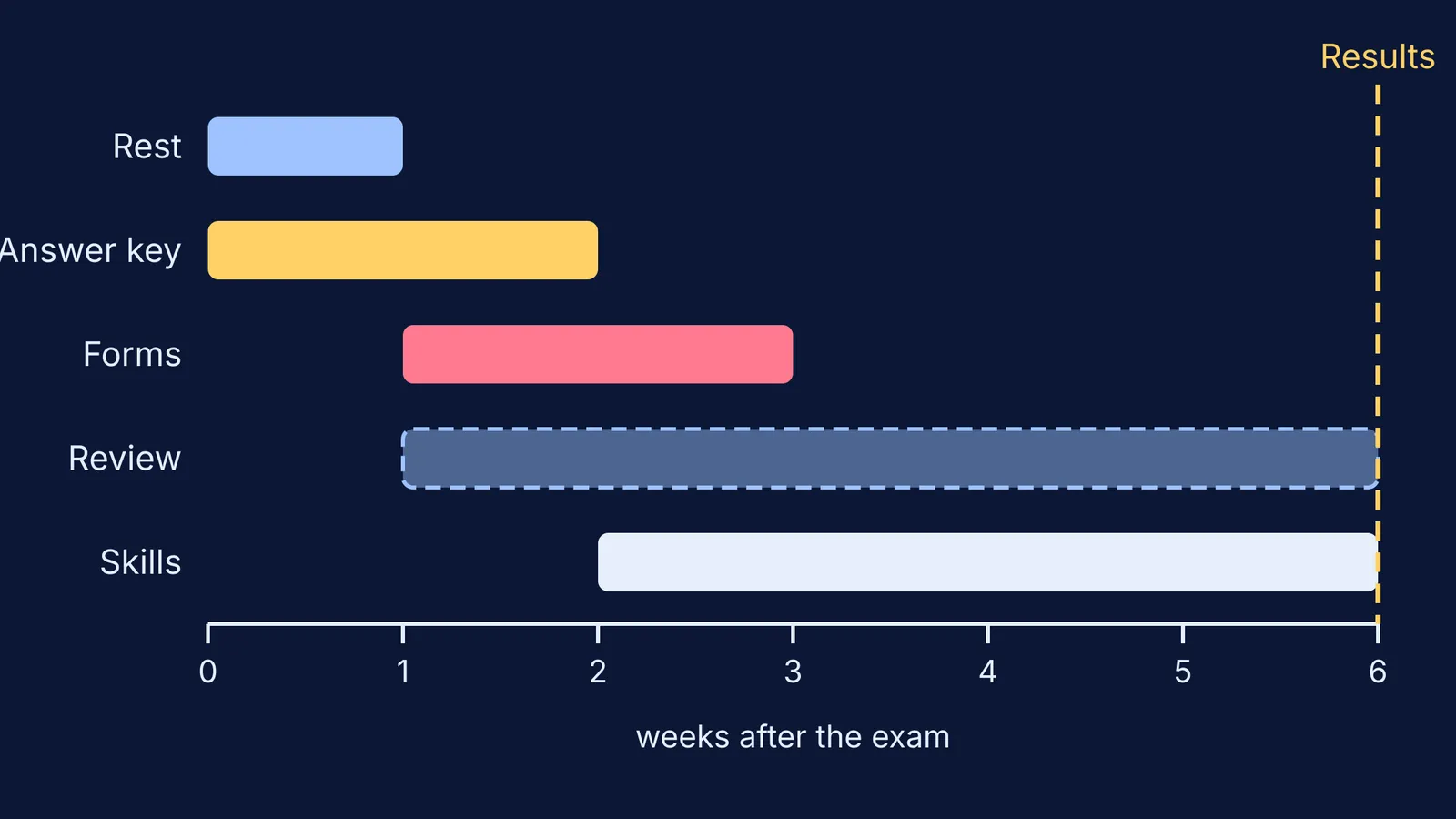
The paper is done, the result is a few weeks away, and everyone keeps asking how it went. This gap is useful time if you split it into four jobs: rest, the answer key, backup forms, and a light plan for whatever comes next. Below is a six-week version you can stretch or squeeze to fit your exam's real dates.
What should you do in the first week after the exam?
Rest first, and mean it. The American Academy of Sleep Medicine's consensus statement says teenagers aged 13 to 18 should sleep 8 to 10 hours per 24 hours on a regular basis (Paruthi et al., 2016). Use this week to get back to a steady bedtime and wake-up time, not to sleep till noon.
Do one useful thing while the paper is still fresh: write down the questions you were unsure about, the ones you guessed, and the ones that ate your time. Ten minutes now beats your memory of it in a month.
For NTA exams such as JEE Main and NEET-UG, the agency displays provisional answer keys along with candidates' recorded responses and opens a window to challenge them (NTA). When the key appears, check your recorded responses, work out a rough score, then put it away. Our guide on how to challenge an NTA provisional answer key walks through the steps.
Which backup forms should you fill while waiting for results?
Weeks two and three are paperwork weeks. Deadlines for other exams and counselling can fall close to results, so check each official page yourself, not forwarded messages.
A checklist to go through with a parent:
List every option still open: state engineering or medical entrance exams, private university exams, and CUET-UG, which NTA runs for admission to central universities and participating state, deemed and private universities (CUET-UG).
For each one, write the official website, the last date to apply, the fee and the exam date in one notebook or shared sheet.
Collect documents in one folder, on paper and scanned: Class 10 and 12 marksheets, ID, photographs, and category, domicile or income certificates if they apply to you. Some take time to issue.
Read how counselling works before you need it: JoSAA for IITs and NITs, and the Medical Counselling Committee for all-India quota medical seats. Our parent guide to JoSAA counselling rounds, choices and documents explains the steps.
Should you start studying for the next exam?
If another session or attempt is ahead, or you are considering a drop year, a short daily review stops your preparation fading. If not, skip to the next section.
You do not need a full timetable to hold on to what you know. In a study of more than 1,350 people, Nicholas Cepeda and colleagues found that the best gap between study sessions grows as the test gets further away; for a test a year off, the best gap was about 5 to 10% of that delay (Cepeda et al., 2008).
A worked example, as a rough guide: say your next attempt is about a year away. Five to 10% of a year is roughly 2.5 to 5 weeks. So rotate through your subjects so that each chapter you have already learned comes back about once a month, and spend the rest of your review time on the mistake list from week one.
When you rework those questions, the Fermi Problem Library has worked problems with a step-by-step solver that explains the reasoning rather than printing an answer. If you are not sure where to begin, Fermi's AI tutor can work out what you already know and build a plan for the session.
What skills can you build in the gap?
From week three, pick one or two things that will still matter in college:
A free online course. SWAYAM, the Government of India's learning platform, offers courses from Class 9 to postgraduate level free of cost; only the optional proctored exam for a certificate carries a fee (SWAYAM).
Basic coding, spreadsheets or touch typing.
Everyday skills: cooking a few meals, managing a bank account, travelling alone in your city.
Something just for you: a sport, music, or reading that is not a textbook.
Stuck choosing? Ask: will this help in my first semester?
What if the waiting starts to feel heavy?
Some worry while you wait is normal. Keep a routine with fixed sleep, time outdoors and people you like. Cut down on result-prediction videos and forum rank guesses; they cannot change your score.
Parents, instead of "How much will you get?", try: "Whatever the result, we'll look at the options together. What do you want to do this week?" Our guide to everyday support for exam stress, and when to get help has more.
If worry starts affecting sleep, eating or daily life, or you have thoughts of harming yourself, talk to a parent, teacher or doctor, or call Tele MANAS, the Health Ministry's free 24x7 mental health helpline, on 14416 (Tele MANAS details via IIT Kanpur).
Start tonight: write your mistake list and set an alarm for a normal wake-up time.


