

On this page
You turn the page and there it is: a question type you have never practised. Two reactions cost marks here: freezing, or charging into the first method that comes to mind. What helps is a short, fixed routine: a few seconds to pin down what is given and what is asked, one honest try at an approach, and then a decision.
Why do unfamiliar questions eat so much time?
The trap is often not a lack of knowledge. It is committing too fast. In his chapter Learning to think mathematically (1992), the Berkeley education researcher Alan Schoenfeld described more than a hundred videotapes of college and high school students working unfamiliar problems.
Roughly 60% of those solution attempts were of the "read, make a decision quickly, and pursue that direction come hell or high water" variety, according to Schoenfeld (1992). In one typical case, a pair of students kept going for the full twenty minutes of the session despite clear evidence they were not making progress.
This is a habit, and habits can change. After his problem-solving course, which kept asking students what they were doing and why, fewer than 20% of their attempts were of the "jump into a solution attempt and pursue it no matter what" type, and problem-solving success rose, the same chapter reports. He notes that the change took the better part of a semester.
There is a second reason a question looks new. In a classic study, Chi, Feltovich and Glaser (1981) found that physics experts first pick out the physics principle behind a problem, while novices go by its literal features. A question can look strange on the surface and still be one you have solved many times underneath.
What should you do in the first 60 seconds?
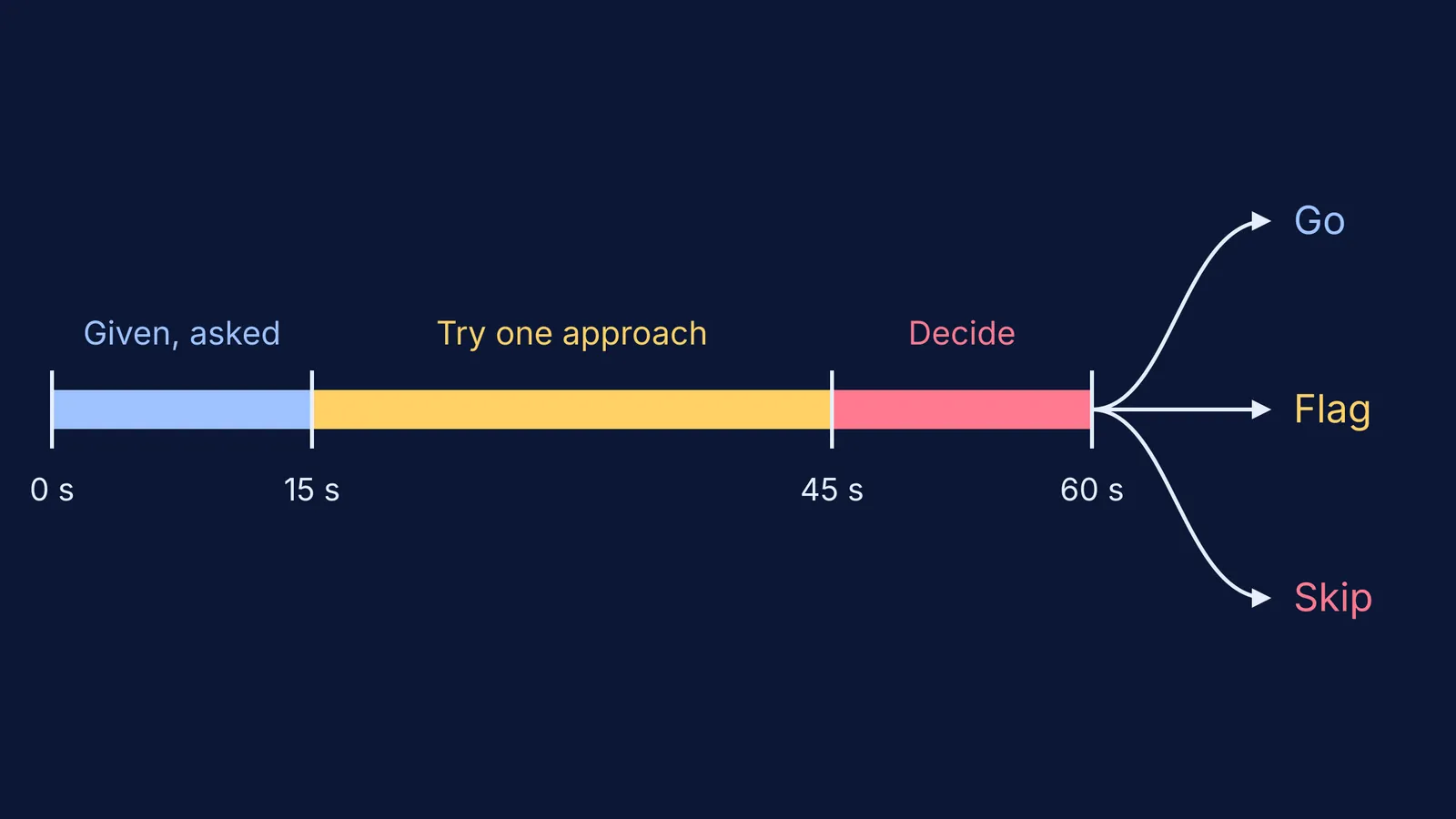
Seconds 0 to 15: given and asked. Write the given quantities in the margin as symbols with units, and the unknown as "? =". Underline words that change the physics or maths, such as smooth, at rest, not, maximum.
Seconds 15 to 45: try one approach. Ask which principle links the given to the asked: a conservation law, a standard equation, a definition, or just the units. Write the first line of working, nothing more.
Seconds 45 to 60: decide. Ask yourself the three questions Schoenfeld put to his students: What (exactly) are you doing? Why are you doing it? How does it help you?
How do you decide whether to attempt, flag or skip?
Go: you have written the first line and can see the next two steps.
Flag: you can name the principle but the working looks long. Note the question number and a one-line hint, such as "energy first, then h", and return after the easier questions.
Skip: after a minute you still cannot connect what is given to what is asked.
Before guessing on a skipped question, check the marking scheme in your exam's official information bulletin: negative marking differs between exams and question types, and can change from year to year.
If your mind goes completely empty, a different routine helps: here is what to do when you blank out mid-exam.
Worked example: a graph you have never seen
Say a question shows a straight-line graph of v squared (in m²/s²) against position x (in m). The line passes through (0, 4) and (6, 28). It asks for the acceleration.
Given: v² = 4 at x = 0, v² = 28 at x = 6, and the graph is a straight line.
Asked: a = ?
One approach: which equation links v² and x? For constant acceleration, v² = u² + 2ax. A straight line means constant a, and its slope is 2a.
Decide: the slope is (28 − 4) ÷ 6 = 4 m/s², so a = 2 m/s². You can see the answer, so go.
Had no equation linking v² and x come to mind by the 45-second mark, that would have been your signal to flag it rather than stare at it.
How do you practise triage before the exam?
In one mock a week, give every unfamiliar question a strict minute before deciding. Our guide to trying different attempt strategies in mocks shows how to compare one approach with another, and afterwards, go through the questions you left unattempted in the mock to see which skips were right.
For each flagged or skipped question, write down the principle it actually needed. If you chose the wrong method, the Fermi Problem Library has worked problems with a step-by-step solver that explains the reasoning rather than printing an answer. If the gap was a concept you never learned, the Fermi Concept Library has a lesson for every concept in physics, chemistry, biology, mathematics and computing.
If exam worry stays with you for weeks or affects your sleep, talk to a parent, teacher or counsellor, or call Tele MANAS, a free 24x7 national mental-health helpline, on 14416.
In your next mock, try it: one minute per strange question, three possible decisions, and no question allowed to take twenty.


