

On this page
Two papers in one day are common in university semester exams, school pre-boards and some multi-subject entrance tests. You know the day is coming, so you can plan it. The aim is to walk into paper two fed, rested and with its key facts fresh.
How should you split revision before two exams on the same day?
The gap is for eating and resting, not studying. The real revision happens before.
Three and two days before: alternate the two subjects, using practice questions rather than rereading.
The day before: timed questions for each paper, then a one-page recall sheet for each: formulas, reactions, definitions, steps you forget.
The night before: pack, then sleep. Here is why sleep before an exam beats an all-nighter.
The gap: only paper two's recall sheet. Nothing new.
Why practice questions? In a study published in Science, participants who learned by restudying showed the usual memory impairment after a stress test a day later, while those who learned by retrieval practice (taking practice tests) were protected from it (Smith, Floerke and Thomas, 2016).
If your practice keeps going wrong at the same step, the Fermi Problem Library has worked problems with a step-by-step solver that explains the reasoning rather than printing an answer, so you can fix the method beforehand.
What should you eat between two exams?
Eat breakfast, even if you're nervous. A review of 36 studies on children and adolescents found mainly positive effects of breakfast on on-task behaviour in class (Adolphus, Lawton and Dye, 2013). Its introduction notes earlier studies suggesting that breakfasts causing a smaller rise in blood sugar may suit thinking better, though the authors call that evidence equivocal.
So choose a familiar, filling breakfast: poha with peanuts, idli and sambar, besan chilla, or eggs with roti. For lunch, a normal home meal, not a feast and not something new from a stall. Carry water and a simple snack such as a banana or roasted chana. Before adding an extra cup of tea, read what the evidence says about caffeine and studying.
How do you use the gap between papers?
Plan it by its length:
Under an hour: water, toilet, snack, walk to the hall, one look at the recall sheet.
One to three hours: eat, rest 15 minutes, then 30 to 45 minutes writing the recall sheet from memory and checking it.
More than three hours: the same, plus a short nap if you can lie down somewhere quiet.
Keep naps short. In a lab study of 24 young adults who had slept about 5 hours, a 10-minute afternoon nap gave immediate gains in alertness and performance, some lasting up to 155 minutes, while a 30-minute nap first caused a spell of grogginess (Brooks and Lack, 2006). Set an alarm.
The hardest part is other people. Comparing answers to paper one costs time and calm, and changes nothing.
What does a sample timetable look like?
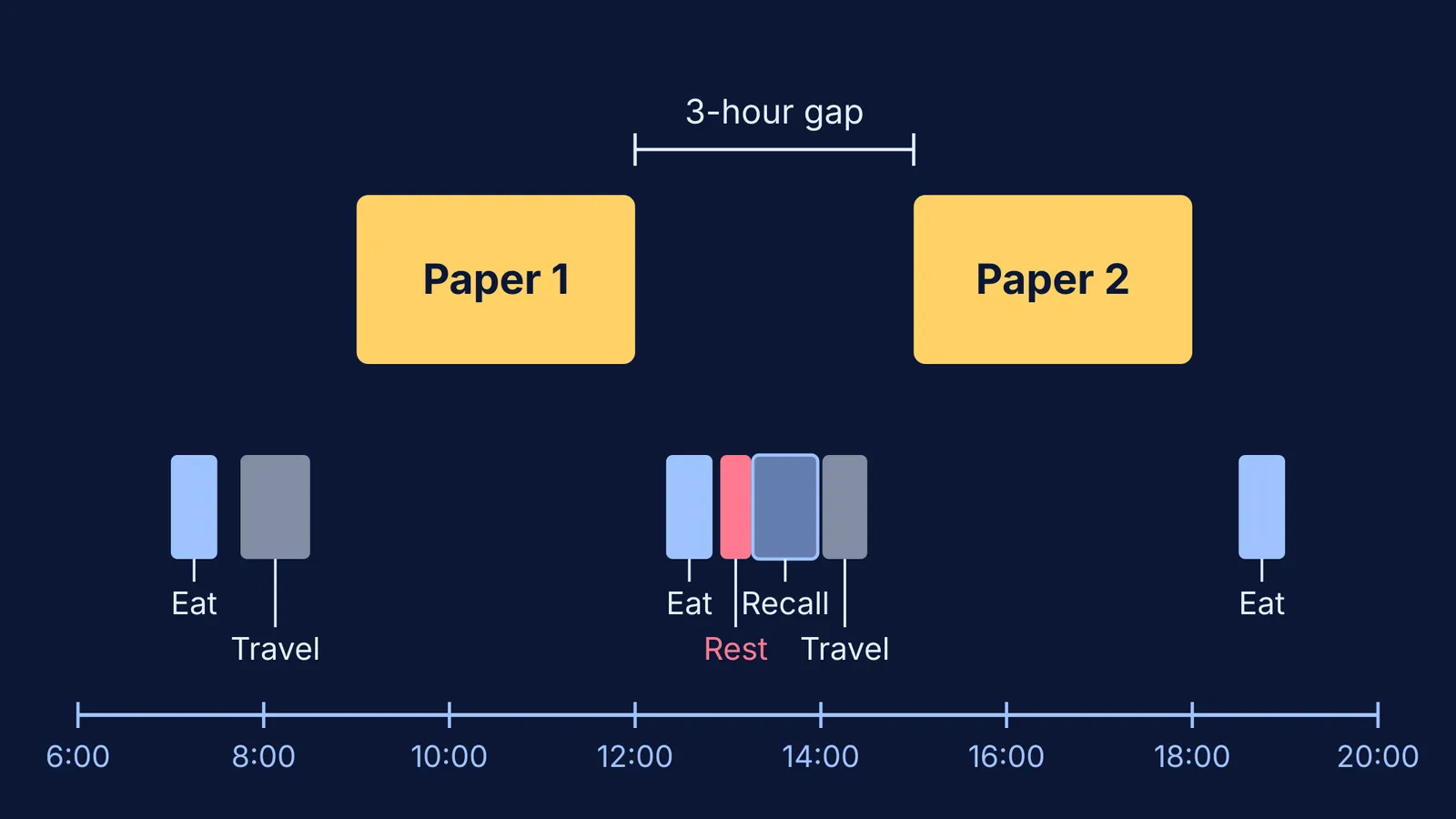
This sample has papers from 9:00 to 12:00 and 15:00 to 18:00. Your real deadline is the reporting and gate-closing time on each admit card or hall ticket, so shift everything to fit yours.
6:30 Wake up, wash, light stretch.
7:00 Breakfast.
7:45 Leave, with a buffer for traffic.
9:00 to 12:00 Paper one.
12:00 Leave the hall, drink water, use the script above.
12:20 Lunch.
12:55 Rest or a short nap, alarm on.
13:15 Recall sheet for paper two, written from memory and then checked.
14:00 Travel or walk to the second hall and report.
15:00 to 18:00 Paper two.
18:30 Dinner, then something easy. No post-mortem tonight.
If a paper went badly, review it later with a 60-minute review after a bad test.
What should you pack for two papers in one day?
Both admit cards or hall tickets, photo ID, pens and pencils.
Each paper's rules on calculators and permitted items, checked separately.
Water, a snack, a lunch box.
The route to the second venue, if different, tried beforehand.
Exam stress is common, and you don't have to handle it alone. IIT Kanpur's counselling page lists Tele MANAS, the free national mental-health helpline.
If you don't know where to start your revision, Fermi's AI tutor works out what you already know and builds a plan for the session, so each sitting begins with a clear next step.


