On this page
Tutoring younger students is one of the most reliable ways to earn money while at university. Because your academic schedule changes every term and exams demand heavy time commitments, a standard part-time job is often too rigid. Tutoring, whether online or locally, lets you pick your hours, set your own rates and work from your hostel room.
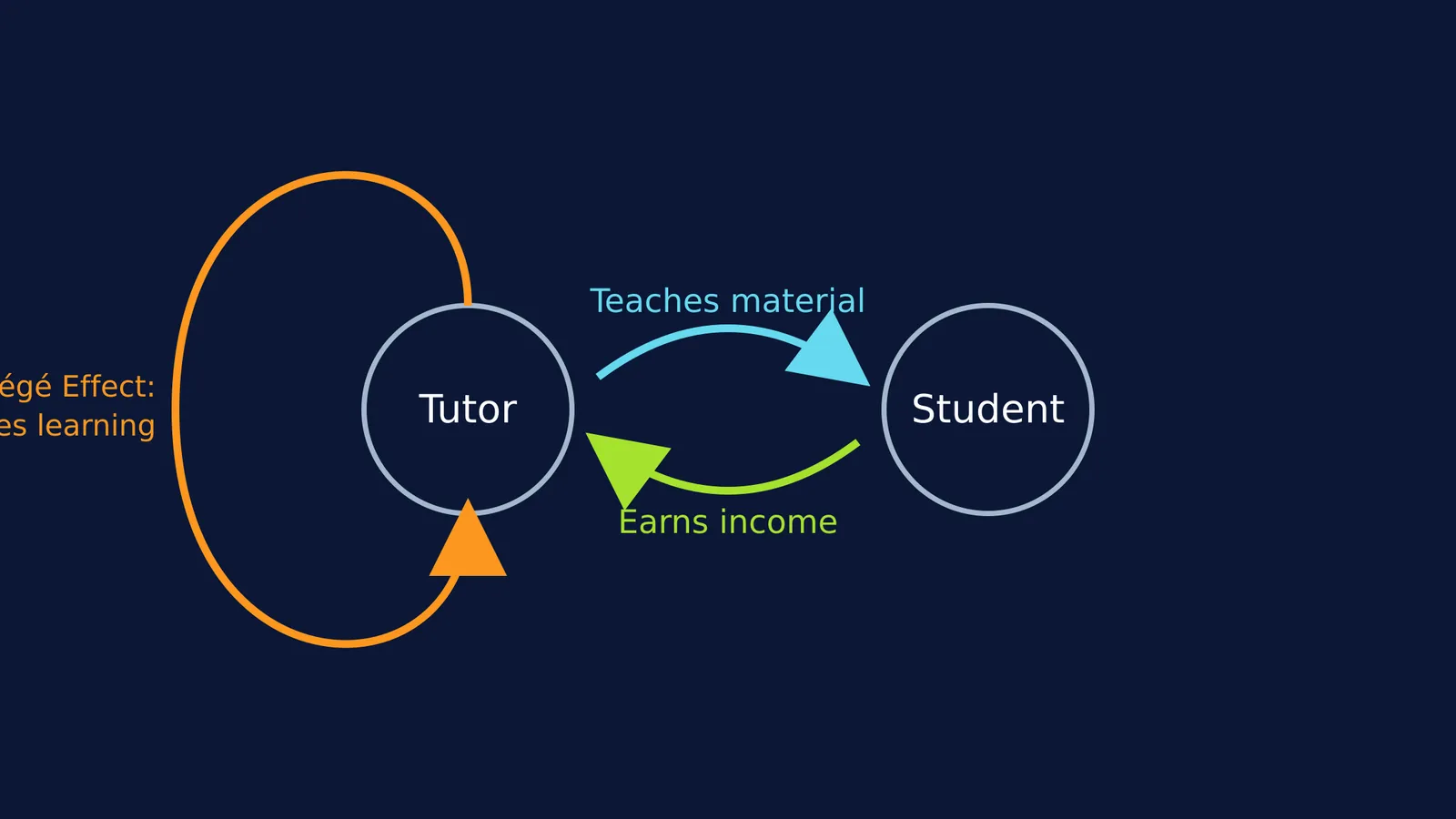
But there is a hidden academic advantage to teaching: it forces you to master the material yourself before you attempt to explain it to someone else.
How does teaching others improve your own grades?
When you prepare to teach a concept, you process the information differently than when you study just to pass a test. This shift in mindset is known as the "protégé effect". In a 2009 study published in the *Journal of Science Education and Technology*, researchers Catherine Chase and colleagues found that students who believed they were learning in order to teach a digital "protégé" spent significantly more time on the material and achieved higher learning gains (10.1007/s10956-009-9180-4). The responsibility of teaching someone else increases your effort and forces you to organise your thoughts clearly.
In a practical sense, explaining an idea out loud highlights the gaps in your own understanding. You cannot gloss over the difficult parts when a student asks you why a particular step was taken.
How do you set your tutoring rate?
Your earning potential depends heavily on your city, the subject you teach and the grade level of your students. As you gain experience and specialise in high-demand areas—such as preparing high school students for board exams or teaching coding—you can steadily increase your fees. Tutors in Tier 1 cities such as Mumbai or Bengaluru often command higher local rates. However, the rise of online tutoring allows you to reach students anywhere in the country or abroad, balancing out regional differences and letting you charge competitive rates without commuting.
How to find your first tutoring clients?
Finding your first few students is usually the hardest part of starting out as a tutor. Here is a practical framework to build a steady client base:
Pick a narrow niche: Do not offer to teach "all subjects to all grades". Be specific. Offer to teach Class 10 mathematics or specialise in specific topics like quadratic word problems in Class 10. Parents are more willing to hire a specialist who knows the syllabus inside out.
Start with your existing network: Inform your neighbours, family friends, and former school teachers that you are available to take on students. Word-of-mouth remains one of the most trusted ways to find local clients.
Register on dedicated platforms: Create profiles on tutoring marketplaces like Superprof, TeacherOn or UrbanPro. Keep your profile updated with your university credentials; parents value tutors who have recently cleared major board or entrance exams themselves.
Offer a free trial class: A 30-minute demonstration session helps you showcase your teaching style. It also gives you a chance to assess the student's current level and see if they are a good fit for your schedule.
Consider group sessions: Once you are comfortable teaching one-on-one, you can group two or three students of the same grade together. This allows you to lower the per-student fee slightly while increasing your total hourly earnings.
How can you protect your own study time?
The biggest trap of tutoring is letting it bleed into your own university coursework. It is easy to take on too many students when the money is good, but you must treat tutoring as a job with hard boundaries.
Box your teaching hours into specific weekday evenings or weekend mornings. Communicate these boundaries clearly to parents upfront. Do not accept last-minute requests for extra sessions before a student's exam if it conflicts with your own assignment deadlines or revision schedule.
To teach well, your own knowledge must remain sharp. If you need to quickly review a university-level topic before explaining it, Fermi's AI tutor can work out what you already know and build a plan for the session, so you sit down to a clear next step. Alternatively, you can use the Fermi Problem Library. It has a step-by-step solver that explains the reasoning rather than just printing an answer, which provides a clear model for how you should structure explanations for your own tutees. For example, if you are helping a senior secondary student with calculating the distance in the nth second, seeing a logical breakdown of the derivation helps you teach it with more confidence and clarity.