

On this page
If you study in a state board school and plan to write JEE Main or NEET-UG, the hardest part often isn't the difficulty. It's the gaps you can't see: units the national exam lists that your textbook skips or teaches differently. Here is a way to find them in one sitting, and a plan to close them.
Which syllabus should a state board student follow for JEE and NEET?
Follow the exam's own syllabus document. Textbooks, state or NCERT, are tools for covering it.
For NEET-UG, the NTA public notice of 8 January 2026 says NTA will conduct NEET (UG)-2026 "strictly based on the syllabus as finalized and notified by NMC", the National Medical Commission. The NEET (UG)-2026 syllabus attached to that notice has 20 Physics units, and Unit 20, Experimental Skills, lists 18 experiments. When NMC notifies the syllabus for the next exam, check it on neet.nta.nic.in before you rely on any unit list, including this one.
The NEET syllabus is not simply the NCERT book. In an NTA FAQ on the NEET (UG) 2024 syllabus, NTA said a few topics not in the new NCERT books were added because they are taught by school boards such as the Maharashtra State Board, Bihar's school board and NIOS.
For JEE Main, the JEE (Main) 2027 Information Bulletin points to the detailed syllabus on jeemain.nta.nic.in. Paper 1 (B.E./B.Tech.) has 75 questions, 25 each in Mathematics, Physics and Chemistry, for 300 marks. The paper is offered in 13 languages, with regional-language papers such as Marathi or Tamil offered at centres in the matching states, and the English version prevails if the two versions differ.
How do I map my state board syllabus to the entrance syllabus?
Work one subject at a time, with the exam syllabus beside your Class 11 and 12 textbooks.
Download the official syllabus and number its units.
Next to each unit, write the matching chapter or chapters from your state books. One unit can span two chapters, or both years.
Read the unit's topic lines one by one and tick each topic your book teaches with worked examples and exercises.
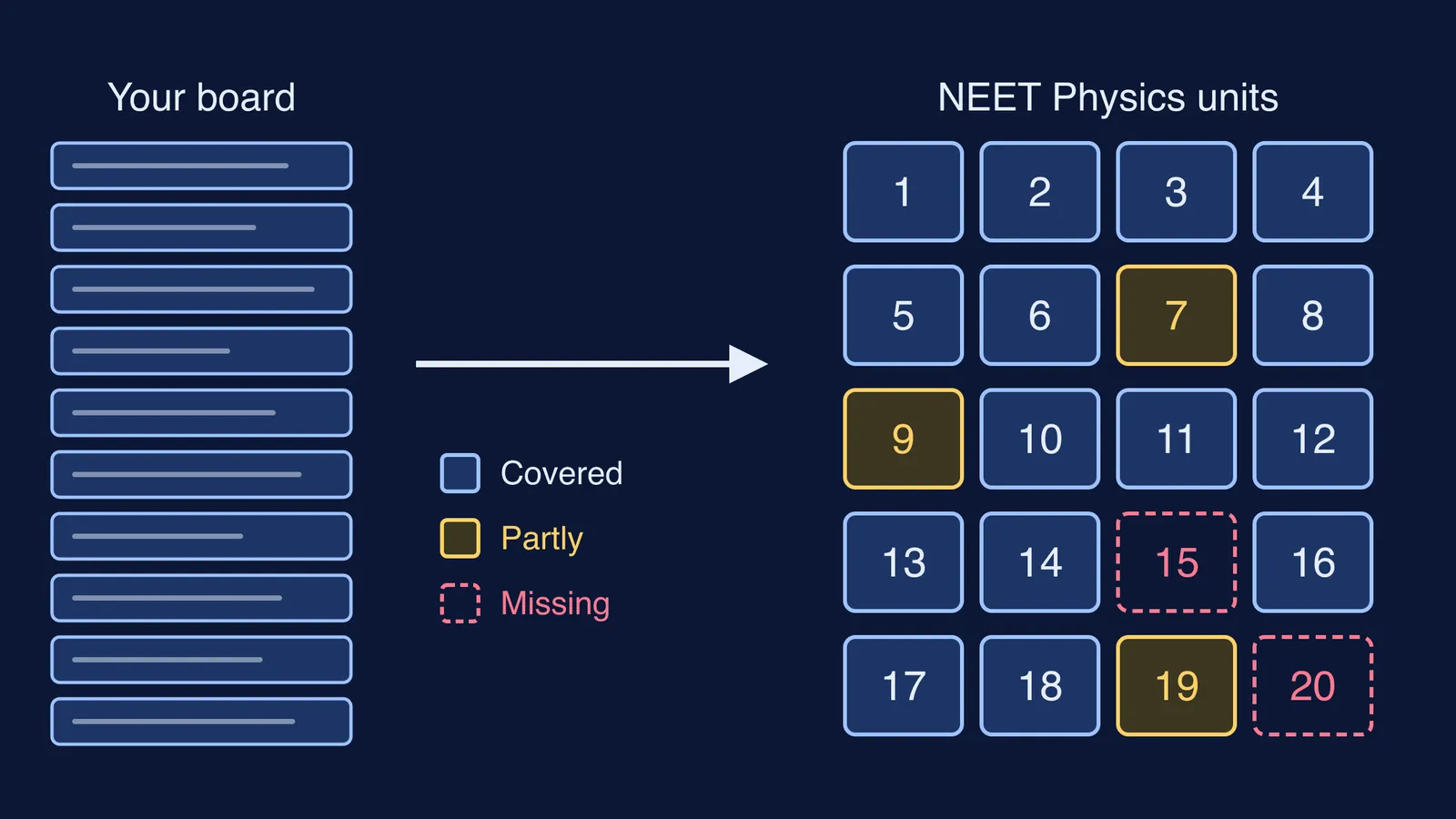
Label the unit: Covered (every line ticked), Partly covered (some lines missing, or defined without problems), or Missing (nothing in your books).
Copy the result onto a one-sheet syllabus tracker for JEE and NEET so you can see every unit's label at a glance.
A worked example: NEET Physics, Units 17 to 20
A made-up example, not any real board: your Class 12 physics book covers the photoelectric effect, atoms and nuclei, and semiconductors, but not practical skills. Against the NEET (UG)-2026 syllabus, the map might read:
Unit 17, Dual nature of matter and radiation: your book teaches the photoelectric effect, Einstein's equation and the de Broglie relation. Covered.
Unit 18, Atoms and nuclei: Bohr model, hydrogen spectrum, mass defect, binding energy, fission and fusion are all there. Covered.
Unit 19, Electronic devices: diodes and rectifiers are taught, but not the Zener diode as a voltage regulator or the logic gates (OR, AND, NOT, NAND, NOR). Partly covered.
Unit 20, Experimental skills: the syllabus names experiments including Vernier callipers, the screw gauge and the half-deflection method for a galvanometer, and your theory book has none of them. Missing.
One unit needs a short top-up and one needs planned time: a calmer picture than "I'm behind on everything".
How should I plan the extra topics?
Missing units get fixed slots: for example, two sessions a week that you never use for anything else.
Partly covered lines join your normal revision of that chapter.
Do Class 11 units before Class 12 where you can, because later units lean on earlier ones.
Keep your board exam timetable and plan the extra work around it.
Relabel the map at the end of each month. A unit only moves to Covered when you can solve problems on it without notes.
If a Missing topic uses words you've never met, the Fermi Concept Library has a lesson for every concept in physics, chemistry, biology and mathematics, each with its place in the map. When your book's method differs from what exam problems expect, the Fermi Problem Library has worked problems with a step-by-step solver that explains the reasoning rather than printing an answer.
For where state books and NCERT tend to differ, see how state board students can close their NCERT gap for JEE and NEET.
What can parents do to help?
Ask to see the map instead of asking about marks. Try: "Show me your Missing units. Which days are they on this week?" That keeps the talk on your child's plan, not on worry.
If you are still deciding whether a board switch is worth it, CBSE or state board for a NEET aspirant covers what really matters. If the pressure starts to affect sleep, appetite or mood for weeks, talk to the school counsellor or a doctor, or call Tele MANAS on 14416.
Start with one subject this week: download the syllabus, map it, and circle your Missing units.


