

On this page
If you study under a state board and plan to sit JEE Main or NEET-UG, your textbook is only half the map, because the entrance exams follow their own published syllabus. You don't need to study everything twice. Find the gaps once, then slot them into the school year you already have.
Does the JEE or NEET syllabus follow my state board?
Not automatically. For NEET-UG, the National Testing Agency's public notice of 8 January 2026 says NTA “will conduct NEET (UG)-2026 examination strictly based on the syllabus as finalized and notified by NMC.” For JEE Main, NTA publishes a separate JEE (Main) 2027 syllabus on its website.
Those documents decide what can be asked, so your job is to find the parts your board book doesn't cover. NCERT books are a practical way to fill those gaps, and NCERT puts its textbooks for Classes I to XII online as PDFs.
How do I compare my state board syllabus with NCERT?
First, see the size of the job. The JEE Main 2027 syllabus lists 14 maths units and 20 physics units, and the last physics unit, Experimental Skills, names 18 experiments. The NEET-UG 2026 syllabus lists 20 physics units, 20 chemistry units and 10 biology units.
Then:
Download the official syllabus for your exam, plus your board's syllabus or the contents pages of your textbooks.
Go one unit at a time. For every sub-topic in the official list, find where your board book covers it.
Mark it S (same depth), T (thinner: it's mentioned, but without the derivation or numericals) or M (missing).
Next to every T and M, write the matching NCERT chapter and section.
Take extra care with the practical units, such as Experimental Skills in physics and Principles Related to Practical Chemistry in NEET chemistry. They don't look like normal chapters, so they're easy to skip.
For a worked example, take Unit 9 of the JEE Main 2027 physics syllabus, Kinetic Theory of Gases. It lists “degrees of freedom, law of equipartition of energy and applications to specific heat capacities of gases, mean free path, Avogadro's number”. Imagine your board chapter (an invented example, not any real board) covers the gas equation, pressure and RMS speed but stops before degrees of freedom. Your row would look like this:
S: equation of state, kinetic interpretation of temperature, RMS speed
T: work done on compressing a gas (stated, with no numericals)
M: degrees of freedom, equipartition and specific heats, mean free path
That's three missing ideas, not a new chapter. A few focused sessions and the NCERT exercise questions on those ideas will close it.
How do I fit the gaps in without doubling my work?
S topics: your board book plus exam-style questions. Nothing extra.
T topics: in the same week, read the NCERT section instead of rereading your board book.
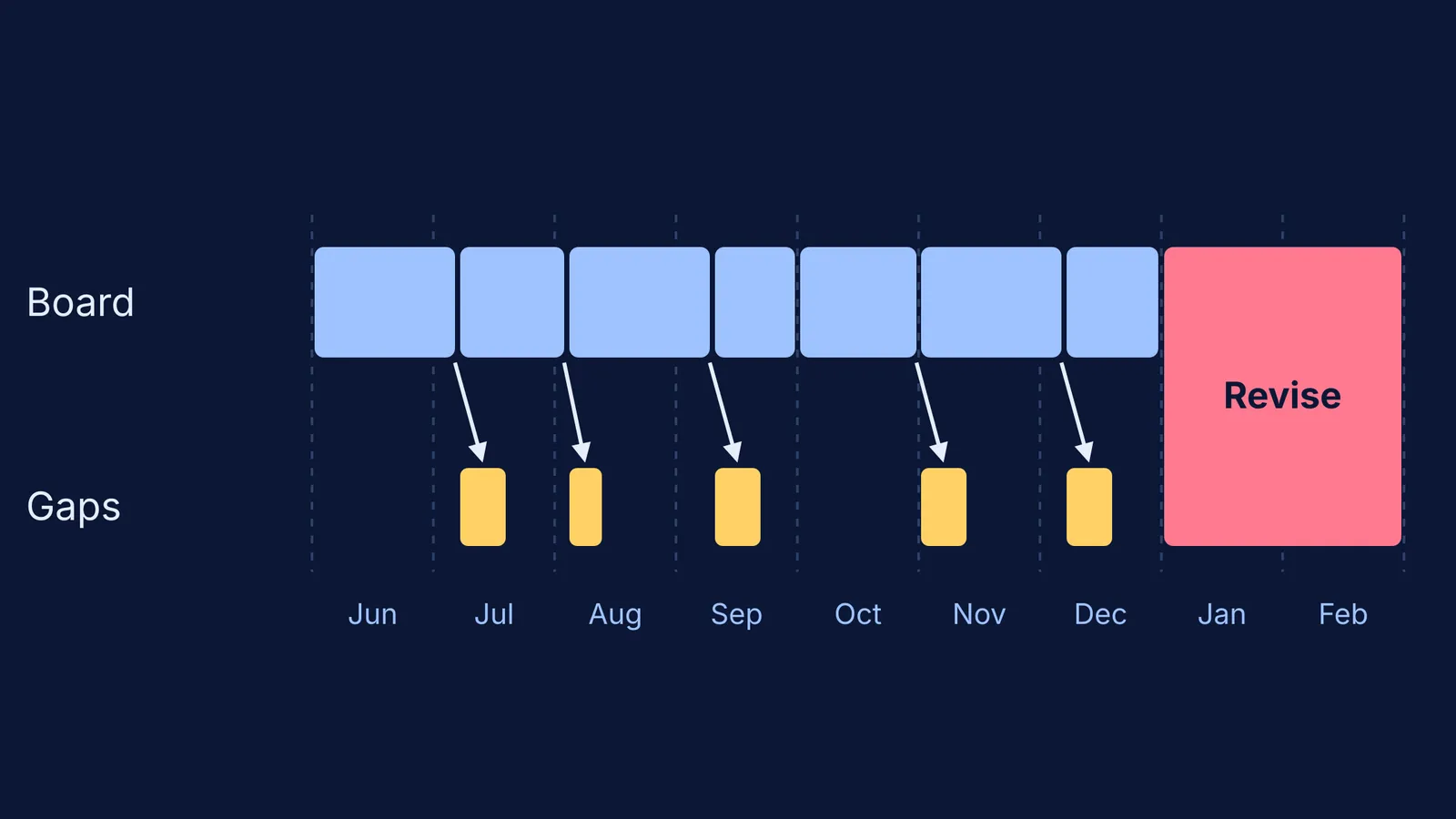
M topics: give them a gap slot within a week of the related board chapter, while the basics are fresh.
Order clashes: if a missing topic depends on something your board teaches later, put it on a holiday list for the Diwali or winter break.
A 2013 review by John Dunlosky and colleagues in Psychological Science in the Public Interest assessed 10 learning techniques. It rated practice testing and distributed practice as high utility and rereading and highlighting as low utility. So rather than one long sitting, come back to each gap topic across several weeks, and finish each slot by answering questions from memory, not by reading the page again.
A realistic week might have three short gap slots and a Saturday self-test on everything marked T or M so far. Our weekly plan for Class 11 physics shows one way to build a study week around school.
When your school doesn't teach a missing topic, the Fermi Concept Library gives every concept in physics, chemistry, biology and mathematics its own lesson and its place in the map, so you can see what the topic builds on before you start. Keep your S, T and M marks in the NCERT book itself. Our guide to annotating NCERT margins for revision shows how.
How can parents help a state board student preparing for JEE or NEET?
You don't need to know physics to help with the sorting. Try this on a Sunday: “You read out each line of the official syllabus, and I'll tick whether your board book has it.” When you meet a teacher, ask: “Which chapters in our board course differ most from NCERT, and is there anything we skip?”
Then protect the gap slots in the family week, as you would a tuition class. For the bigger picture, see our guide to helping your child balance Class 12 boards and entrance exams.
If a long M list leaves you unsure where to begin, Fermi's AI tutor can work out what you already know and build a plan for the session, so a long list becomes one clear next step.
Print the syllabus tonight and sort one unit. By the weekend, you'll know how big your gap really is.


