On this page
As exam boards increasingly move toward digital assessments, the physical act of typing is no longer just a technical skill—it is an academic advantage. Students who rely on the "hunt-and-peck" method hit a speed ceiling and split their attention between the screen and the keyboard. Learning to touch type shifts this process into muscle memory, keeping a student's full focus on their ideas.
When writing flows automatically, learning becomes more efficient. For example, when exploring a physics question in the Fermi Problem Library, the AI tutor holds a line of reasoning and asks checking questions. A fluid typist can answer at the speed of their thoughts, rather than losing focus while searching for a key. This smooth interaction makes digital learning feel as natural as a conversation.
Why does typing speed change how you think?
When you handwrite or hunt-and-peck, you use a significant portion of your cognitive working memory just to form the words on the page or screen. Touch typing automates this physical transcription, freeing up that valuable mental space for higher-order tasks like planning, structuring arguments and critical thinking. When you no longer need to consciously think about where your fingers are, your brain can dedicate its resources entirely to the subject matter.
The academic impact is notable. A 2025 study by researchers at University College London and Liverpool John Moores University tested pupils in mock exams. Students who used a keyboard scored higher and produced more detailed answers than those who wrote by hand. Typing allows for faster transcription and easier editing without crossings-out, leading to better-structured essays.
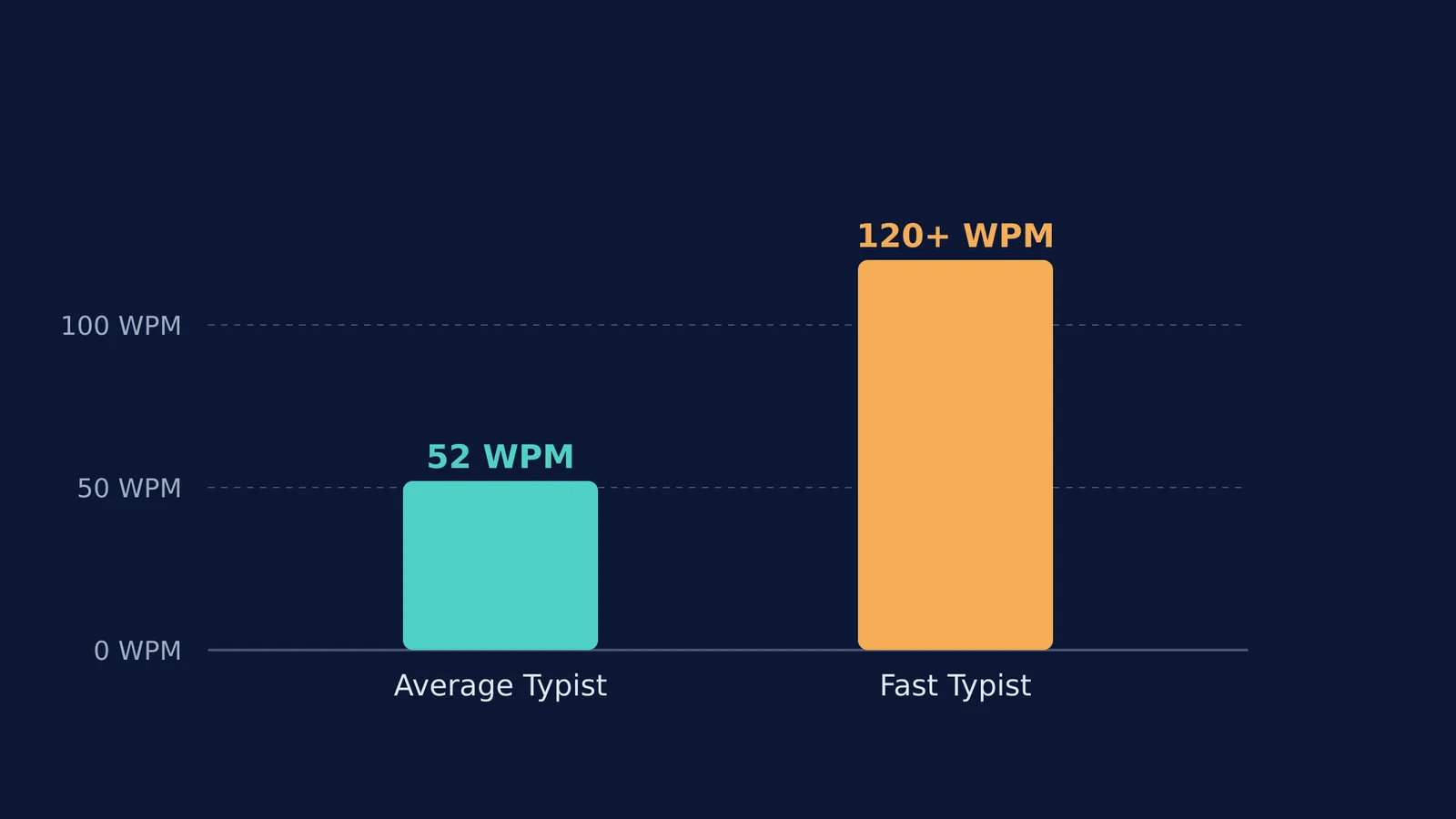
To understand what makes a typist fast, a 2018 study by Aalto University and the University of Cambridge analysed 136 million keystrokes. The average typist reached 52 words per minute (WPM). Interestingly, the fastest typists rarely used formal ten-finger techniques. Instead, their speed came from strict consistency—using the exact same finger for the same key every time.
The Aalto study found that fast typists use "rollover" for 40 to 70 percent of their keystrokes—pressing the next key before the previous one is released. You can only achieve this fluidity by keeping your eyes fixed on the screen, allowing your brain to process the visual feedback.
How can you learn touch typing in two weeks?
Transitioning from hunt-and-peck requires overriding old habits. Untrained typists plateau early because finding keys visually takes too much time. Just like understanding why some JEE aspirants plateau, breaking a speed ceiling takes deliberate practice. Here is a two-week plan to help you build a study routine that lasts and lay the foundations of touch typing.
Days 1 to 3: The home row and visual discipline
Place your index fingers on the F and J keys (feel for the small bumps).
Let your other fingers rest lightly on ASDF and JKL;.
Practice typing only these keys without looking down. The rule is absolute: if you make a mistake, use the backspace key by reach, but never look at your hands. Building visual discipline early is the most important step.
Days 4 to 7: Reaching the top and bottom rows
Introduce the keys directly above and below your home fingers.
Maintain your consistency. Using the same finger for the same key every time matters more than perfect traditional technique.
Prioritise accuracy over speed. Typing slowly with high accuracy builds better muscle memory than typing quickly with errors. Speed will naturally follow.
Days 8 to 14: Sentences and rollover
Begin typing full, simple sentences using all the alphabetical keys.
Focus on the rollover technique: anticipate the next letter in the word and prepare that finger before the current key is released. This overlapping movement is the secret to high speeds.
Limit your practice sessions to fifteen minutes a day to prevent fatigue and reinforce good habits without frustration.
What are the long-term benefits for college and work?
Proper posture is just as critical as finger placement. Sit back, keep your wrists slightly elevated above the keyboard, and ensure your screen is at eye level. Looking straight ahead, rather than hunching over the keys, prevents neck and eye strain during long study sessions.
Typing speed is an unseen productivity multiplier that compounds over time. In college and professional work, students will write longer essays, code complex programs, and manage heavy email workloads. The ability to type efficiently makes these tasks significantly less exhausting. When you type fast, a two-thousand-word essay feels less daunting because the physical act of writing is no longer a barrier.
It also changes how you learn interactively in the digital age. When exploring new concepts with Fermi's AI tutor, having the technical friction of typing removed means you can fully engage with the science being taught. The ultimate goal of touch typing is not just to finish an assignment faster, but to ensure that the keyboard never gets in the way of your critical thinking.