

On this page
If you are in Class 11 or 12 with school in the day and coaching in the evening, homework arrives from two places that never compare notes. School sets worksheets and practical files; coaching sets daily practice problems (DPPs) and modules. Nobody adds it up except you. You cannot do everything well, so the real skill is choosing.
How much homework is too much?
There is no single cut-off, but more hours stop paying off, and the hours that pay are the ones where you think for yourself.
In a study of 7,725 Spanish secondary students, about one hour of homework a day was the optimum for maths and science results, and working on your own mattered more than effort or time spent (Fernández-Alonso, Suárez-Álvarez and Muñiz, 2015). Those students were about 13, and a link is not proof of cause.
Older students at demanding schools can carry far more. A survey of 4,317 students at ten high-performing Northern California high schools found they averaged 3.11 hours of homework per weeknight, and only 6% called it 'very useful' for learning or test preparation (Education Week report on Galloway, Conner and Pope, 2013). Students who spent more time on homework reported more stress and physical health problems, partly because they did not get enough sleep.
Teenagers aged 13 to 18 need 8 to 10 hours of sleep per 24 hours, according to the American Academy of Sleep Medicine. If homework regularly pushes you below that, the load is too much. For the wider picture by age, read our post on how much homework actually helps.
What should you do fully, fast or skip?
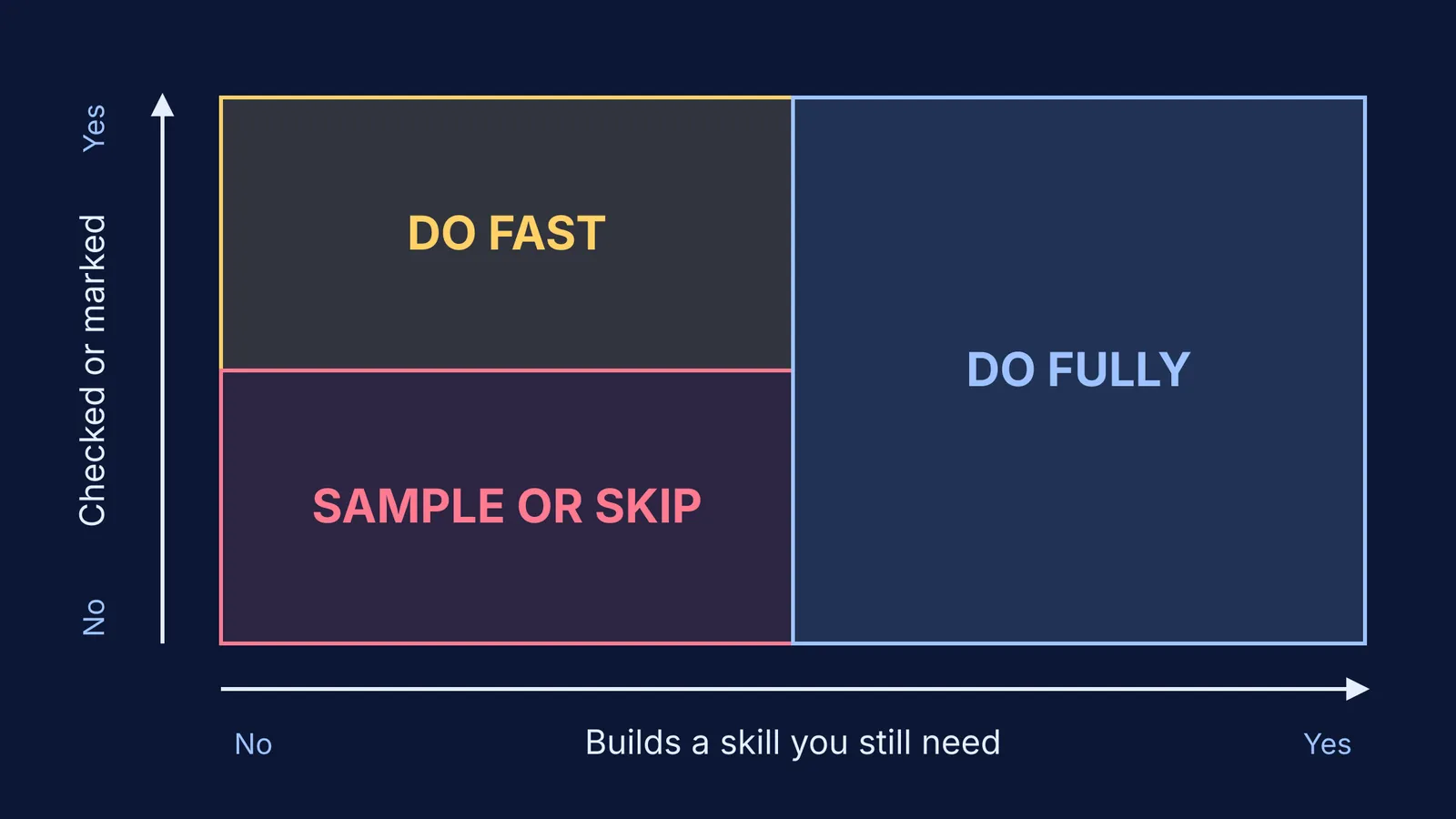
Ask two questions of every task:
Does it build something I still can't do, such as a weak chapter or a question type I keep getting wrong?
Will someone check it or mark it?
Then sort each task into one of three piles:
Do fully: anything that builds a skill you lack, checked or not. Work without the solutions open, then check, and redo every mistake.
Do fast: checked, but you can already do it, or it is mostly copying. Make it complete and neat, set a timer, don't polish.
Sample or skip: unchecked and low value for you. Do the two or three hardest questions to confirm you can, then stop.
When a do-fully problem stops you cold, the Fermi Problem Library has a step-by-step solver that explains the reasoning rather than printing an answer, so you can find where your method broke and try the next one yourself.
A worked example: one weekday evening
One hour a day, the optimum for maths and science in the Spanish study, is unrealistic for most coaching students, but the lesson holds: protect the time you spend thinking alone. Take a Class 11 student home from coaching at 8:30 pm, with about two and a half hours before sleep. The list:
School physics worksheet: 15 kinematics questions, checked tomorrow.
Coaching DPP: 25 kinematics questions, not collected.
Coaching chemistry module on the mole concept, her weakest chapter.
School chemistry practical file: two write-ups, due Friday.
School English: read one chapter for discussion.
Here is how it sorts:
Mole concept: do fully. Sixty minutes on 15 module questions, checked and corrected.
Kinematics: the DPP is harder, so she does its 10 toughest questions fully in 40 minutes, then the checked school worksheet fast in 20.
English chapter: fast, a 15-minute read noting two questions for class.
Practical file: fast, moved to Wednesday.
The rest of the DPP and module: skipped, written on a carry list for Sunday.
That is about two and a quarter hours, with the best of it spent on her weak chapter. If you never know where to start, Fermi's AI tutor can work out what you already know and build a plan for the session. To make this a weekly habit, see time blocking for students juggling school and coaching.
How do you tell teachers you can't finish?
Tell them before the deadline, show what you did, and offer a specific alternative.
To a school teacher: 'Ma'am, I have coaching until 8 on weekdays, so I couldn't finish the whole worksheet. I've done questions 1 to 10 and the two hardest ones. Can I hand in the rest on Monday, or is there a part you'd like me to focus on?'
To a coaching teacher: 'Sir, I'm doing the DPPs every day but can't finish all of them alongside school work. Which questions matter most, so I do those properly?'
Parents can help by asking the school how much homework each subject expects per week, bringing a list of real evenings rather than a complaint.
When is it more than a homework problem?
If you are short of sleep most nights, dread every evening, or feel hopeless, talk to a parent, a school counsellor or a doctor. Tele MANAS, the government's free mental health helpline, answers on 14416 or 1800-891-4416 (PIB).
If the carry list keeps growing week after week, you have a backlog, not a busy night: our triage plan for a JEE or NEET chapter backlog is the next step.


