

On this page
If you are an Indian student applying to US universities, you have likely encountered the term "test-optional." Across the US, roughly 90% of accredited four-year colleges—1,941 test-optional and 80 test-free institutions out of 2,247 tracked by the FairTest database—do not require standardized test scores for undergraduate admission.
Yet "optional" does not mean "irrelevant." Understanding how admissions committees evaluate Indian applicants without standardized test scores is crucial to deciding whether to sit for the SAT or ACT, when to submit your scores, and how to plan your high school years.
What does test-optional mean for Indian students?
In simple terms, a test-optional policy gives you the choice to submit your SAT or ACT scores. If you submit them, the admissions office factors your scores into their evaluation. If you do not submit them, your application is considered complete, and you are evaluated on your remaining materials.
However, you should not confuse test-optional with test-blind (also called test-free). At a test-blind institution, such as the University of California system, admissions officers do not review test scores even if you send them. At a test-optional university, submitted scores are actively reviewed and can provide an important competitive advantage.
For students from CBSE, CISCE (ICSE/ISC), or state board schools, applying test-optional fundamentally alters how your academic record is judged. US high schools use continuous grade point averages with standardized course levels across four years. In contrast, Indian schools rely on internal exams in Class 9 and Class 11, alongside external board exams in Class 10 and Class 12. Because Indian schools rarely provide US-calibrated grading curves, standardized tests give admissions officers an objective, globally comparable reference point.
How do US admissions officers read applications without test scores?
When an applicant withholds test scores, admissions officers must evaluate the candidate with one fewer quantitative anchor. That places greater weight on your transcripts, curriculum rigor, recommendations, essays, and extracurriculars. If you are balancing activities alongside academics, research on how extracurriculars interact with academic marks shows that sustained commitment matters far more than casual club memberships.
Admissions officers examine your trajectory across Class 9, Class 10, Class 11, and Class 12 predicted marks. This creates a hurdle for Indian applicants. Internal Class 11 exams are notoriously deflationary: students who scored top marks in Class 10 often see their school marks drop sharply during Class 11, particularly while managing demanding entrance coaching.
Admissions officers unfamiliar with your school cannot easily distinguish between routine grade deflation and an academic slump. An NBER study by Friedman, Sacerdote, Staiger, and Tine found that standardized test scores were four times more predictive of first-year college grades than high school GPA across Ivy-Plus universities. Students admitted without test scores performed comparable to peers scoring roughly 1300 on the SAT. Without test scores, admissions committees scrutinize transcripts with heightened caution.
When should you submit your SAT score or withhold it?
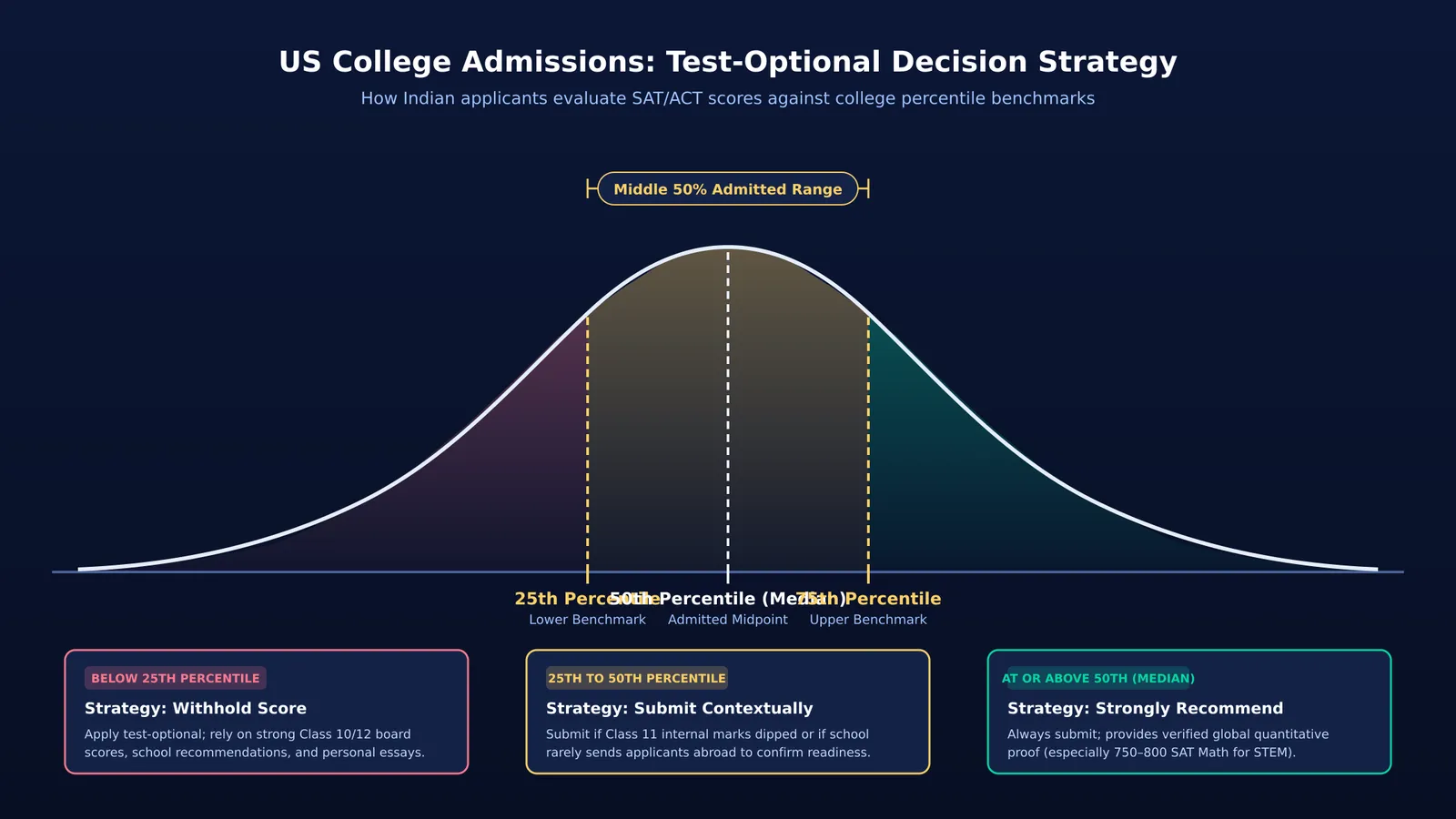
Deciding whether to submit your score requires checking each college's Common Data Set for its middle 50% range—the 25th and 75th percentiles of admitted students, as explained in College Board's score guidance.
You can use the following decision framework:
Submit if you are at or above the median (50th percentile): Sending your score reinforces your academic standing. For STEM applicants, an SAT Math score between 750 and 800 provides clear proof of quantitative mastery.
Submit between the 25th and 50th percentile with an uneven transcript: If your Class 11 marks dipped or your school rarely sends applicants abroad, a score in this band confirms your academic readiness.
Withhold below the 25th percentile: If your score falls below the 25th percentile, it may weaken an otherwise competitive profile. Applying test-optional lets committees focus on your board marks and essays.
How should you plan your high school testing timeline?
If you take the SAT or ACT, planning avoids clashes with board exams. In its testing guidelines, Dartmouth College's admissions office noted that while national exams like CBSE or ICSE can fulfill testing requirements, final results must be available by February. Because Class 12 board results arrive in May, current Indian seniors cannot use final board marks to satisfy testing mandates.
To balance school exams and testing, structure your high school timeline systematically:
Class 10 (January–April): Focus entirely on your board examinations.
Class 11 (May–November): Familiarize yourself with the digital SAT. Build steady habits using building a study routine that lasts.
Class 11 (December–March): Take your first SAT attempt. Parents can assist by teaching your child to plan their time to prevent burnout.
Class 12 (May–August): Retake the exam if needed before application deadlines.
When preparing for quantitative sections alongside school coursework, Fermi's AI tutor can work out what you already know and build a plan for the session, keeping revision targeted. For conceptual practice in mathematics and science, the Fermi Problem Library provides worked problems with a step-by-step solver that explains the reasoning rather than printing an answer.
Treating test-optional policies as a strategic tool gives you the flexibility to present your strongest possible academic case to universities abroad.


