

On this page
If you go to maths tuition three evenings a week, maths starts to feel like the subject that matters. Tuition homework has a deadline and a person who checks it. Physics and chemistry have neither, so they get whatever time is left, which is often none.
This is a common situation. India's Comprehensive Modular Survey: Education 2025, part of the 80th round of the National Sample Survey and released by MoSPI, found that 27.0% of school students were taking or had taken private coaching in the current academic year, 30.7% in urban areas and 25.5% in rural areas.
Why does the tutored subject take over?
The tutored subject has a fixed time, a set task, and someone who notices if you skip it. The others live under "whenever I get time". The fix is to give them the same three things, on paper, before the week starts.
Peter Gollwitzer and Paschal Sheeran pooled 94 independent tests of implementation intentions38002-1), plans that spell out in advance when, where and how you will act, in an if-then form. They found a medium-to-large effect on reaching goals (d = 0.65). The plans helped people get started and shield a goal they were already pursuing from unwanted influences.
The second idea is spacing. Nicholas Cepeda and colleagues reviewed 317 experiments on distributed practice in verbal recall tasks, where study is spread across sessions rather than crammed into one. They found that the gap between sessions giving the best recall grew as the time until the test grew. That points towards three shorter chemistry slots a week rather than one long Sunday catch-up.
How do I plan the other subjects around tuition?
Use five rules, in this order.
Mark tuition first. Block the class plus travel time, so the calendar shows what is really free.
Cap tuition homework. Give it one slot right after you get home, say 40 minutes, with a timer. Whatever is unfinished moves to the weekend slot, never into tonight's physics.
Give every other subject a named slot. At least three a week for each main subject, each with a task ("Physics, Laws of Motion, four NCERT examples"), not just a subject name.
Write the switch as an if-then. "If it is 7:50 on Monday, then I close maths and open physics." Write it on the timetable itself.
Keep one weekly review. A mixed-problems session and ten minutes to plan next week.
What does a week look like with tuition for one subject?
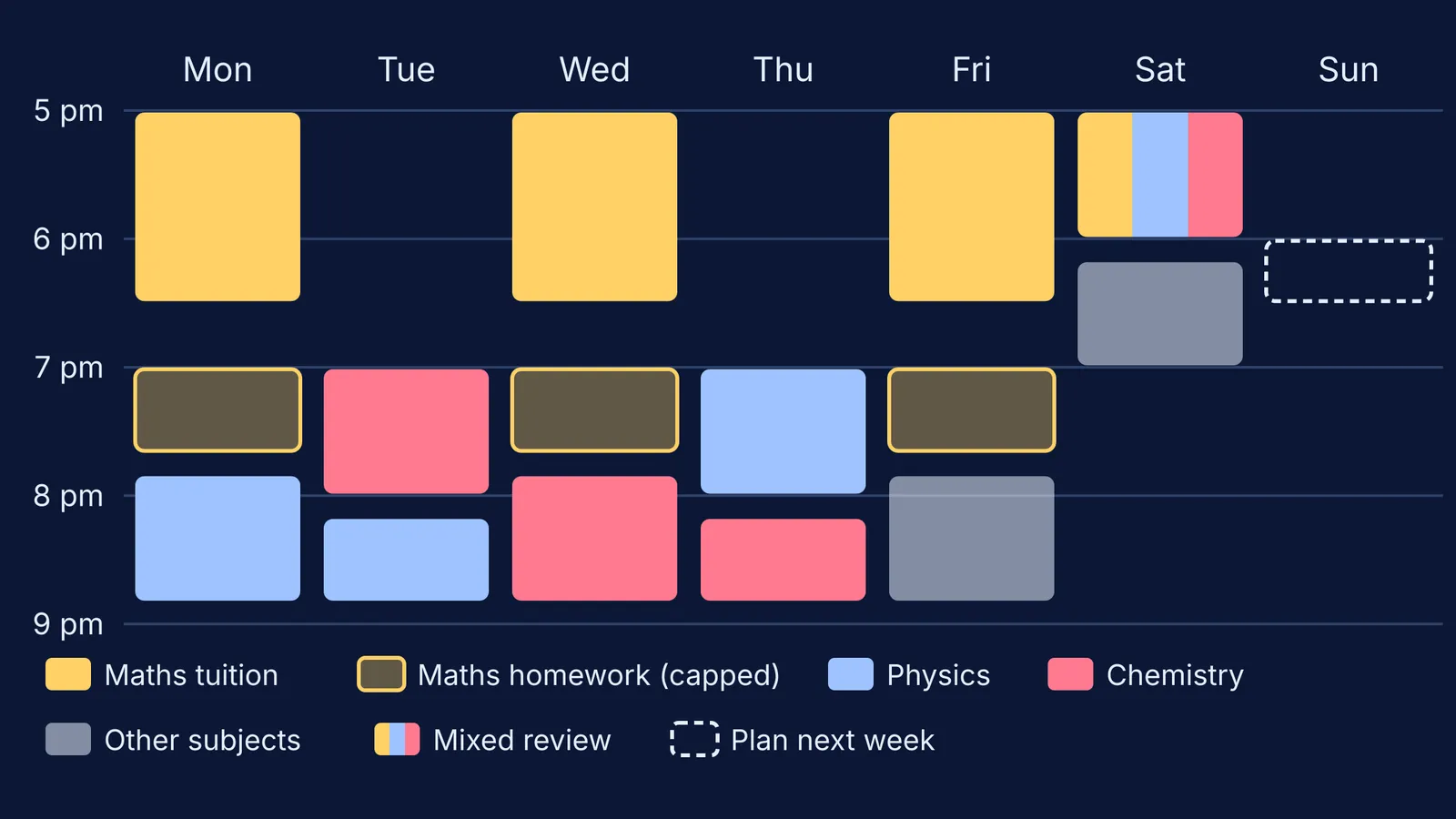
Here is a worked example for a Class 11 student with maths tuition on Monday, Wednesday and Friday from 5:00 to 6:30 pm, and about 100 minutes of self-study on weekday evenings.
Monday: 7:00 to 7:40 maths homework, 7:50 to 8:50 physics
Tuesday: 7:00 to 8:00 chemistry, 8:10 to 8:50 physics problems
Wednesday: 7:00 to 7:40 maths homework, 7:50 to 8:50 chemistry
Thursday: 7:00 to 8:00 physics, 8:10 to 8:50 chemistry problems
Friday: 7:00 to 7:40 maths homework, 7:50 to 8:50 English or other school subjects
Saturday: 5:00 to 6:00 mixed problems from maths, physics and chemistry, then 6:10 to 7:00 other subjects
Sunday: 6:00 to 6:30 check the week and plan the next one
Maths still gets the most total time, but physics and chemistry each get 160 minutes on weekdays before Saturday. Nothing depends on "time left over".
The Saturday hour works best when you mix problem types rather than doing one chapter. Our plan for interleaved practice explains why and how to set it up.
What if I get stuck in a subject with no tutor?
Without a tutor, doubts pile up. Keep a doubt list per subject and take it to your school teacher once a week. In between, sort each doubt first. If you do not understand the idea itself, the Fermi Concept Library covers every concept in physics, chemistry, biology and mathematics, each with its own lesson. If you know the idea but your method keeps going wrong, the Fermi Problem Library has worked problems with a step-by-step solver that explains the reasoning rather than printing an answer.
How can parents help without adding another tuition?
Before booking a second tutor, try the plan for three weeks, with one short weekly check instead of daily questions. You could say: "Maths tuition seems to be going well. Show me where physics and chemistry sit this week, and which slot you missed."
If you are already paying for several classes, our guide on how to judge each tuition and drop the overlap can help you decide what is worth keeping.
Tonight, write tomorrow's slots for your untutored subjects, each with one task and one if-then switch.


