

On this page
A house move takes over the cupboards, the evenings and your desk. If you are in Class 10, 11 or 12, or preparing for JEE or NEET-UG, stopping completely feels risky, and a full timetable rarely survives the packing. The middle path works better: protect a small, fixed amount of study and make it count.
How do you keep studying when your family is shifting house?
Follow three rules.
Pack your study kit last. The books for your current chapters, one notebook, pens and a charger stay out until the final night.
Set it up first. In the new house, your desk (or a corner of a table) is the first thing you unpack, before your clothes.
Go lighter, not to zero. Plan shorter sessions for the move week, and decide when they happen before the week starts.
Deciding in advance helps. A 2006 meta-analysis by Peter Gollwitzer and Paschal Sheeran combined 94 independent tests and found that "if-then" plans had a medium-to-large effect on reaching goals, d = 0.65 (Advances in Experimental Social Psychology). For a move, an if-then plan sounds like: "If the packers are in my room, then I study at the dining table for 30 minutes after lunch."
What should go in your study kit?
Keep it to one bag or one small box, labelled clearly so nobody loads it onto the truck by mistake.
Textbooks and notes for the chapters you are on now, not the whole syllabus
One rough notebook, plus your formula sheet or flashcards
Pens, a small clip-on lamp, a charger and earphones
Your upcoming school and coaching test dates
A printed copy of your move-week plan
On the first evening in the new house, set up the corner with the basics from our study space checklist for parents: good light, a chair that fits the table, and the phone out of reach.
What does a lighter move-week plan look like?
What you do in the short sessions matters as much as how long they are. In Henry Roediger and Jeffrey Karpicke's 2006 experiments, students who took recall tests on a passage remembered more 2 days and 1 week later than students who restudied it, even though restudying made them feel more confident (Psychological Science). So in move week, quiz yourself on chapters you have already done, and leave new chapters for when you are settled.
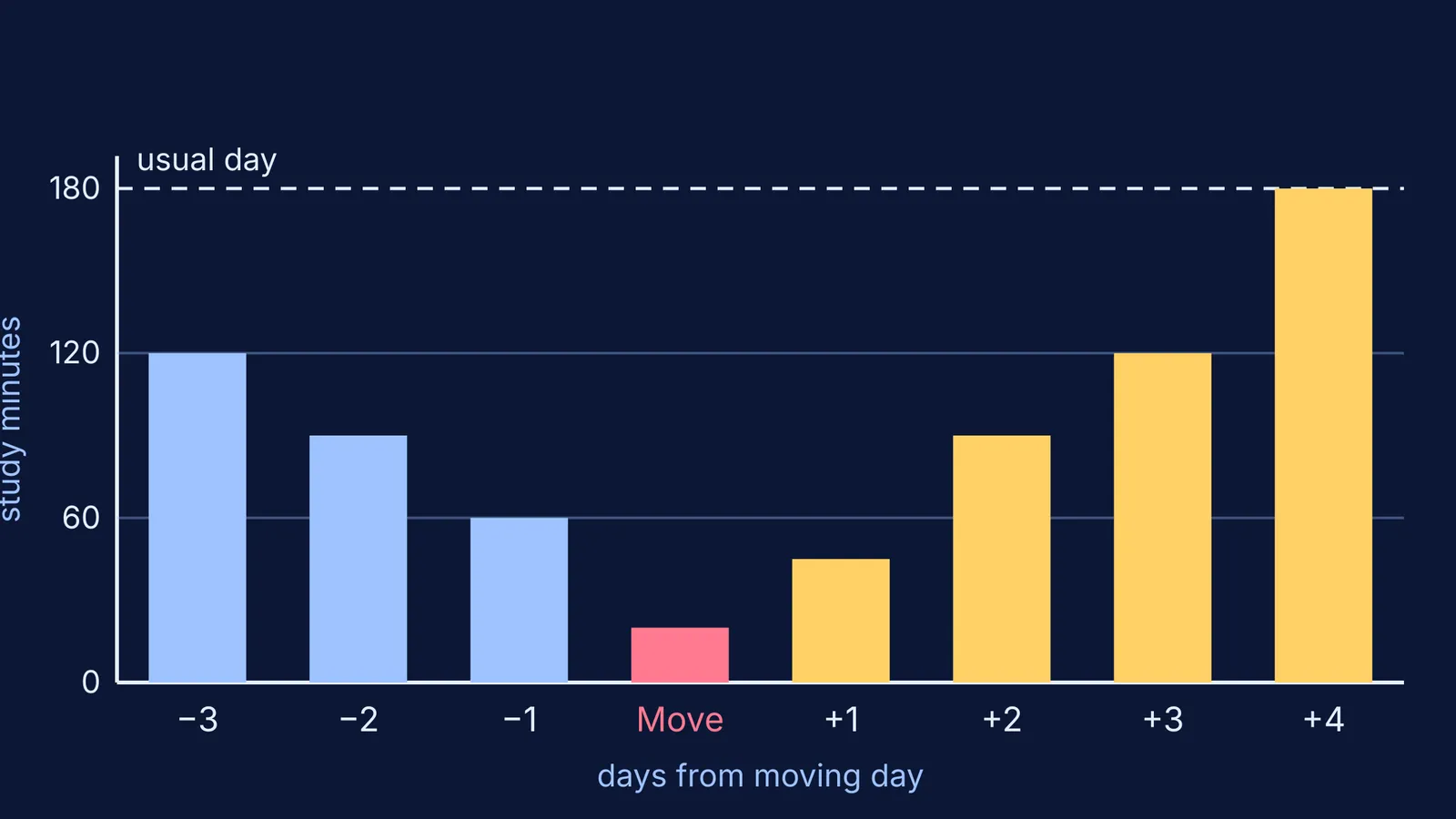
A worked example for a student who usually studies 3 hours a day outside school (scale it to your own day):
Three days before: 2 hours. Pack everything except the study kit.
Two days before: 90 minutes.
The night before: 1 hour, then pack the kit last.
Moving day: 20 minutes of self-testing from flashcards or a short question set.
The day after: set up the desk first, then 45 minutes.
Two days after: 90 minutes.
Three days after: 2 hours.
Four days after: back to your usual 3 hours.
Protect sleep too. The American Academy of Sleep Medicine recommends that teenagers aged 13 to 18 sleep 8 to 10 hours per 24 hours on a regular basis (Journal of Clinical Sleep Medicine).
If you come back from the move unsure which chapter to restart with, Fermi's AI tutor can work out what you already know and build a plan for the session, so you sit down to a clear next step. If the move has left you several chapters behind, use our triage plan for clearing a chapter backlog. For whether a new room affects memory, see what studies found about changing where you study.
How can parents help a student during the shift?
Pack the study kit together, and agree that it travels in the car with the family, not in the truck.
Give the student one move job with a clear end, such as packing the bookshelf, rather than "help whenever we call".
Protect one study slot every day, including moving day.
Get the internet connection and a desk light working before the TV.
A script the student can use: "I'll finish packing my room by Thursday. Can my study bag stay out until Friday night, and can I have a short slot after lunch on moving day when nobody calls me?"
What if the move falls during exams, or it all feels like too much?
If board exams or an entrance exam fall close to the move, tell your school or coaching teacher early and ask which upcoming tests matter most, then spend your plan's minutes there.
If worry, poor sleep or low mood carry on after you have settled in, talk to a parent, a school counsellor or a doctor. In India, Tele MANAS, the Ministry of Health and Family Welfare's mental health helpline, takes calls on 14416 or 1-800-891-4416 (Tele MANAS).
Write your own move-week plan tonight, before the first box is taped.


