

On this page
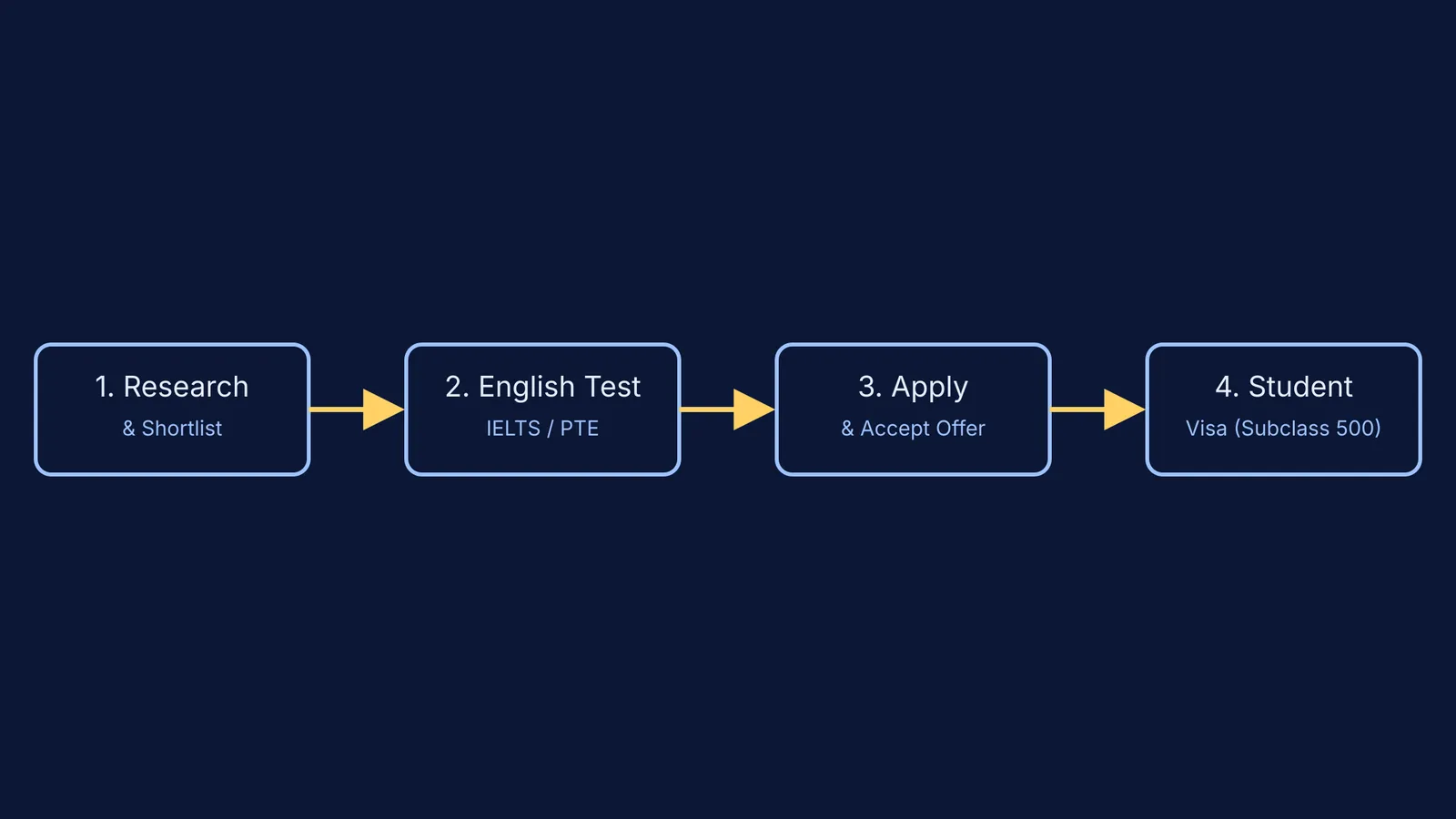
Australia is a major destination for Indian students finishing Class 12, offering internationally recognised degrees and clear post-study work pathways. However, the process of moving from a CBSE or state board classroom to an Australian campus involves strict academic, English, and financial requirements. Here is how the process works and what you need to prepare.
What are the academic and English requirements?
Australian universities look directly at your Class 12 board exam results. Your Indian Class 12 qualification (like CBSE, ISC, and most state boards) is widely recognised as equivalent to the Australian Year 12.
For a standard Bachelor's degree, most universities require an overall aggregate of 65% to 75%. Competitive programs, such as Engineering or Computer Science at Group of Eight (Go8) universities, typically require 85% or higher. Some courses also set subject-specific prerequisites, such as high marks in mathematics for engineering degrees.
Meeting these academic cut-offs requires a deep understanding of core subjects early on. If you are struggling with foundational concepts, Fermi's AI tutor can work out what you already know and build a plan for the session, so you sit down to a clear next step. Managing this alongside regular schoolwork can be demanding, which is why finding a study routine that lasts is crucial for maintaining your grades.
Because Australian degrees are taught in English, international students must also prove their language proficiency. The most common requirement is an overall IELTS Academic score of 6.0 to 6.5, with no individual band below 6.0. Equivalents like PTE Academic (typically requiring a score of 50 to 58) or TOEFL iBT are also widely accepted by universities and immigration authorities.
How to apply to Australian universities after Class 12?
The academic year in Australia primarily begins in February (Semester 1), with a secondary intake in July (Semester 2). You should start preparing your application at least six to eight months before your intended start date.
Research and shortlist courses: Use the official CRICOS registry to ensure your chosen course and university are registered to teach international students. This registry protects international students by guaranteeing course standards.
Submit applications: You can apply directly through the university's online portal or use an authorised education agent. You will need your Class 10 and 12 mark sheets, a valid passport, and your English test results. Many students also include a Statement of Purpose (SOP) to explain their motivation.
Accept the offer: If you meet all conditions, the university will issue a Letter of Offer. To accept it, you must pay the first semester's tuition deposit and arrange Overseas Student Health Cover (OSHC) for the duration of your stay.
Receive the CoE: Once your deposit is received, the university will issue a Confirmation of Enrolment (CoE). This document is your official proof of admission and is mandatory for your visa application.
Navigating offers and acceptances can be an anxious time for families. During this phase, it is important to help children learn without adding pressure as they transition to university-level expectations.
Which scholarships are available for international students?
Australian universities offer a range of scholarships that can significantly reduce your tuition burden. These are largely merit-based, rewarding students who achieve exceptional marks in their Class 12 exams.
Vice-Chancellor's International Scholarships: Many universities offer prestigious scholarships ranging from 20% to 50% of tuition fees. These often require a Class 12 average of 85% or higher.
Destination Australia Scholarships: Backed by the Australian government, this program encourages international students to study in regional Australia, offering up to AUD 15,000 per year.
Early Bird Bursaries: Some institutions offer a flat discount (often around AUD 2,000 to AUD 5,000) simply for accepting your offer and paying the deposit before a specific deadline.
Always check individual university websites for specific scholarship deadlines, as they often close months before the actual course intake begins.
What are the financial and visa requirements?
With your CoE in hand, the final step is applying for the Student visa (Subclass 500). The current base application charge for a student visa starts from AUD 2,500.
The Australian Department of Home Affairs requires you to prove you have enough money to support yourself without relying on work during your studies. Effective May 10, 2024, you must show you can cover the first 12 months of living costs, which is set at AUD 29,710 for a single student. You must also have funds for your first year of tuition and travel expenses (typically around AUD 2,000).
Alternatively, you can provide official tax documents showing your parents have a personal annual income of at least AUD 87,856.
You must also meet the Genuine Student (GS) requirement. This involves answering targeted questions in your visa application to demonstrate that your primary purpose for coming to Australia is to obtain a quality education and that the course aligns with your future career plans.


