

On this page
For a lot of Indian students, cricket season and exam season share the same calendar. In 2026 the IPL league stage ran from 28 March to 24 May, with evening matches starting at 7:30 pm IST and some afternoon games at 3:30 pm, according to Wisden's IPL 2026 fixtures list.
"Just checking the score" has a way of turning into twenty checks, so plan rather than rely on willpower. The plan has three parts: rules for score checks, a few matches you watch as planned rewards, and morning hours that cricket does not touch.
Why does checking the score break your concentration?
A score check feels quick; the cost comes after. In two experiments, management researcher Sophie Leroy found that people struggled to pull their attention away from an unfinished task, and their performance on the next task suffered (Leroy, 2009, Organizational Behavior and Human Decision Processes). She called this leftover thinking attention residue.
A live chase is about as unfinished as a task gets. Once you know the game is close, part of your mind stays with the required run rate while your eyes are on the chemistry chapter. Score-check rules that hold up:
Check only in a break between study blocks, never inside one.
One look at one app: the score, not the commentary, clips or group chat.
The phone then goes back to another room (see our guide to keeping your phone off the study desk).
On study nights, the last check is at a fixed time, say 9:30 pm. After that, the result waits for the morning.
How can you watch matches as a reward instead of a distraction?
A field experiment tested an idea called temptation bundling: allowing yourself something you want only while doing something you should do. Participants who could listen to gripping audiobooks only at the gym initially visited the gym 51% more often than a control group, though the effect faded over time (Milkman, Minson and Volpp, 2014, Management Science).
That study paired audiobooks with exercise, not cricket with homework, so treat it as an idea to test on yourself rather than a rule. The cricket version looks like this:
Every Sunday, look at the coming week's fixtures and pick two matches you really care about.
Write them into your timetable as match nights before the week starts.
On those nights, finish the evening study block before the first ball, then watch without guilt.
Every other match is a score-check night under the rules above.
Choosing in advance matters because you make the decision once, calmly, instead of every evening at 7:25 pm. More on this: how rewards affect study motivation.
Why protect your morning study hours during the IPL?
Teenagers aged 13 to 18 should sleep 8 to 10 hours per 24 hours on a regular basis, according to a consensus statement of the American Academy of Sleep Medicine. The same statement links regularly sleeping less than this with attention, behaviour and learning problems.
With evening matches starting at 7:30 pm (Wisden), watching to the last ball pushes bedtime late. So set a hard stop on match nights: if you wake at 6 am, lights go out at 10 pm, and whatever is left of the match becomes a result you read at breakfast.
Then guard the first block of the day. Before the phone, and before anyone mentions last night's match, spend 60 to 90 minutes on your hardest subject. Not sure mornings suit you? Our piece on studying in the morning or at night walks through the trade-offs.
If an early session tends to stall on "where do I even start", Fermi's AI tutor can work out what you already know and build a plan for the session, so you sit down to a clear next step.
What does a study week during IPL season look like?
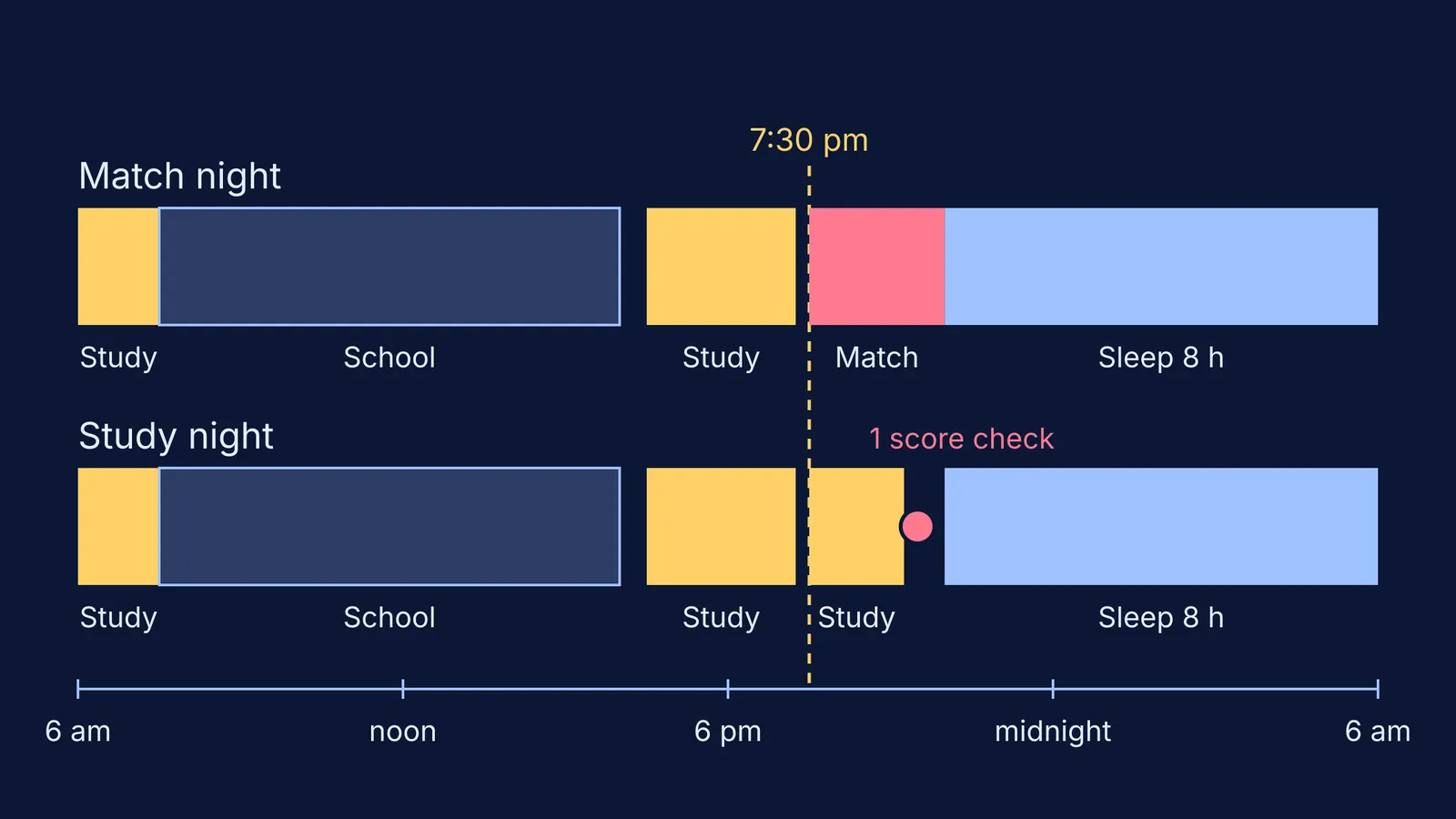
A worked example for a Class 12 student preparing for boards and JEE Main, with school and travel until about 4 pm:
Every day, 6:00 to 7:30 am: hardest subject, phone in another room.
Every day, 4:30 to 7:15 pm: two study blocks with a short break between them.
Study nights (five a week): a third block from 7:30 to 9:15 pm, one score check at 9:30, lights out at 10.
Match nights (two a week): watch from 7:30 pm, lights out at 10, result at breakfast.
On study nights, the 7:30 block suits mixed problems, because each problem gives you something definite to finish before the score check. A set from the Fermi Problem Library comes with a step-by-step solver that explains the reasoning rather than printing an answer.
For a World Cup played in another time zone, redo the times once the fixtures are out; the three rules stay the same.
If exam pressure starts to feel like more than match-day nerves, talk to someone you trust, or call Tele-MANAS, the free 24x7 national mental-health helpline launched by the Ministry of Health and Family Welfare, on 14416 (IIT Kanpur counselling service).
Pick your two matches for this week tonight.


