

On this page
Every year, students across India secure funding for their education through government schemes. Over 1.08 crore students apply for scholarships worth ₹5,200 crore through the National Scholarship Portal alone, according to the MeitY Annual Report 2022-23. However, finding the right scheme requires navigating both central and state-specific portals.
If you are a student or a parent looking for financial support, understanding how state government scholarships work is the first step. Most state scholarships are tied to your domicile—the state where you hold a permanent residence certificate.
Where do you apply for state government scholarships?
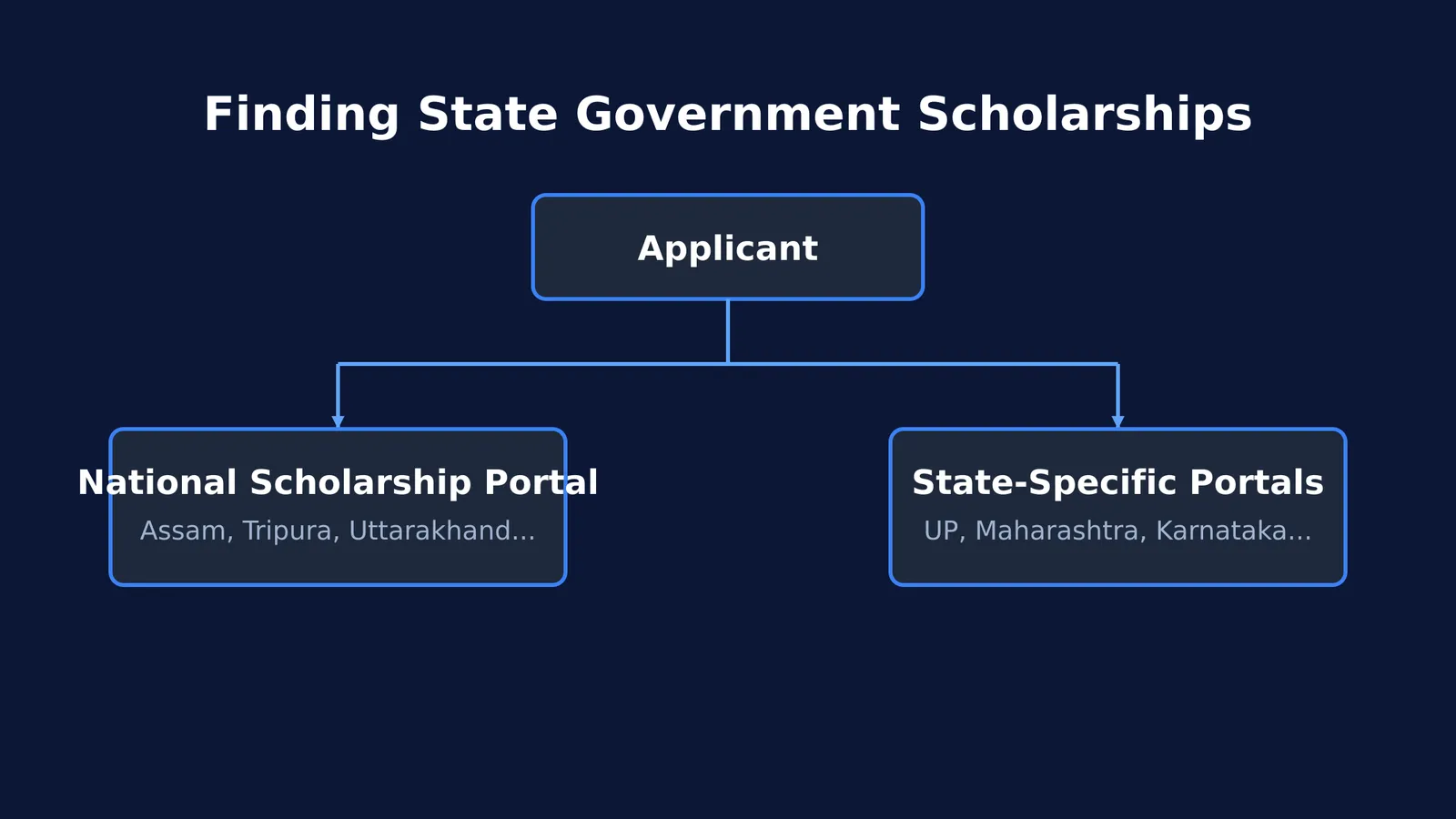
There is no single website for every scholarship in India. Instead, applications are split between a central hub and independent state websites.
The National Scholarship Portal (NSP) (scholarships.gov.in) hosts schemes for several states and union territories. If you live in Assam, Arunachal Pradesh, Manipur, Meghalaya, Tripura, Uttarakhand, or union territories like Chandigarh and Ladakh, you will find your state schemes listed directly on the NSP homepage under the "State Schemes" tab.
However, many larger states maintain their own independent portals. If your state has its own system, you must apply there. Some of the major independent portals include:
Uttar Pradesh: scholarship.up.gov.in
Maharashtra: mahadbt.maharashtra.gov.in
Karnataka: ssp.karnataka.gov.in
West Bengal: oasis.gov.in (for SC/ST/OBC) and wbmdfcscholarship.in (for minority students)
Rajasthan: scholarship.rajasthan.gov.in
Always check the NSP first. If your state is not listed there, search for your state's name alongside "scholarship portal" or look up the state's Social Welfare Department.
How to find state government scholarships for your profile?
State governments design schemes for specific groups. To find the ones you qualify for, look for these three common categories:
Pre-Matric and Post-Matric Schemes: These are the most common state scholarships. Pre-matric schemes support students from Class 1 to 10, while post-matric schemes cover Class 11, Class 12, undergraduate, and postgraduate studies. They are usually divided by category (SC, ST, OBC, EBC, or Minority).
Merit-cum-Means Scholarships: These target students who score well in their board or university exams but come from families with an annual income below a certain threshold. You can read more about where to look for scholarships for science students if you are pursuing STEM degrees.
Talent Search Exams: Many states run their own competitive exams to identify and fund bright students. For example, the NMMS scholarship for Class 8 provides financial aid to students who clear the National Means-cum-Merit Scholarship test.
If your scholarship requires an entrance test or high board marks in science, you can use the Fermi Concept Library to review every concept in physics, chemistry, biology and mathematics before the exam.
How to keep track of scholarship deadlines?
Missing a deadline is the most common reason students lose out on funding. Scholarship windows follow the academic cycle, but the exact dates shift slightly each year.
Opening Dates: Most state and central portals open their application windows between July and September.
Closing Dates: The initial deadlines usually fall between October 31 and December 31.
Extensions: While states often extend deadlines into January or February, it is risky to wait. Document verification by your school or college takes time, and late applications often get stuck at the institute level.
To stay on track, create a simple calendar. Mark the first week of August to check your state portal for new announcements. Set a personal deadline to submit your application by the end of October.
A checklist before you apply
Before the portals open, gather your paperwork. Rushing to get a certificate at the last minute can cause you to miss the window. Here is a practical plan to get ready:
Check your Aadhaar Seeding: Your Aadhaar card must be linked (seeded) to your active bank account. The government uses the Direct Benefit Transfer (DBT) system, which means the money is sent directly to your Aadhaar-linked account. You can verify this status at your bank branch.
Update your Domicile Certificate: This proves you are a resident of the state and eligible for its specific schemes.
Renew Income and Caste Certificates: Ensure these are recent and issued by a competent authority, such as a Tehsildar or Sub-Divisional Officer (SDO). Income certificates often need to be renewed annually.
Organize Academic Records: Keep your previous year's marksheet and a fee receipt from your current school or college. You will also need a bonafide certificate from your institute.
By preparing these documents early and knowing exactly which portal belongs to your state, you can secure the funding you need for the academic year. While a scholarship takes care of the fees, Fermi handles the actual learning by acting as a one-to-one AI tutor that teaches, explains and works through problems alongside the student.


