

On this page
When you clear the National Defence Academy written examination conducted by the Union Public Service Commission, you earn a call-up for the Services Selection Board interview. The written paper carries 900 marks, and the SSB interview carries an equal weight of 900 marks, creating a combined total of 1800 marks (UPSC Examination Notice). While the written stage tests your mastery of mathematics and general ability, the SSB evaluates your personality and leadership potential over five rigorous days at military selection centres across India (Join Indian Army).
The selection framework was established by the Defence Institute of Psychological Research (DIPR) to assess 15 core Officer Like Qualities (OLQs) grouped across planning, social adjustment, social effectiveness, and dynamism. In the *Defence Life Science Journal*, DIPR researchers Nishi Mishra, Apoorva Ghanekar, and Arunima Gupta (Mishra et al., 2018) explain how military leadership assessment relies on a triad model—psychological evaluation, group testing, and personal interviews—to measure core candidate attributes across cognitive, affective, behavioural, psychomotor, and value domains. For candidates who balanced board exams with defence preparation, our guide on the NDA exam for science students outlines how written scoring feeds directly into this selection pipeline.
How does Stage 1 screening work on Day 1?
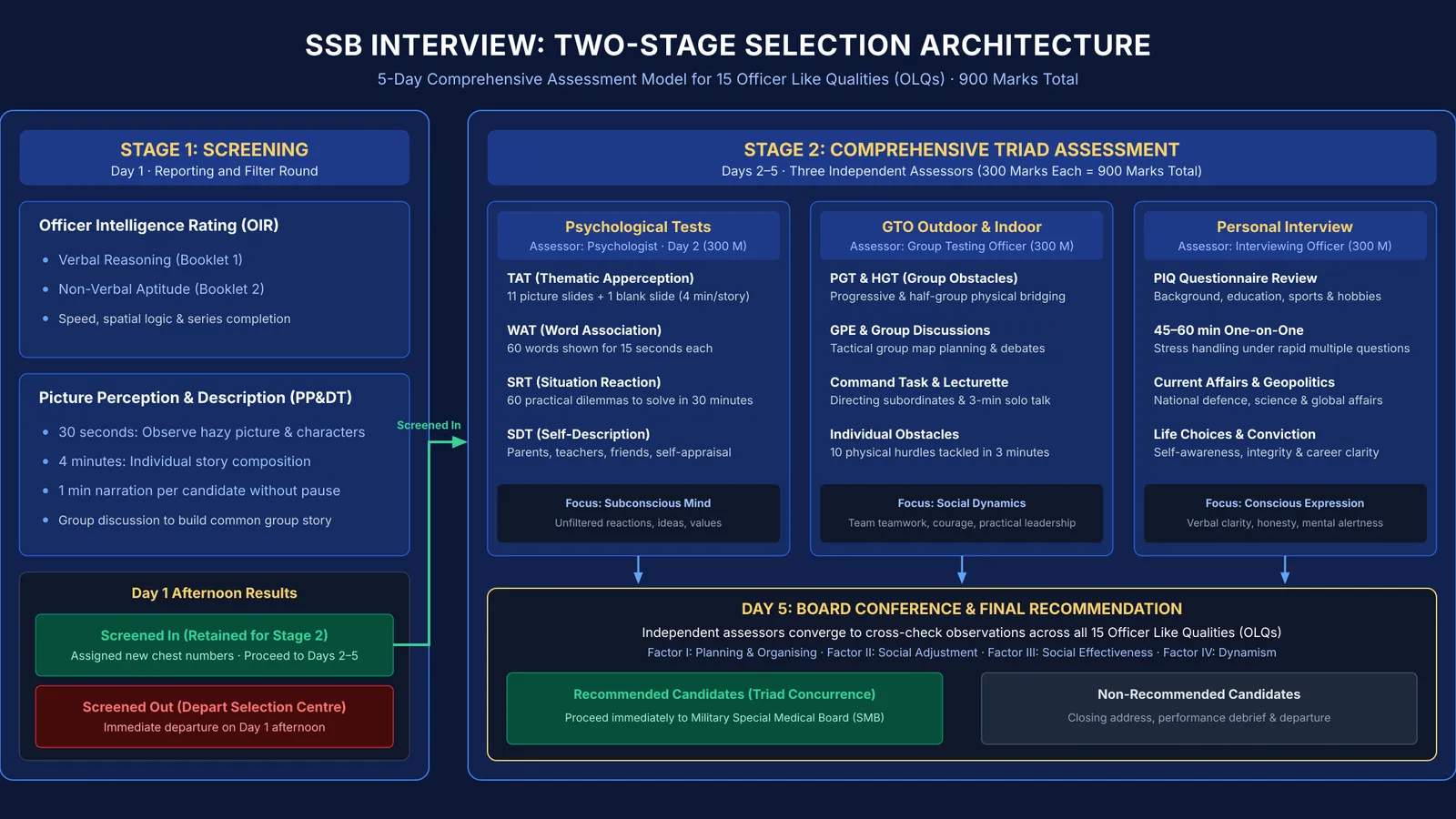
Day 1 functions as a strict elimination round called the screening test, designed to select candidates suited for detailed evaluation (Join Indian Army). You face two distinct exercises:
Officer Intelligence Rating (OIR) test: Two separate booklets comprising verbal and non-verbal reasoning problems that test spatial visualisation, number series, and logical deduction under tight time limits.
Picture Perception and Description Test (PP&DT): You view a hazy, ambiguous picture for 30 seconds, note the number of characters along with their age, sex, and mood, and then have 4 minutes to write an action-oriented story.
Once individual writing concludes, candidates are divided into groups of 12 to 15 (Join Indian Army). Each candidate delivers a 1-minute individual narration of their story without interruption, followed immediately by a group discussion to reach consensus on a single shared narrative. Candidates who clear both the OIR and PP&DT are retained for Stage 2, while the remaining candidates depart that afternoon. To succeed in the discussion, maintain clear vocal projection, avoid interrupting peers, and actively acknowledge valid points made by others rather than shouting to dominate the circle.
How are psychological tests, GTO tasks, and interviews assessed?
Candidates retained for Stage 2 undergo parallel evaluations conducted by three independent assessors over Days 2 through 5 (Join Indian Army):
The Psychologist evaluates your subconscious personality through projective testing on Day 2. You complete the Thematic Apperception Test (TAT) consisting of 11 clear picture slides and one blank slide with 4 minutes per story, the Word Association Test (WAT) with 60 words shown for 15 seconds each, the Situation Reaction Test (SRT) presenting 60 practical dilemmas to solve in 30 minutes, and a Self-Description Test (SDT).
The Group Testing Officer (GTO) assesses social dynamics and leadership through nine indoor and outdoor exercises on Days 3 and 4. These include the Progressive Group Task (PGT), Half Group Task (HGT), Group Planning Exercise (GPE), Command Task, and Individual Obstacles where you tackle 10 physical hurdles within 3 minutes.
The Interviewing Officer conducts a detailed personal interview lasting 45 to 60 minutes between Days 2 and 4, examining your academic background, sports, family dynamics, and general awareness based on your Personal Information Questionnaire (PIQ).
On Day 5, all assessors convene for the Board Conference (Join Indian Army). Each candidate appears for a brief interaction before the board compiles independent ratings to decide final recommendations.
What is the best strategy to prepare after the NDA written exam?
Preparing for the SSB requires genuine daily habit formation rather than memorising coaching templates, aligning with the behavioural competencies highlighted in the Join Indian Army selection guidelines. You can follow a structured 4-week preparation plan:
Week 1: Audit your Personal Information Questionnaire. Review your life choices, academic trajectory, achievements, and failures. Be prepared to explain why you made specific subject choices or how you handled setbacks in school.
Week 2: Build verbal fluency and current affairs awareness. Read national newspapers daily, write brief editorial summaries, and practice 3-minute lecturettes on contemporary topics. When revising basic scientific principles for technical questions in the personal interview, Fermi Concept Library offers structured lessons across physics and mathematics.
Week 3: Practice situational reasoning and active reflection. Write quick, practical resolutions for everyday emergencies without pretending to be a superhero. To manage nervous arousal before public speaking or high-stakes interviews, evidence on treating exam nerves as energy shows that reappraising racing heartbeats as helpful excitement improves performance under scrutiny.
Week 4: Strengthen physical stamina and mental agility. Run two to three kilometres daily and practice push-ups and pull-ups for the outdoor obstacle course. Research examining how exercise helps learning and endurance demonstrates that cardiovascular fitness directly supports sustained attention during demanding multi-day tests.
If you struggle to organise your revision hours alongside everyday schoolwork, Fermi's AI tutor can work out what you already know and build a plan for the session so you practice reasoning with confidence. Approach each task with honesty, listen attentively to your peers, and let your natural problem-solving guide your performance.


