On this page
Every year, engineering and science students look for ways to build real-world projects. The Smart India Hackathon (SIH) is one of the largest national platforms for this, but getting in requires navigating a strict college-level selection process.
If you are planning to enter, you cannot simply sign up on the website. Here is exactly how college teams participate, from finding a problem statement to winning the internal college round.
What is the Smart India Hackathon?
The Smart India Hackathon is a nationwide initiative where students solve pressing problems faced by government ministries and private industries. Teams choose from themes such as Smart Automation, MedTech, and Space Technology. According to the official SIH 2024 portal, the college-level Grand Finale ran from 11 to 15 December 2024.
The competition is split into Software (digital solutions) and Hardware (physical prototypes) editions. Before reaching the national stage, however, every team must pass their college's internal screening.
How to form a team for the Smart India Hackathon?
The organisers have strict rules for team composition. If your group does not meet these criteria, your college cannot nominate you.
According to the SIH 2024 rules, every team must have exactly 6 members. The SIH 2024 guidelines also make it mandatory to include at least one female member per team. Finally, all 6 students must be enrolled in the same college, as inter-college teams are not permitted.
While it is not officially mandated, successful teams usually mix their skills. A software team typically needs frontend developers, backend specialists, and someone who can design the interface and deliver the final presentation.
What is the college registration process?
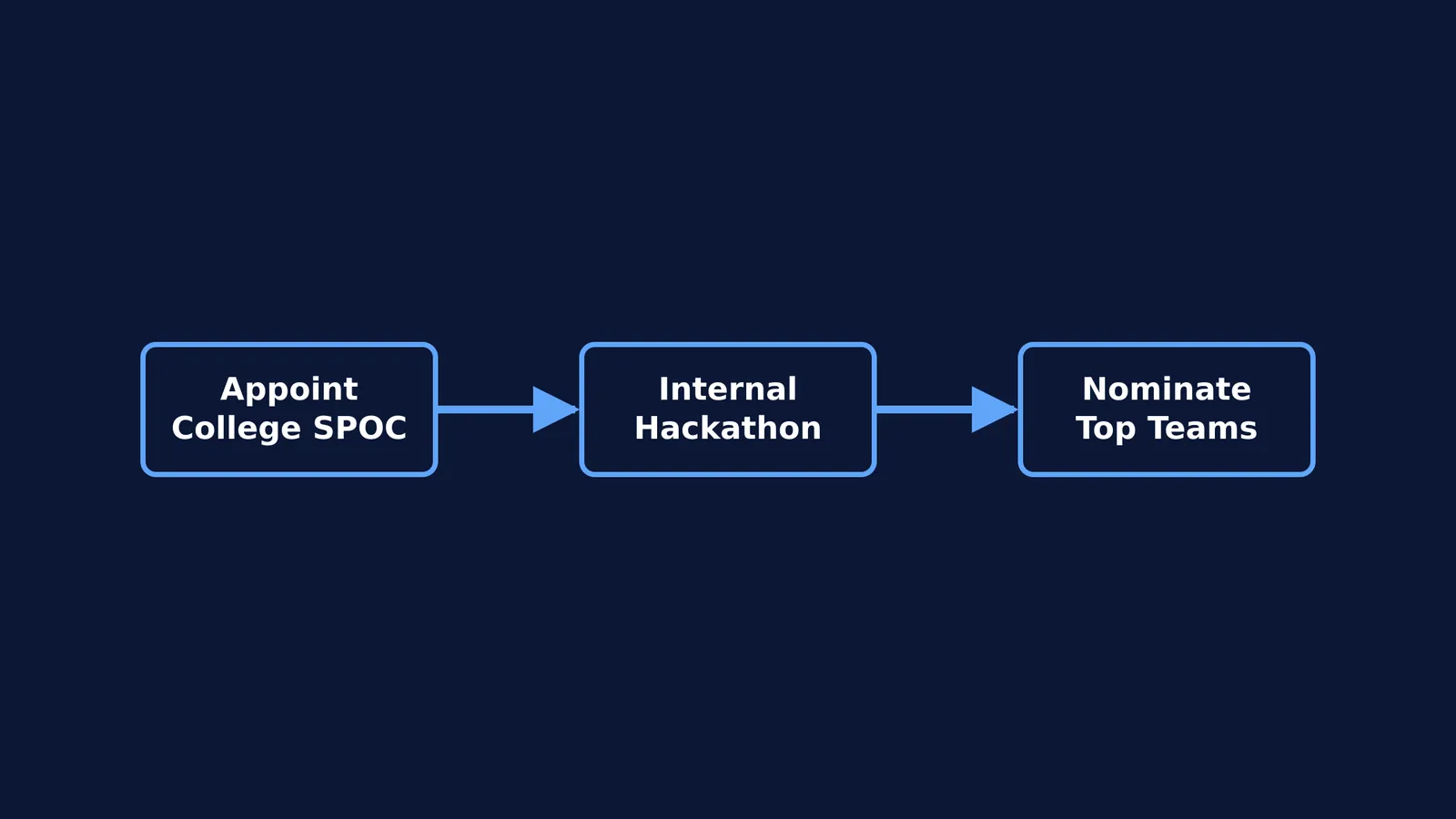
Individual students cannot register their own teams directly. The entire entry process is routed through your college.
The College SPOC: Your institute must appoint a College Faculty Single Point of Contact (SPOC). This professor registers the college on the SIH portal.
The Internal Hackathon: The college is required to organise a mandatory Internal Hackathon. This is a local competition where all interested teams in your college pitch their solutions.
The Nomination: After the internal round, the SPOC uploads the winning teams' details and presentation slides to the national portal.
To start your journey, find out which professor is acting as the SPOC for your college and ask for the date of the internal hackathon.
How to prepare for the Internal Hackathon?
Your first real hurdle is convincing your college jury that your idea is worth nominating.
Here is a practical plan for the internal round:
Pick the right problem: Review the official problem statements as soon as they are released. Choose a highly specific problem where your team has the technical skills to build a working prototype, rather than a vague, broad topic.
Use the official template: Submissions must follow the official Idea PPT format. Keep your slides clean and focus on the architecture and technology stack you will use.
Address knowledge gaps early: If your solution requires a concept you haven't mastered—such as a specific machine learning algorithm or data structure—start learning it before the internal pitch. If you are stuck on the underlying mathematics or computer science theory of your project, we built Fermi's AI tutor to help. The tutor works out what you know and builds a plan for the session, teaching you the concepts rather than just printing a block of code.
Consult the library: If you need to quickly revise algorithms or physics principles for a hardware project, the Fermi Concept Library offers structured explanations for university-level topics.
Building a strong project for the Smart India Hackathon is a great way to improve your resume. If you are looking ahead to your career, a national hackathon project is a strong addition when figuring out how to get a job off campus as a fresher in India. If you are coding late into the night in your dorm, knowing how to set up a study desk in a hostel room will help you stay productive.
How are hackathon ideas evaluated?
During both the internal college round and the national screening, juries look for specific qualities in your submission. The SIH 2024 guidelines state that solutions are judged on novelty, feasibility, impact, and user experience.
Novelty: Does your idea solve the problem in a new way? If you are simply copying an existing commercial application without adding unique value, the jury will likely reject it.
Feasibility: Can your team actually build this prototype in the given timeframe? According to the SIH 2024 portal, the Software edition Grand Finale involves a 36-hour continuous coding session. A common mistake is proposing a massive platform that would take months to develop. Focus on a core, functional prototype.
Impact: How well does the solution address the core issue outlined in the problem statement? The jury wants to see that you understand the end user's pain points.
User experience: Even for complex technical solutions, the interface must be intuitive. A working prototype with a clean design often scores higher than a complex backend with a confusing interface.
Final checklist for your SIH entry
Before you submit your idea to your SPOC, verify these details:
Do you have exactly 6 members?
Is there at least one female team member?
Are all members from the same college?
Does your presentation use the official SIH PPT template?
The Smart India Hackathon is a test of execution as much as ideas. Get your team together early, clarify the internal deadlines with your college, and start building.