

On this page
Many students pick a round number like "99 percentile" because it sounds good. A target you can work towards starts at the other end: the seat you want, then rank, percentile, marks per subject and this week's work.
How do you turn a college into a target rank?
JoSAA publishes opening and closing ranks by round, institute, programme and seat type. For NITs, IIITs and other GFTIs these are JEE Main ranks; for IITs they are JEE Advanced ranks, so this method covers the NIT+ system.
Take the final-round closing rank for your seat type, check two or three earlier years in JoSAA's archive, and use the toughest. For a category seat, the closing rank is a category rank, so compare like with like.
Board marks count too. JoSAA's 2026 business rules require NIT+ candidates to have at least 75% aggregate in Class 12 (65% for SC, ST and PwD candidates), or to be in the category-wise top 20 percentile of successful candidates in their board exam. Our parents' guide to JoSAA rounds and choices walks through it.
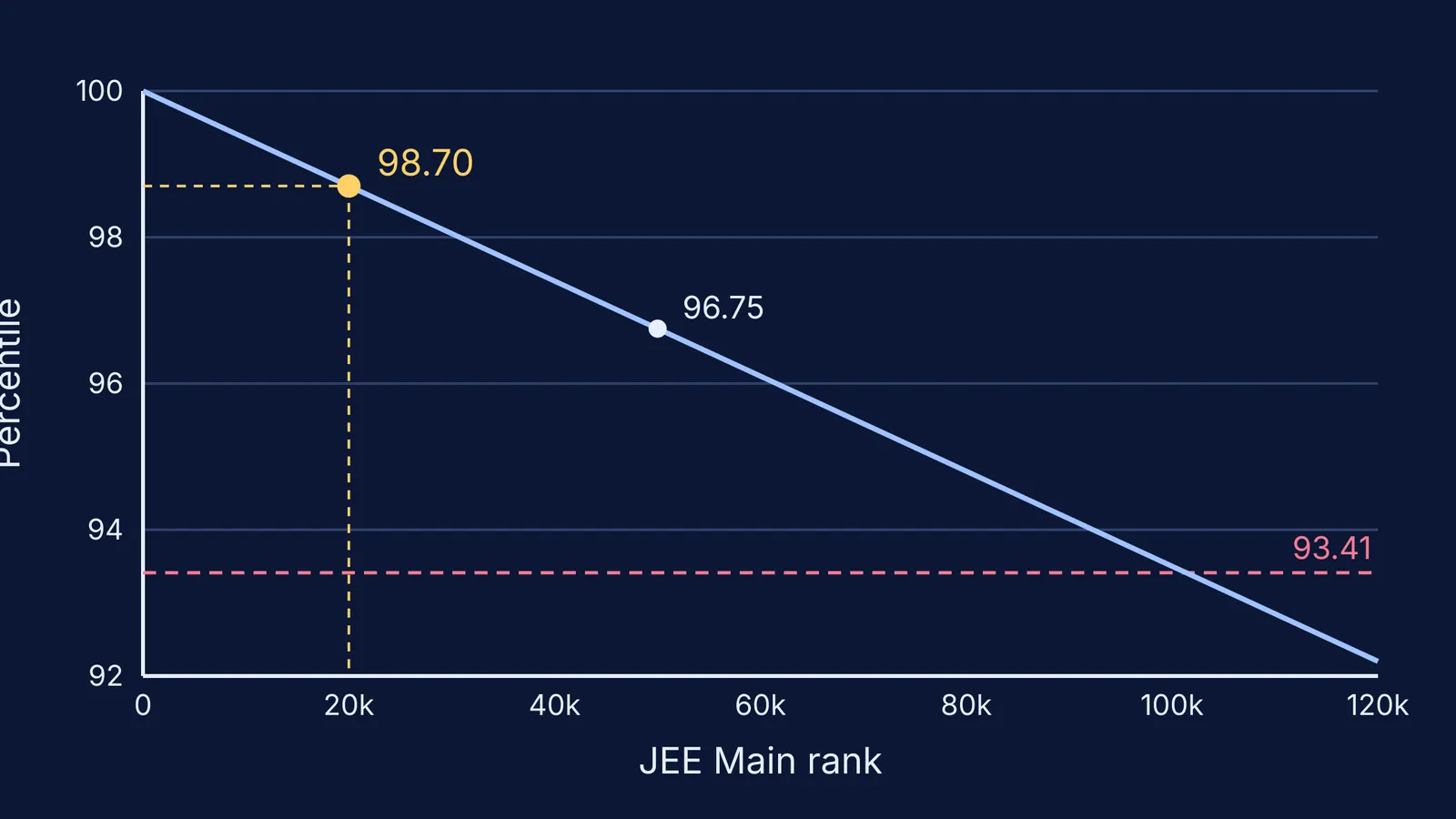
For IITs, JEE Main is the gate to JEE Advanced. In 2026, the General (UR) cutoff to qualify for JEE Advanced was 93.4123549 percentile, according to NTA's 20 April 2026 result notice.
How do you convert a rank into a JEE Main percentile?
NTA's information bulletin defines your percentile as 100 times the number of candidates in your shift who scored the same as you or lower, divided by the number who appeared in that shift. It is not your percentage of marks, and your total percentile is not the average of your subject percentiles.
So you can estimate a percentile from a rank:
Percentile ≈ 100 × (1 − target rank ÷ total candidates)
NTA's 2026 result notice says 15,38,468 unique candidates sat Paper 1 across both sessions. On that count, a rank of 20,000 works out to about the 98.7th percentile. A rank of 50,000 works out to about 96.75. These are estimates, since the count changes every year and percentiles are worked out shift by shift (see how JEE Main percentile and shift normalisation work).
How many marks do you need in each subject?
Paper 1 has 75 questions, according to the JEE Main 2027 bulletin. That is 25 each in mathematics, physics and chemistry: 20 multiple-choice questions and 5 with numerical answers. Each subject is worth 100 marks, for 300 in total. A correct answer earns +4, a wrong one costs 1 mark, and an unanswered question scores 0, in both sections.
The bulletin gives no fixed marks-to-percentile table, and the same raw score can give different percentiles in different shifts. So set a marks range from full-length mocks that report an all-India percentile, aiming a little above where your percentile has fallen recently. Split the marks by where they are cheapest for you, not equally.
Here is a worked example. Say your programme closed near rank 20,000 (an example; look up your own). That is about the 98.7th percentile. Suppose your test series suggests that percentile has needed about 185 marks, so you aim for 190. Your last three mocks averaged 150: maths 40, physics 50, chemistry 60. You need 40 more marks.
Chemistry, 60 to 72: three more correct answers.
Physics, 50 to 66: four more correct answers.
Maths, 40 to 52: two more correct answers and four fewer wrong ones.
Each wrong answer you stop making is worth 1 mark; turning a wrong attempt into a correct one is worth 5.
How do you turn the target into weekly goals?
Session 1 of JEE Main 2027 is scheduled for 20 to 28 January 2027 and Session 2 for 2 to 7 April 2027, according to NTA's 2027 information bulletin. From late October, that leaves about 12 weeks: plan three four-week blocks.
Each week, name one chapter per subject that will produce your extra marks.
Set a question count for each and record how many you get right.
Sit one timed full mock a week; write each subject score beside its target.
Sort every wrong answer: concept gap, wrong method or careless slip.
After each block, compare your average with the target. If you are well short, re-split the marks rather than adding hours.
If one chapter keeps producing concept gaps, the Fermi Concept Library has a lesson for every concept in physics, chemistry and mathematics. For wrong-method mistakes, the Fermi Problem Library has worked problems with a step-by-step solver that explains the reasoning rather than printing an answer.
To make weekly goals stick, see our guide to study goals with WOOP and if-then plans.
A target is a tool, not a verdict on you. If it starts to feel crushing, talk to someone you trust, or call Tele MANAS, the government's toll-free 24x7 tele-mental health line, on 14416.
Start tonight: look up one closing rank, and write down your three subject targets.


