On this page
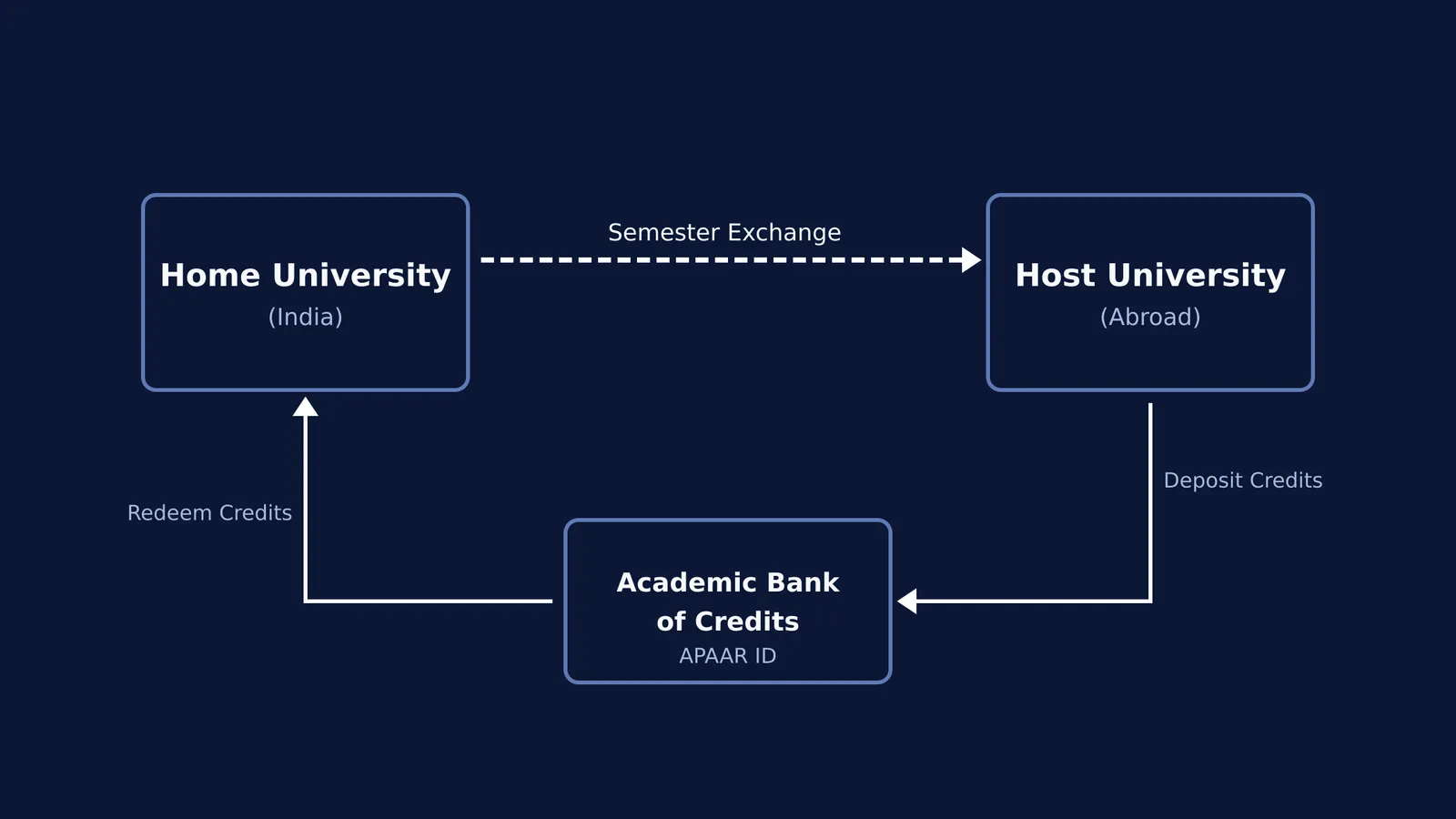
Studying abroad for a full degree can be prohibitively expensive, but a semester exchange offers a more accessible path. A semester exchange allows you to study at a partner university abroad for one or two semesters while remaining enrolled at your home institution. You earn credits that are transferred back to your Indian college, and you typically pay your regular tuition fees to your home university.
Here is how to plan for a semester exchange, from eligibility and applications to managing the costs.
How to apply for a semester exchange in college?
The application process for a semester exchange happens through your home college, typically via an Office of Global Engagement or International Relations office.
You can only go to universities that have a formal Memorandum of Understanding (MoU) with your college. You must usually apply well in advance before the exchange semester begins. For example, some programmes open their application window in February or March for an intake starting in September of the same year.
Before applying, you need to set goals for what you want to achieve academically and personally while abroad. Set study goals you actually hit with WOOP and if-then plans to help clarify your priorities before you choose a destination. Planning ahead ensures you meet any specific application requirements.
What is the minimum CGPA for a semester exchange?
Because you will be taking university-level courses in a new environment, colleges look for a strong academic record to ensure you can handle the workload.
Most Indian institutes expect applicants to have a strong academic record and no active backlogs. Competitive scholarships require even higher marks. For example, DAAD scholarships for study in Germany require strong academic qualifications, documented by your study results, and a high-quality study project.
If your grades need a boost before you apply, read How to improve your CGPA: a semester plan backed by research.
How does credit transfer work in India?
The central goal of an exchange is that your time abroad counts toward your Indian degree.
Before you leave, you must work with your faculty advisor to map your courses. This means finding subjects at the host university that are equivalent to your required courses in India. For European exchanges, students sign a learning agreement before departure to define exactly how their activities will be recognised. After you complete the semester, the host university issues an official transcript.
To make this process easier across institutions, the Indian government established the Academic Bank of Credits (ABC). Under this system, students create a unique APAAR ID that acts as a digital repository linked to DigiLocker and the National Academic Depository. More than 36 crore APAAR IDs have been created, mapping over 10 crore academic records. Credits earned at recognised foreign institutions can be verified and deposited here, then redeemed by your home university.
When you return to India, you might find that the local syllabus moved on without you, or you may need to catch up on a prerequisite you missed. Fermi's AI tutor can work out what you already know and build a plan for the session, so you sit down to a clear next step. If you encounter a gap in your knowledge, the Fermi Concept Library holds every concept in physics, chemistry, biology, mathematics and computing, each with its own lesson and its place in the map.
How much does a semester exchange cost for Indian students?
The most significant financial advantage of an exchange programme is the tuition structure. Under reciprocal agreements, you pay your regular tuition to your Indian college and pay zero tuition fees to the host university.
For example, students participating in the European Union's Erasmus+ study mobility programme, which lasts between two and twelve months for most degrees and up to 24 months for single-cycle courses like medicine, are exempt from fees for tuition, registration and examinations at the receiving institution. They are also exempt from charges for accessing laboratories or libraries, though small fees for insurance or a student union may apply.
You are, however, responsible for your airfare, visa, insurance and living expenses depending on the country.
Fortunately, there are several funding options to cover these out-of-pocket costs. The Erasmus+ study mobility programme offers a grant to contribute to travel and daily living costs, which varies based on the distance and living cost differences between the countries. Many Indian institutes also offer internal travel grants to help with flights.
Meanwhile, external scholarships can cover living expenses entirely. For example, DAAD scholarships for graduates in Germany provide a monthly stipend of €934, a travel allowance, a one-off study allowance, and payments towards health, accident and personal liability insurance cover.