

On this page
Your phone has a voice recorder, and your day has dead time: the auto ride to class, the walk to the bus stop. One short recording session at your desk turns those minutes into quiz time.
The trick is the pause. A voice note that reads out your notes is rereading with earphones. One that asks a question, goes quiet and makes you answer first is a test.
Why does answering out loud beat listening to notes?
Psychologists call it the testing effect: pulling an answer out of memory strengthens it more than seeing the material again (Roediger and Karpicke, 2006).
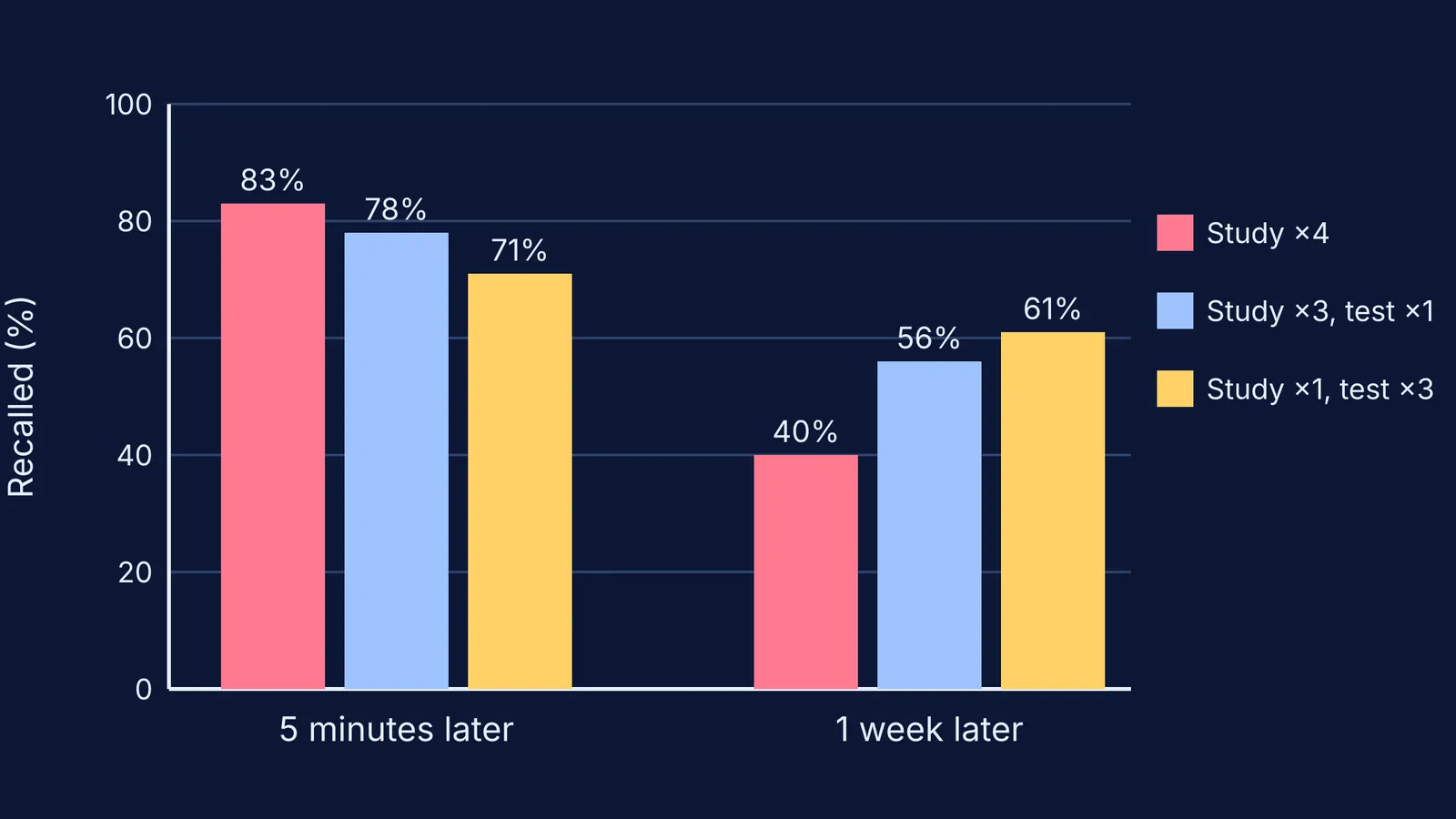
In their second experiment, students who studied a short passage on a science topic once and then tried to recall it three times remembered 61% of it a week later, while students who spent all four sessions studying it remembered 40% (Psychological Science). The repeated studiers read the passage about 14 times; the testers read it about 3 times. On a test five minutes after the session, the repeated studiers were ahead, 83% against 71%. That is why rereading feels like it works. The repeated studiers also predicted they would remember the passage better, and a week later they remembered least.
A follow-up with foreign-language vocabulary found that once students could recall a word, more studying did nothing for later recall, but more testing had a large positive effect (Karpicke and Roediger, 2008). So keep the questions you already get right in the file.
A review of ten study techniques rated practice testing and spreading study over time as the two with high utility (Dunlosky and colleagues, 2013). A voice quiz played across the week does both.
How do I record a voice-note quiz on my phone?
Open the voice recorder and, at your desk:
Pick one chapter and write 10 to 15 questions on paper first.
Make each question need a spoken answer: "State Lenz's law and the direction of the induced current", not "Lenz's law?"
Say the question number, then the question.
Stay silent for five seconds, or about ten for a multi-step question.
Say the answer in one or two sentences.
Save one file per chapter, named with the chapter and date.
A sample script, with brackets marking the silence:
"Question 1. What is the SI unit of magnetic flux? [5 seconds] The weber. One weber is one tesla metre squared."
"Question 2. Where in the chloroplast does the light reaction happen? [5 seconds] On the thylakoid membranes."
"Question 3. Pure water is heated. Does its pH change, and is it still neutral? [10 seconds] The pH falls below 7 because more water ionises, but it stays neutral because the H+ and OH- concentrations are still equal."
What should I do while the quiz plays?
Answer out loud in the pause, even a half answer or a mumble. If you only think it, it is easy to tell yourself you knew it. Then hear the recorded answer and judge honestly.
Remember the numbers you missed and type them into a note at your next stop: "Ch 4: 3, 7, 12". Don't look anything up mid-quiz; that turns it back into reading.
How do I fix the weak questions at my desk?
Sort each miss by what went wrong, because each needs a different fix.
Blank: you could not start, so the gap is in the idea itself. Reread the textbook section, then explain it in your own words. The Fermi Concept Library has a lesson for each concept in physics, chemistry, biology and maths.
Wrong method: you started but went the wrong way. Work through one full problem on that idea on paper. The Fermi Problem Library has a step-by-step solver that explains the reasoning, so you can see where your method went wrong.
Slip: you knew it but missed a unit, a sign or a key word. Write the correct answer once and move on.
Then record a short "misses" file and play it two or three days later. Our concept-by-concept revision plan can help you choose what goes into each file.
What does a week of voice-note quizzing look like?
Sunday, at your desk: write and record two chapter files.
Monday to Wednesday, on the move: play one file each way and keep your list of misses.
Wednesday evening: sort the misses, fix them, record a misses file.
Thursday and Friday: play the misses file, then the older files.
Saturday: shuffle the files so chapters mix, the way our interleaved practice plan suggests.
When a chapter's misses list stays short, check how to tell if you are ready for the exam.


