

On this page
Transferring a scholarship is not automatic. The National Scholarship Portal (NSP) does not just move your funds when you move colleges. What happens to your funding depends entirely on the rules of your specific scheme, and many students lose their financial support by missing paperwork deadlines during their transition.
Can you keep your scholarship if you change college?
The ability to keep your funding depends on the scholarship type. For some major central schemes, a college transfer is strictly forbidden. If you receive the Prime Minister's Special Scholarship Scheme (PMSSS) for J&K students, you cannot change your college after the final allotment. Doing so breaks the scheme's rules, marks you as a dropout, and leads to immediate forfeiture. The same applies to University Grants Commission (UGC) Post Graduate scholarships; moving to another university cancels the award without exception.
For the DST INSPIRE Scholarship for Higher Education (SHE), you may only change your university during the first year of your B.Sc. studies, provided you stay within the 18 approved basic science subjects.
For general merit schemes like the Central Sector Scheme of Scholarship for College and University Students (CSSS), you can transfer your scholarship by following the correct procedure before leaving your old college.
How do you update your college on the NSP?
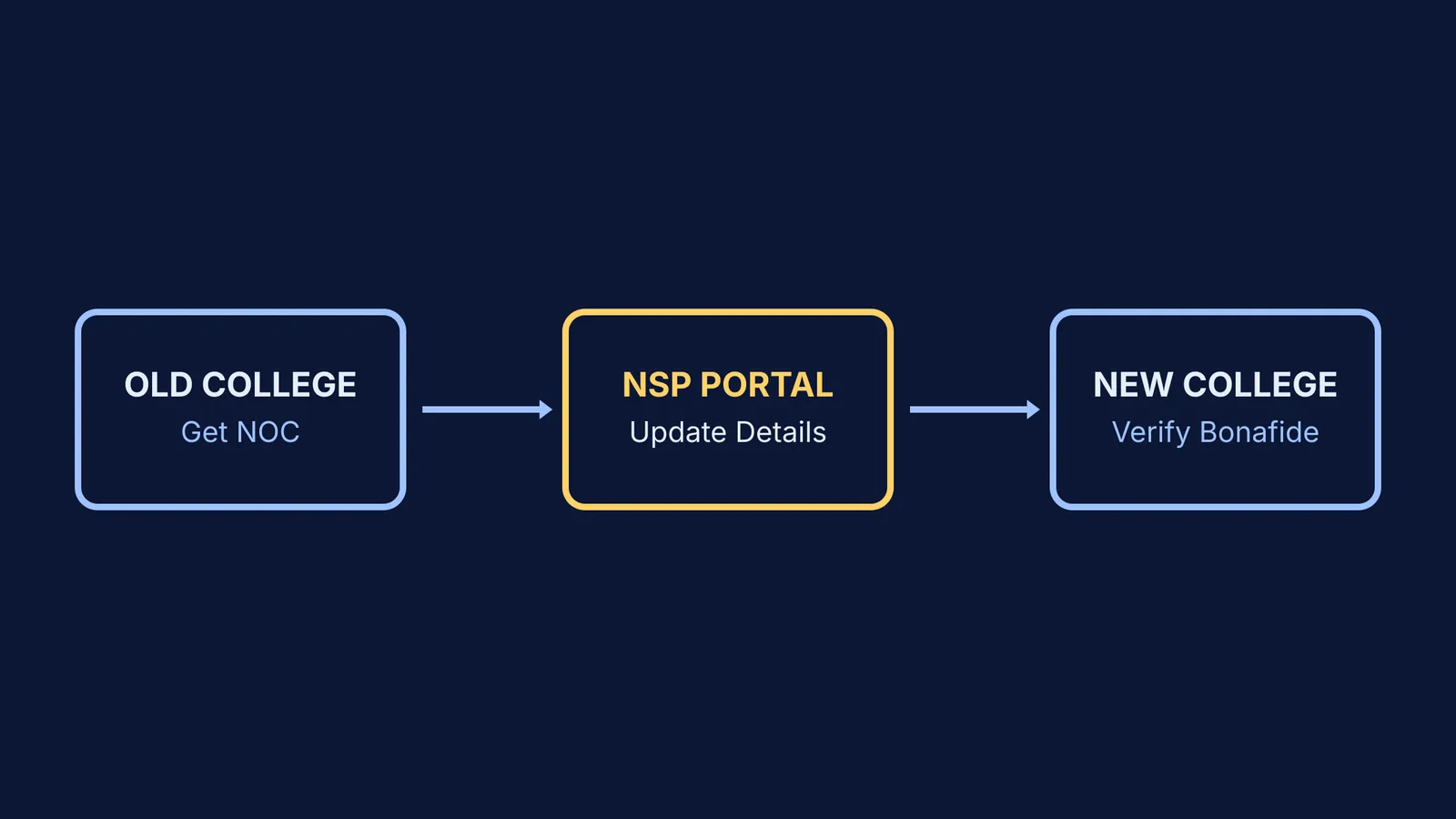
If your scheme allows a transfer, you must complete the paperwork on the National Scholarship Portal (NSP) during the annual renewal window. Do not create a new profile, as your Aadhaar and bank details are already locked to your existing Application ID.
Get an NOC: Ask the Scholarship Nodal Officer at your current college for a No Objection Certificate (NOC). They must also initiate a "Transfer Out" request on the portal so your profile is released to the new institution.
Apply for Renewal: Log into the NSP using your existing Application ID and select the "Renewal" option.
Update Institute Details: In your renewal form, change the college name and address to your new institution.
Submit a Bonafide Certificate: Upload a new Bonafide Certificate. This document must be stamped and signed by the administration of your new college, proving that you are actively enrolled. You will also need to upload your previous year's mark sheets.
The Nodal Officer at your new college must then verify your application online. Before you transfer, confirm that your new college is registered on the NSP and has a valid AISHE (All India Survey on Higher Education) code. Without this code, the college cannot verify you, and your application will be marked as defective.
What happens if you change your course?
Changing your degree program or stream is much harder than changing your college. Most scholarships are granted for a specific course of study and are tied to that particular academic progression.
If you are on the CSSS, you must remain in the same stream. If you switch from a Science stream to an Arts degree, you will lose the scholarship. For INSPIRE scholars, switching from a B.Sc. to a professional course like a B.Tech or MBBS results in immediate cancellation because the funding is exclusively for basic sciences. For AICTE and UGC PG schemes, any change of course drops the scholarship immediately.
If your scheme permits you to change courses, you still have to meet the standard academic criteria to renew your funding—such as maintaining 75% attendance and scoring at least 50% in your annual exams.
When you start a new course midway, catching up on missed classes can put those required grades at risk. If you are struggling to keep up with a new physics syllabus—perhaps needing to catch up on the energy density in an electric field—the Fermi Concept Library can help. It holds every concept in physics, chemistry, biology, mathematics and computing, each with its own lesson and its place in the map, so you can rebuild your foundation efficiently.
What is the checklist before you switch?
Before you make any formal transition or pay fees at a new college, complete these steps to protect your funding:
Check the specific guidelines: Read the official PDF guidelines for your exact scheme on the NSP homepage to confirm if institutional transfers are allowed.
Talk to your Nodal Officer: Do not leave your current college without speaking to the scholarship desk. Secure your NOC and your original mark sheets before you officially withdraw.
Verify the new college's status: Ask the new administration if they actively accept transferring scholarship students and if their AISHE code is active on the NSP.
If the coursework at your new college involves harder assignments, such as working through the hydroboration-oxidation of alcohols in an advanced organic chemistry class, you do not have to tackle them alone. The Fermi Problem Library has worked problems with a step-by-step solver that explains the reasoning rather than printing an answer, helping you learn the method alongside your new peers.


