On this page
Building a robot is one of the best ways to test your physics and coding skills in the real world. Rather than just reading about kinematics and circuitry, you have to apply those principles to make a machine move, turn, and react. Globally, over 785,000 students participated in FIRST robotics programs during the 2023–2024 season (FIRST Impact). In India, the momentum is just as strong. The World Robot Olympiad (WRO) India saw over 1,000 teams register in 2023 (WRO India). But knowing where to begin can feel overwhelming, especially if your school does not already have an established team or a dedicated lab. The good news is that you can start small.
What types of robotics competitions are there?
School robotics contests generally fall into two broad categories: task-based challenges and open-ended design problems. Understanding the difference will help you choose the right entry point.
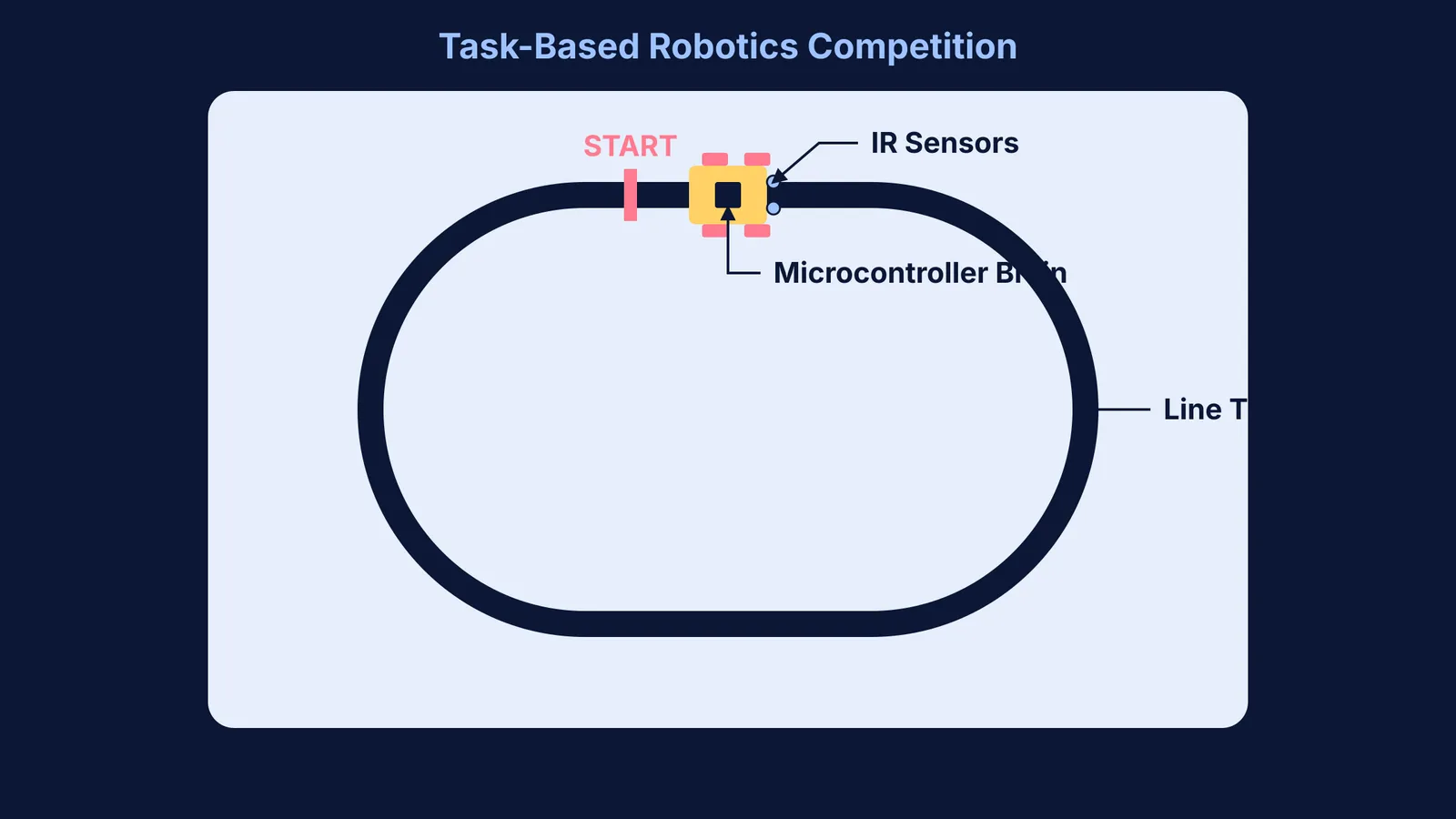
Task-based contests: These events, such as a local university Techfest or the basic levels of Technoxian, ask you to build a robot that performs one specific, highly defined job. Common examples include the line follower, where a robot must navigate a black line on a white surface as fast as possible, or a maze solver, where the robot maps and escapes a labyrinth. These are excellent for beginners because the goal is clear and the mechanics are straightforward.
Theme-based leagues: Competitions such as the FIRST LEGO League (FLL) or the World Robot Olympiad release a completely new theme and game mat each year. Teams must design a robot to complete several related, complex missions within a time limit, such as sorting colored blocks or clearing obstacles. These require more advanced planning, strategy, and teamwork.
How much does it cost to start a robotics team?
A common misconception is that you need to buy expensive, proprietary robotics kits to start learning. While those kits are useful, you can build your first robot from scratch using widely available open-source components.
A basic 4-wheel drive smart robot chassis kit costs about ₹587 (Robocraze). By adding an Arduino Uno microcontroller, a standard motor driver, and a few infrared sensors, you can assemble a competition-ready line follower for well under ₹3,000. This low barrier to entry means you can start a small robotics club with just a few interested friends.
Many schools in India are also gaining access to better equipment through structured government grants. The Indian government provides a grant of ₹20 lakh to selected schools to set up an Atal Tinkering Lab (NITI Aayog). If your school has an ATL, you likely already have the 3D printers, sensors, soldering stations, and hand tools needed to prototype more advanced designs and enter national events without paying out of pocket for hardware.
What do teams actually build?
A beginner team usually builds an autonomous mobile robot. Instead of using a remote control, the robot must think for itself. This requires three main systems working together in a continuous loop:
Sensors: These act as the eyes of the robot. Infrared (IR) sensors detect the contrast between a black line and a white floor, while ultrasonic sensors bounce high-frequency sound waves off walls to measure distance and detect obstacles.
Microcontroller: This is the brain. Boards like the Arduino Uno take the incoming sensor data and run your programmed code to decide what the robot should do next.
Actuators: These are the muscles. Motor drivers take the microcontroller's logic signals and send the correct amount of electrical power to the DC motors to drive or turn the wheels.
If you are struggling to write the logic for this feedback loop, or if you need help understanding the physics of motor torque, Fermi's AI tutor can work out what you already know and build a plan for the session, teaching you the concepts step by step.
How to prepare for your first competition?
Winning a robotics contest is rarely about having the most expensive parts. It is about consistent testing, finding flaws, and iterating on your design. Here is a plan to get your team ready:
Master the basics first: Before you attach a single motor, learn simple C++ or block-based coding. Understand how basic electrical circuits work and practice wiring components on a solderless breadboard.
Build a prototype early: Do not wait until your design looks perfect on paper. Build a rough, taped-together version, test it on a printed track, and observe where it fails. Real-world friction and battery voltage drops will always behave differently than you expect.
Document everything you do: Judges in major leagues often score your engineering notebook as highly as the robot's performance. Keep a daily log of the problems you faced and the changes you made to fix them.
Connect it to your studies: When you hit a conceptual wall, step back from the hardware. You can link your physics curriculum directly to your robot's mechanics. If you want a structured way to balance your regular studies with competition preparation, following a study plan for Class 11 physics can help you manage your time effectively. Similarly, establishing a solid routine for learning physics at home ensures your foundational knowledge remains strong as you attempt to build more complex machines.