

On this page
It is tempting to try to swallow the constants list inside a textbook cover whole. Instead, sort the constants by where you use them, decide how many digits each deserves, and spend five minutes a day pulling them out of memory.
Which physical constants should you know by heart?
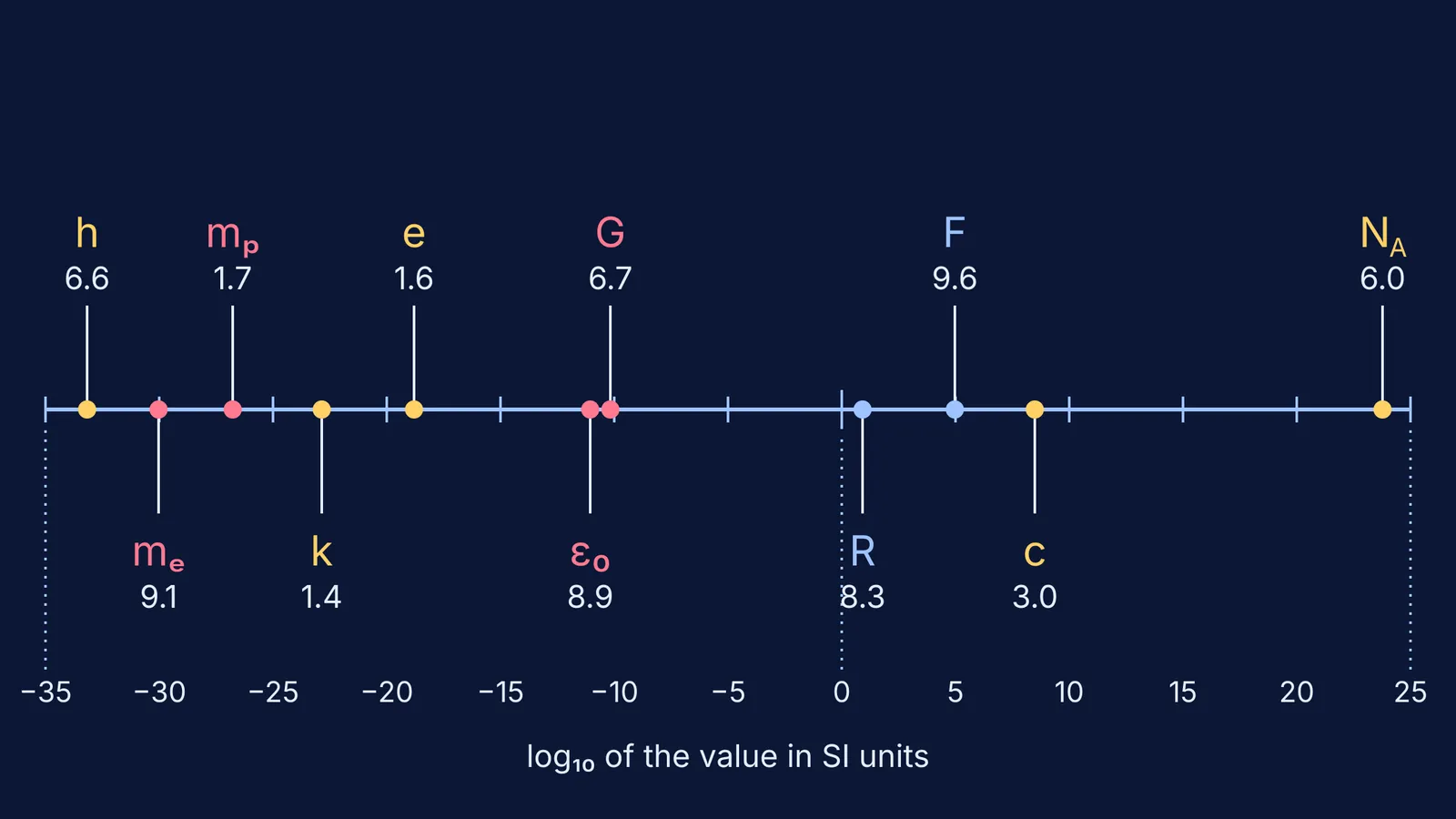
The values below come from the NIST table of 2022 CODATA recommended values, rounded for everyday use. Since the 2018 revision of the SI, five of the constants you use most (c, h, e, k and N_A) have exact, fixed values with no uncertainty, according to the BIPM page on the SI defining constants.
Mechanics and gravity
g ≈ 9.8 m/s² (the standard value is exactly 9.80665 m/s²)
G ≈ 6.67 × 10⁻¹¹ N m² kg⁻²
Electricity and the atom
e ≈ 1.60 × 10⁻¹⁹ C
mₑ ≈ 9.11 × 10⁻³¹ kg and mₚ ≈ 1.67 × 10⁻²⁷ kg, so mₚ/mₑ ≈ 1836
ε₀ ≈ 8.85 × 10⁻¹² F/m, which makes 1/(4πε₀) ≈ 9.0 × 10⁹ N m² C⁻²
Light, photons and nuclei
c ≈ 3.00 × 10⁸ m/s
h ≈ 6.63 × 10⁻³⁴ J s
hc ≈ 1240 eV nm
Rydberg energy (close to the ionisation energy of hydrogen) ≈ 13.6 eV
Electron rest energy ≈ 0.511 MeV, and 1 u ≈ 931.5 MeV
Chemistry and heat
N_A ≈ 6.022 × 10²³ mol⁻¹
k ≈ 1.38 × 10⁻²³ J/K
R ≈ 8.314 J mol⁻¹ K⁻¹
F ≈ 96 485 C/mol
Molar volume of an ideal gas ≈ 22.4 L at 273.15 K and 101.325 kPa, or 22.7 L at 100 kPa
1 atm = 101 325 Pa exactly
Which values are worth knowing to two digits?
Most of them. Two significant figures are enough to estimate an answer and rule out a wrong option. Learn more digits, as listed in the NIST CODATA table, only where the extra digits change your working:
Values you plug into long chemistry numericals, where early rounding adds up: R = 8.314, F = 96 485, N_A = 6.022.
Values that act as conversion factors: 1240 eV nm, 13.6 eV, 931.5 MeV, 0.511 MeV.
You can also remember fewer numbers by deriving some from others. Here is a worked example using the values above:
F = N_A × e = 6.022 × 10²³ × 1.602 × 10⁻¹⁹ ≈ 9.65 × 10⁴ C/mol.
R = N_A × k = 6.022 × 10²³ × 1.3806 × 10⁻²³ ≈ 8.314 J mol⁻¹ K⁻¹.
Energy of a 500 nm photon: E = hc/λ = 1240/500 ≈ 2.5 eV.
Remember N_A, e and k, and F and R come free.
How do you remember constants without cramming?
Test yourself instead of re-reading. In Roediger and Karpicke's 2006 experiments, students who took recall tests remembered more on a final test 2 days or 1 week later than students who restudied the same material, even though restudying made students feel more confident. A 2013 review by Dunlosky and colleagues assessed 10 learning techniques and gave practice testing and distributed practice the highest utility ratings, while rereading and highlighting rated low.
The five-minute daily recall drill
Minute 1: on a blank sheet, write every constant you can, group by group, with units.
Minute 2: check against your one-page sheet. Circle every miss, wrong power of ten or missing unit.
Minutes 3 and 4: use each circled value once in a quick calculation, such as 1240/λ for a photon or N_A × e for F.
Minute 5: cover the sheet and rewrite only the circled values.
Do it daily for a week. Then a value you get right three days running moves to a weekly check, while circled ones stay daily. Our 4-week spaced revision schedule shows how to stretch the gaps.
What should a one-page constants sheet look like?
Make it yourself: writing it is your first round of recall. Our guide to building your own formula sheet and testing yourself on it covers the method. For constants, add these rules:
Group by use (the four groups above), not alphabetically.
Write every value with its unit and its power of ten.
Mark exact values (c, h, e, k, N_A) differently from measured ones (G, mₑ, mₚ, ε₀).
Draw arrows for derived values: N_A and e to F, N_A and k to R, h and c to 1240 eV nm.
Keep a margin column for the date of each miss.
The drill will not help if you cannot say what a constant does, such as ε₀ in Coulomb's law. The Fermi Concept Library has a lesson for every concept in physics, chemistry, biology, mathematics and computing, so you can learn what a constant stands for before you drill it. And if you know the value but a numerical still comes out wrong, the Fermi Problem Library has a step-by-step solver that explains the reasoning rather than printing an answer.
Tonight, write your sheet from memory first, then check it against the NIST table. Tomorrow, start the drill.


